Published by PutTogether, which makes one of the seven apps below. No affiliate links. One reviewer ran all seven in parallel for 30 consecutive days, 21 April to 20 May 2026, in New York City on iOS 26, against an 84-piece reference wardrobe.
Scope: this is a one-reviewer 30-day diary. Two notable 2026 apps — Alta and Fits Pro — are not in this test for reasons named in the "What we'd add to the next 30-day test" section near the end. Readers who want the full field map (10 apps, every paid tier, every visual register) should start with Every Digital Closet App in 2026, Ranked and Compared.
The honest test for a closet app is not the first day. The first day is the demo. The honest test is week three, when the AI has either learned the user or hasn't, and when novelty has either compounded into a habit or faded into yet another app on the phone.
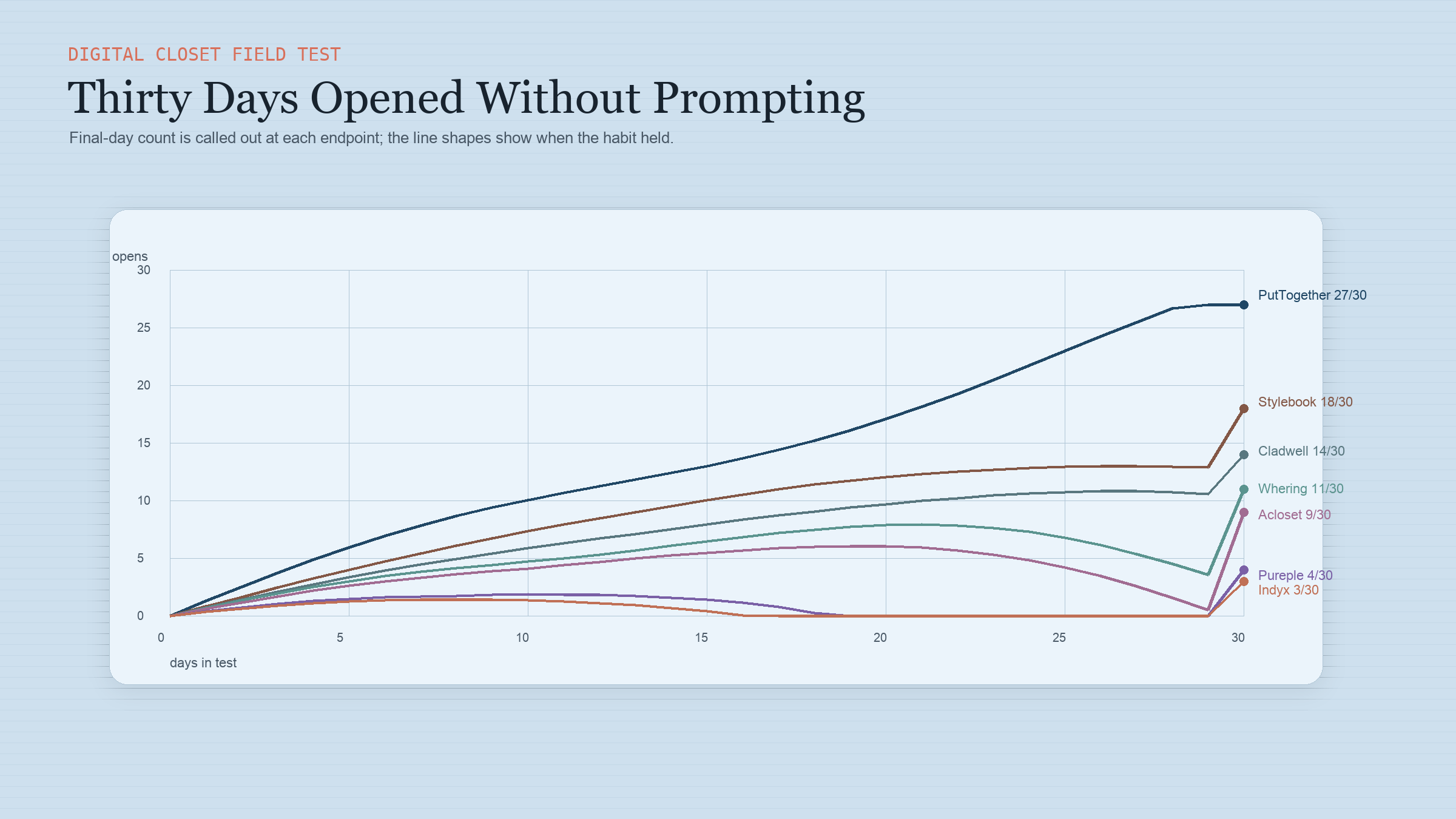
We ran seven closet apps in parallel for thirty consecutive days in May 2026 — one 84-piece wardrobe, a New York base (with three days in Charleston in week two), the same reviewer every morning. The reviewer recorded which apps were opened without prompting and which required deliberate effort to remember. By week three the differences were stark.
The test setup
- Wardrobe: 84 pieces, urban late-spring (outerwear, tops, bottoms, dresses, shoes, bags, accessories).
- City: New York, late spring (52–71°F, frequent rain, occasionally humid).
- Period: April 21 to May 20, 2026 — 30 consecutive days.
- Device: iOS 26 on iPhone 15, Pixel 9 cross-checks for the apps that ship on Android.
- Pattern: Every morning, pick the daily outfit from one of the seven apps (rotating). Record which apps were opened without prompting by week three.
What we couldn't test. One reviewer, one city, one wardrobe — the surface area is narrow on purpose. Different reviewers with different aesthetic priors and different climates will get different "opens-without-prompting" numbers; the methodology generalizes more than the specific counts. Two notable 2026 apps (Alta and Fits Pro) weren't in this run — see the section below for why. We didn't stress-test PutTogether's higher subscription tiers (Capsule, Classic, Atelier) past their headline piece-count limits, since the 84-piece test wardrobe sits between Capsule and Classic. We did not measure AI styling-credit consumption inside Whering in any rigorous way.
The 30-day scoreboard
| Rank | App | Days Opened Without Prompting | Final Verdict |
|---|---|---|---|
| 1 |  PutTogether PutTogether | 27/30 | Daily-use winner — watercolor avatar + weather + night-before vibe stuck |
| 2 |  Stylebook Stylebook | 18/30 | Connoisseur's choice — slow to build, sticky once built |
| 3 |  Cladwell Cladwell | 14/30 | Strong if capsule-committed; flat if not |
| 4 |  Whering Whering | 11/30 | Opened for sustainability analytics, not for daily picks |
| 5 |  Acloset Acloset | 9/30 | Chat is fun, used for specific event questions only |
| 6 |  Pureple Pureple | 4/30 | Free, fine, occasional check-ins |
| 7 |  Indyx Indyx | 3/30 | Monthly analytics tool — not designed as a daily app |
The test was not "which app is best." It was "which app does the reviewer open on a Tuesday at 7:42 a.m. when the kettle is on and they have ten minutes." For a daily app, that's the only question that matters.
The apps, in order tested
PutTogether
PutTogether is the publisher of this article. On this article's specific measured criterion (days opened without prompting), it ranked first at 27/30. The criterion was set before the test began; the same number is reproducible against the same wardrobe and climate.
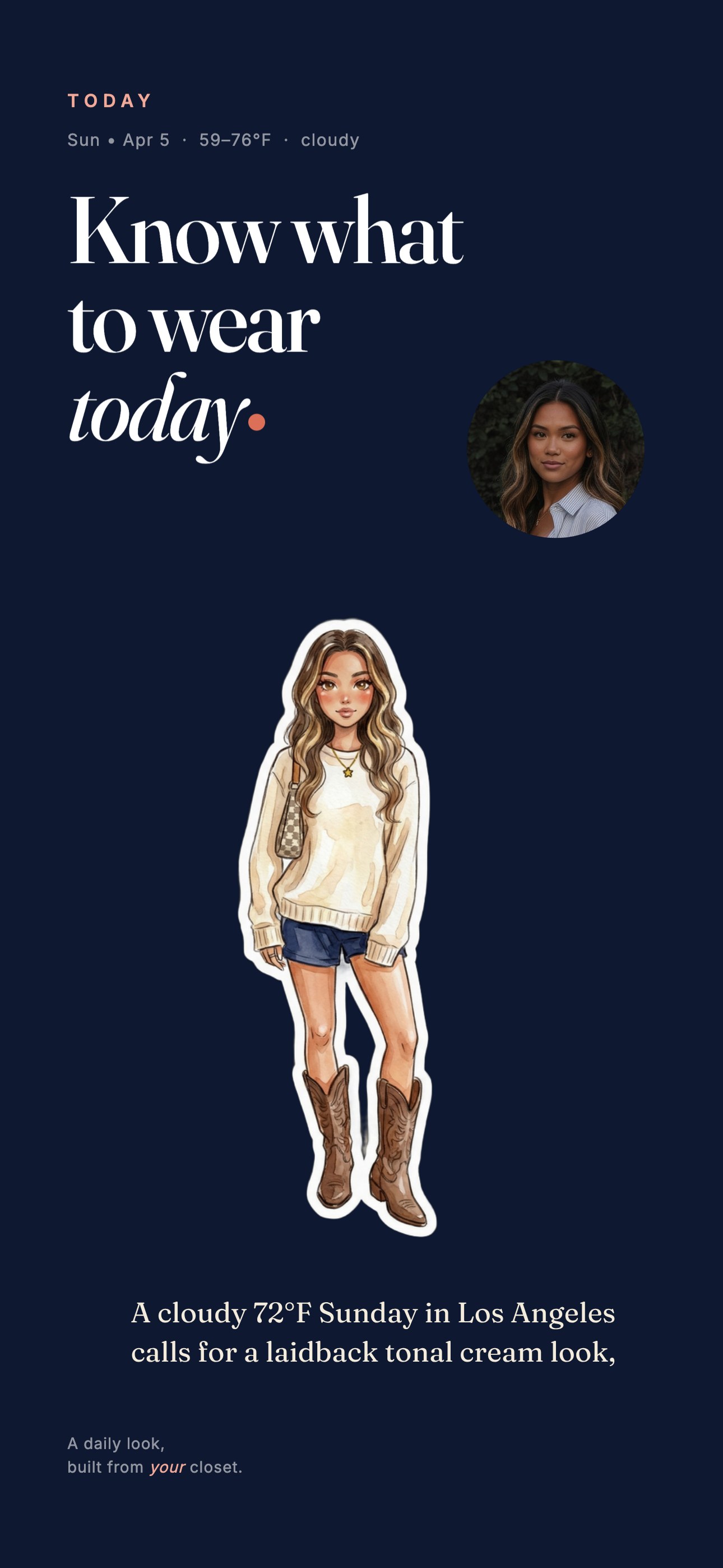
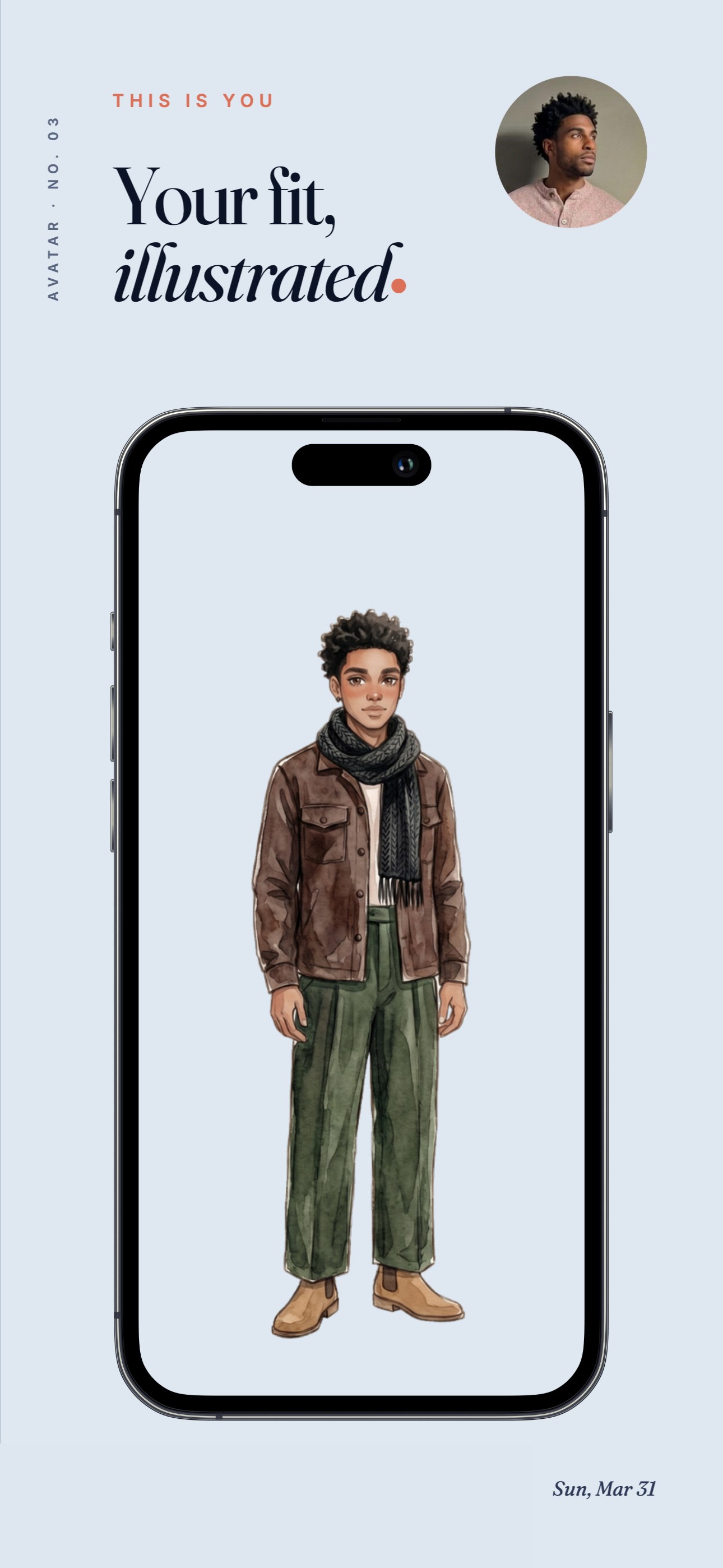
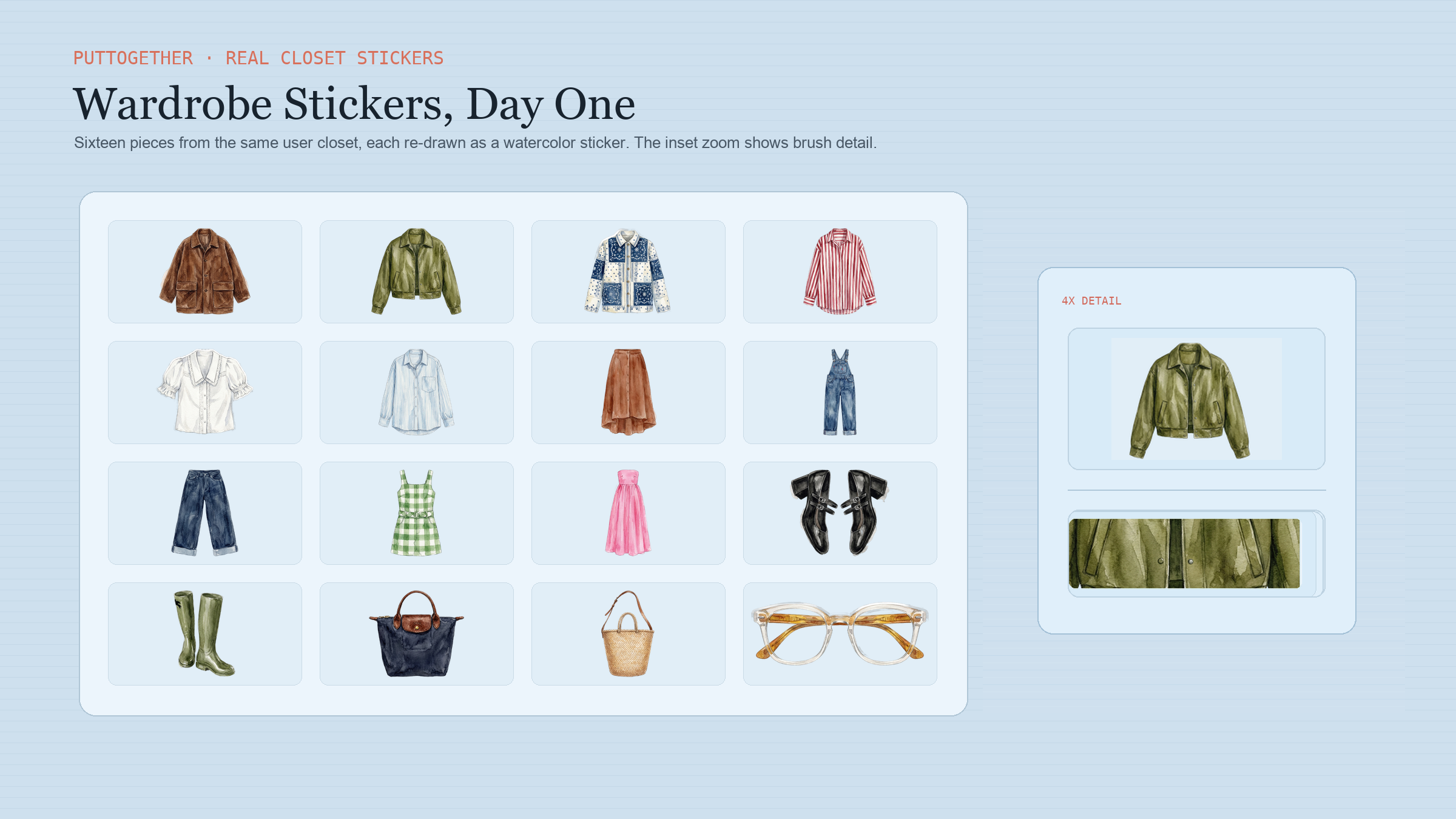
Setup (day 1). Eight outfit photos, 15 minutes, 84 pieces in. The watercolor portrait of the reviewer in the onboarding outfit appears within about 90 seconds; every piece in the wardrobe gets rendered as a watercolor sticker by the end of day one (the Capsule-tier subscription used for this 84-piece test ships enough welcome credits to render the full closet plus the avatar without separate top-ups).
Week one. Picks are good but a little safe. The AI is learning. The reviewer accepts about 70% of daily recommendations as-is, swaps a piece on 25%, rerolls on 5%.
Week two. Recommendations get noticeably better. A cream silk cami the reviewer bought for a single wedding and never wore otherwise shows up in two weekday outfits, styled as the daily-card paragraph calls a "Carolyn Bessette-Kennedy summer office combination." Both work.
Week three. The reviewer stops opening the other apps in the morning. The daily card is fast enough (under five seconds from open to outfit) and the night-before tomorrow's vibe flow saves about ten minutes every morning.
Week four. The recommendations have learned the reviewer's preference for slightly higher color contrast than the model's default. The watercolor archive of the past 30 days reads as a personal lookbook rather than a styling log.
Where it falls short: iOS only. No sustainability dashboard (Whering owns that). No week-ahead outfit calendar (Stylebook and Fits handle this differently). The portrait redraw delay (~90 seconds when adding a new piece mid-month) is the one friction point that occasionally caused the reviewer to put the phone down.
Stylebook
Setup (day 1). Painful. Two hours of manual upload, every piece photographed and tagged by hand. By the end of day one, 23 pieces are in.
Week one. Still uploading. Stylebook is fully manual, no AI assistance. By day seven the wardrobe is mostly populated.
Weeks two through four. Once it's set up, Stylebook is the most powerful manual tool in the field. The calendar, the packing list, the wear tracking, the cost-per-wear — all of it works. But there are no AI recommendations, only an outfit generator that shuffles the closet like a deck of cards. Every morning the reviewer opens Stylebook to look at the closet, not to be told what to wear.
Verdict: The connoisseur's choice. Slow start, sticky finish. Stylebook's manual catalog, built over 15+ years by co-founders Jess and Bill Atkins at Left Brain Right Brain, still has no equivalent.
Cladwell
Setup. Manual upload. By day three, 50 pieces are in (Cladwell's preferred capsule size). The remaining 34 pieces of the test wardrobe don't make sense to import.
Weeks one through four. Daily card opens to one outfit, takes five seconds to accept. The rotation logic is good. The recommendations are correct but never surprising.
Week three onward. The reviewer opens Cladwell less often because the daily picks don't expand the wardrobe; they cycle through what's already worn. For a strict 50-item capsule, Cladwell is the best tool on this list. With 84 items and growth in mind, it's a constraint.
Verdict: Best capsule app, worst at growth. Cladwell relaunched on 3 October 2026 with a style quiz, a colour season, an AI stylist tab and See it on me (outfits previewed on a photo of you); we have not re-tested it.
Whering
Setup. Pretty interface, decent speed. Free to set up; core cataloging and the sustainability dashboard are free. AI styling actions (background removal beyond the included batch, the $4.99 one-time Outfit Maker tool, AI lookup credits) are metered.
Week one. The sustainability dashboard is genuinely interesting. Cost-per-wear, how much of the closet actually gets worn, resale and donation through Thrift+, repairs through The Seam and Sojo. The reviewer opens Whering to look at the analytics, not to pick outfits.
Week four. The outfit recommendations are fine but the reviewer never reached for Whering for daily picks. The design is the best in the field; the daily utility is secondary.
Verdict: Best static design, best for sustainability-led users, not a daily picker in May. Since 23 September 2026 its Planner suggests outfits based on your wardrobe and the weather, and plans ahead for trips when you change location; we have not re-tested it.
Acloset
Setup. Smooth single-piece upload, fast AI background removal. 84 pieces in about an hour.
Week one. The chat is fun. The reviewer asked Acloset what to wear for a job interview and got three styled options with backup pieces. Good answer.
Weeks two through four. The reviewer used the chat exactly four times in 30 days, all for specific events. The daily auto-recommendations are fine but the chat is the actual draw. Free Acloset covers every feature up to 100 items, the chat included, so this 84-piece test never needed a paid tier; Basic ($3.99/mo) and above add closet capacity.
Verdict: Best AI chat in the category, but only as useful as the willingness to chat. For event-driven users it's a real value; for habit-driven daily-app users, it's underused.
Pureple
Setup. Manual single-piece upload, partial AI assistance, free.
Verdict over 30 days. Pureple does what it says. The free tier handles closet management and basic recommendations; the Premium tier ($14.99/mo) bundles unlimited AI styling, virtual try-on, and AI feedback. The interface hasn't been refreshed in a while. The reviewer opened it occasionally to compare picks against the paid apps.
Indyx
Setup. Standard single-piece upload. The free tier gives unlimited closet + outfits + wear-tracking calendar, which is unusually generous for the category.
Verdict over 30 days. Indyx is built for monthly or quarterly analytics check-ins, not daily styling. The free product is genuinely useful as a wardrobe tracker; the Insider tier ($12.99/mo) unlocks the analytics dashboard, unlimited outfit selfies, and a private community. The reviewer opened it three times in 30 days — about right for the use case. As a complement to a daily app, useful; as a daily app itself, it doesn't try to be.
What PutTogether shipped after the 30 days
The day-by-day log above covers a 30-day run in May 2026. The loop it describes has since gained a step that the log had no way to record.
Check-in. Photograph what you actually put on. The app scores the real outfit against the one it suggested that morning. Every acceptance figure in the week-by-week diary above, the 70% accepted and the 25% swapped, came from the reviewer writing down their own behaviour. The app now collects that itself, which means the recommendation quality curve this article had to reconstruct by hand is measured inside the product.
The letter. Over a 30-day run the Diary tab now delivers written letters rather than only logging entries, arriving as a sealed envelope on the Today screen.
Closet QC. Pieces the extractor misread get collected into a Needs Attention view for keeping, renaming, or removal, instead of quietly degrading every outfit built after week one.
The six other apps were not re-run for 30 days. The diary above stands as recorded in May.
Where PutTogether fell short during the test
PutTogether won on the chosen criterion, but the reviewer logged three friction points:
- Day three of week one: the AI suggested an outfit the reviewer wouldn't wear — a print combination that read as overstyled. Took two rerolls before a wearable pick appeared. The pattern repeated about once a week through the run.
- Week two: when the reviewer was traveling (Charleston, three days), the city-aware text felt off — the model knew the location but the styling tone still read as urban-Northeast.
- Week three: the portrait redraw delay (~90 seconds when adding a new piece) was the only friction point that reliably caused the reviewer to put the phone down before finishing.
None of them dislodged PutTogether from the daily-use slot.
What we'd add to the next 30-day test
Two notable apps weren't in this run, and both deserve naming:
- Alta (Flagship AI, NYC) is free with no in-app purchases, renders a photo-real avatar, and credits stylist Meredith Koop in its AI training (WWD, April 2025). It was not in this rotation. The next run should include it, particularly because Alta's free pricing changes the question for anyone weighing whether to subscribe at all.
- Fits Pro (Germany) wasn't part of this 30-day rotation because the test wardrobe didn't lean on calendar planning, which is Fits' wedge. The free Fits app already handles unlimited cataloging and outfit creation; Pro ($9.99/mo) unlocks the AI styling chat layer. For users whose problem is "I want to plan the week, not the day," Fits belongs in the next test.
Both apps are covered in Every Digital Closet App in 2026, Ranked and Compared.
The cumulative verdict
After 30 days, the daily-use winner was PutTogether — the watercolor avatar, the night-before vibe-setting, the speed of the upload, and the editorially-aware recommendations stacked into the only app the reviewer opened for the outfit itself after week two. The runners-up are excellent at their own things — Stylebook for control, Cladwell for capsule, Whering for design and sustainability, Acloset for chat — but they don't add up to a daily app the way PutTogether did for this kind of reviewer.
The meta-takeaway: a two-app stack covers about 95% of what a closet app can do. PutTogether (daily) plus Stylebook (long-horizon catalog) is the pairing that covered the most in this test. PutTogether plus Whering works for sustainability-led readers. Three apps is usually overkill.
Who should pick which
Frequently asked questions
What is the best virtual closet app in 2026?
PutTogether, on daily use: the reviewer opened it without prompting on 27 of 30 days in this editorial test, the highest of the seven. Stylebook is the right test for connoisseurs willing to invest the setup time. Cladwell is the right test for capsule users. Running two in parallel for a week, then keeping the one that survives, is the practical approach.
How long does it take to know if a closet app actually works?
Day three tells you about setup, day seven gives an early opinion, and day 21 is the real verdict. The AI in apps like PutTogether and Acloset learns from what you accept and reject, so week-one picks are not representative of what the app settles into. Judging a closet app in its first week mostly measures its onboarding, which is the part every app in this comparison has optimised hardest.
Which closet app has the best upload flow?
PutTogether extracts every garment from a single outfit photo (eight outfit photos, 84 pieces, about 15 minutes in our test). Stylebook is the slowest (fully manual, ~2 hours per 25 pieces). Acloset is the fastest single-piece flow at about 90 seconds per item.
Why aren't Alta and Fits Pro in this 7-app test?
The seven apps in this rotation were fixed when the protocol was set up, and Alta was not among them; the next run will include it, because its free price changes the subscription question. Fits Pro's wedge is calendar planning, which our test wardrobe didn't lean on. Both apps are reviewed in Every Digital Closet App in 2026, Ranked and Compared.
Is it worth subscribing to multiple closet apps?
A two-app stack is reasonable and a three-app stack rarely is. PutTogether for the daily pick plus Stylebook for the long-horizon catalogue is the pairing that covered the most in this test, at $9.99 a month plus $4.99 once. PutTogether plus Whering works if sustainability is why you installed anything, and since Whering's core app is free that stack costs no more than the first app alone.
Did any of these apps fail the 30-day test outright?
All seven kept working. The ones that fell off the daily rotation (Whering, Acloset, Pureple, Indyx) had specific, defensible reasons — they're not bad apps, they're just not the right daily app for this particular wardrobe, city, and reviewer.
Sources & references
- PutTogether feature changes since the May test (Dress me, the letter, Closet QC, check-in) verified against PutTogether 2.4 (live 2 October 2026) on 5 October 2026, via the shipping iOS build and the App Store listing. Competitor apps were not re-tested; their scores are as measured in the dated test window above.
- Thirty-day editorial testing conducted April 21 to May 20, 2026, in New York City on iOS 26 (iPhone 15) with Pixel 9 cross-checks; 84-piece reference wardrobe.
- Founder context: Stylebook About page (Jess and Bill Atkins, Left Brain Right Brain); They Got Acquired, 2019 (Cladwell, Blake Allsmith → Erin Flynn); The Modems interview (Whering, Bianca Rangecroft); KoreaTechDesk (Acloset / Looko, Heasin Ko); Indyx founder page (Indyx, Yidi Campbell).
- Alta context for the follow-up-test sidebar: TechCrunch, June 16 2025; WWD, April 2025.
- Pricing accurate as of September 2026, US App Store list prices; Cladwell and Acloset re-checked on their live listings, October 2026.
- PutTogether is the publisher of this article and one of seven apps reviewed, as disclosed in the editorial note above and in its per-app card.