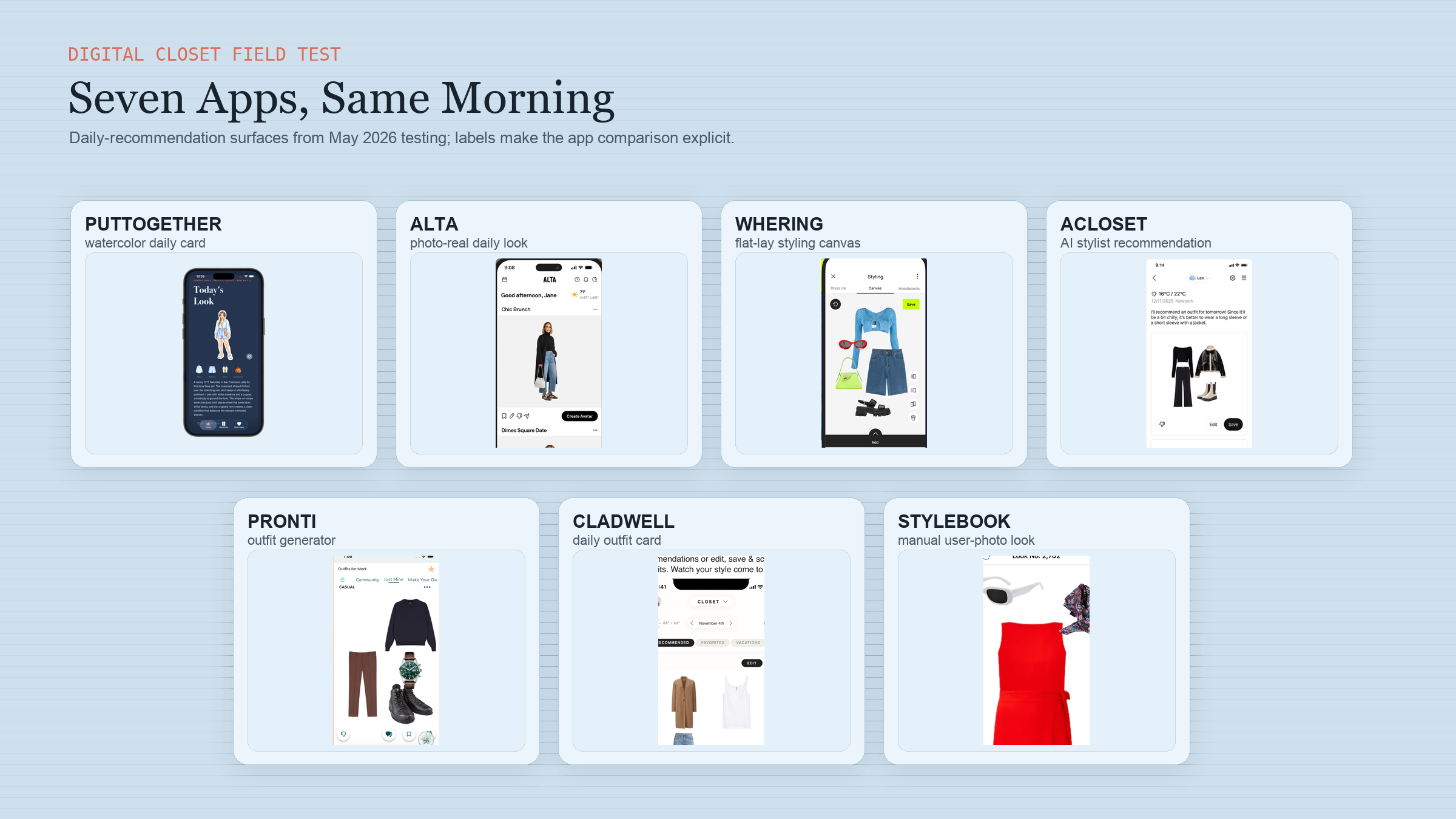
Published by PutTogether, which makes one of the seven apps below. No affiliate links. Every app was tested on iOS 26 over 30 days in May 2026 against an 84-piece reference wardrobe, with Pixel 9 notes for the apps that ship on Android.
Scope: this article is about taste — recommendation quality, editorial language, cultural literacy in styling. Readers who want the full field map (free vs paid, platform, upload model) should start with Every Digital Closet App in 2026, Ranked and Compared.
A closet app with taste is recognizable within a week, and the test isn't subtle. After seven days of daily picks, do the recommendations occasionally pair pieces in the user's closet that the user wouldn't have paired themselves — and do the unexpected combinations actually work? If yes, the app has taste. If every pick is the user's existing default, the app is a catalog with extra steps.
Most 2026 closet AIs are catalogs. Two are trying to be more, in two different registers.
What taste looks like on five different people
The clips below are the share videos PutTogether made for five members' Today looks, exactly as the app exported them. Each runs five seconds: the mini-you, the pieces, then the paragraph explaining the outfit. Pause on that paragraph. It says why the pieces belong together (a color pulled from a print, one cool note in a warm palette), and that reason is the taste, not the outfit.
How we measured taste
Four criteria, each scored 0 to 10. Same 84-piece test wardrobe, parallel testing for 30 days, May 2026, on iOS 26.
- Recommendation surprise rate. Of ten daily picks, how many pair pieces the user wouldn't have thought to pair?
- Editorial language. Does the recommendation read like a stylist explaining a choice, or like an algorithm dumping output?
- Design language. Does the app's interface feel like a fashion magazine, or like a spreadsheet?
- Cultural literacy. Does the app reference specific designers, eras, and editorial codes — or speak in generic adjectives?
What we couldn't test. Alta's stylist work with Meredith Koop is documented in WWD (April 2025) but the specific contents of the training data are private; we evaluated Alta's output, not its inputs. We did not test Alta's "trip planner" feature on a long-term basis. The surprise-rate score is a directional read from a single 84-piece test wardrobe in one city.
The May 2026 scoreboard
| Rank | App | Surprise Rate | Editorial Language | Design | Cultural Literacy |
|---|---|---|---|---|---|
| 1 |  PutTogether PutTogether | 35–40% | Stylist voice; named archetypes (May test) | Magazine-aesthetic, watercolor | Referenced Bessette-Kennedy, Philo, Coppola (May test) |
| 2 |  Alta Alta | ~30% (estimated) | Koop-trained, polished | Photo-real, retail-ready | Implicit; references not surfaced in user-facing copy |
| 3 |  Whering Whering | 15% | Editorial flat-lay | Best static UI in field | Sustainability-led, not stylist-led |
| 4 |  Acloset Acloset | 25% | Conversational chat | Seoul-minimalist | Generic, deliberately global |
| 5 |  Pronti Pronti | 50% raw / ~25% curated | Generator output | Composite grid | Absent |
| 6 |  Cladwell Cladwell | 5% | Functional | Daily-card minimalism | Absent by design |
| 7 |  Stylebook Stylebook | N/A (manual) | User's own choices | Utilitarian | Whatever the user brings |
A zero-percent surprise rate means the AI is a catalog. A fifty-percent raw rate without curation means random. The right zone is around thirty-five percent with the surprises landing as deliberate — and "deliberate" is where the stylist input shows up.
What "taste" actually means in a closet app
A closet app with taste does three things at once. First, it knows the rules: color theory, silhouette balance, dress-code register, occasion register. Second, it knows when to break them — when a coral cardigan over a navy shirtdress actually works because it lands in a specific editorial register (Sofia Coppola pastels, Phoebe Philo neutrals, Carolyn Bessette-Kennedy summer whites). Third, it knows the user: the pieces in the closet, the way the user wore them last time, the occasions the user builds outfits for.
Most closet AIs handle the first thing. Two handle the second. The two split on which kind of stylist informs the model:
- Alta ships Meredith Koop's styling logic in its AI training data (WWD, April 2025). Koop dressed Michelle Obama for nearly a decade — her register is confident, on-camera, retail-shoppable, designed to read clearly in a press photo. Alta's daily recommendations reflect that lineage: polished, lookbook-clean, often featuring pieces from Alta's ~4,000 partner brands.
- PutTogether built a styling knowledge base from stylists' insights its editorial team gathered from Vogue and fashion writing, editorial archetypes among them: Carolyn Bessette-Kennedy's summer office, Phoebe Philo-era Céline, Sofia Coppola pastels. In our May test those references surfaced by name in the daily card's styling paragraph.
Both lanes are legitimate. The differences show up in what each app reaches for when it surprises you.
The apps, one by one
PutTogether
PutTogether ranks first overall in our May test: top editorial-language and cultural-literacy scores, and a 35–40% surprise rate that lands as deliberate.
What PutTogether reached for in May: the cream silk cami you bought for a wedding and never wore again showed up in two weekday outfits styled like Carolyn Bessette-Kennedy's summer office. The cream silk + slate trousers + brown leather combination wasn't an algorithm pattern; it was a specific editorial archetype from the knowledge base, matched to pieces already in the closet. In May, the styling paragraph on the daily card named the reference: "Cream silk cami + slate trousers — a 1996 Carolyn Bessette-Kennedy summer office combination. The contrast suits your usual register."
In September the daily card moved to plain language. With a closet of 25 or 50 pieces, the model leaned on whatever the notes praised (name linen and linen came back every warm day), so the knowledge base now informs Dress me, and the morning reason talks about the weather and the pieces. The archetypes behind those May references are published here as Style DNA: Coastal Patrician for Bessette-Kennedy's summer whites, Quiet Sculptor for Philo's Céline, Slip Romantic for Coppola. Take the Style DNA quiz to see which archetype you lean toward.
The visual register matches the editorial intent: every piece in your closet is re-rendered as a hand-drawn watercolor sticker, and you are re-rendered as a watercolor portrait wearing those pieces. Other apps store your clothes as background-removed photos; PutTogether re-draws them. New subscribers on any tier get welcome credits on top of the first month's credits, enough to fill the tier's closet or a comfortable rotation in month one; monthly credits add more pieces over time, and retiring a piece frees its room.
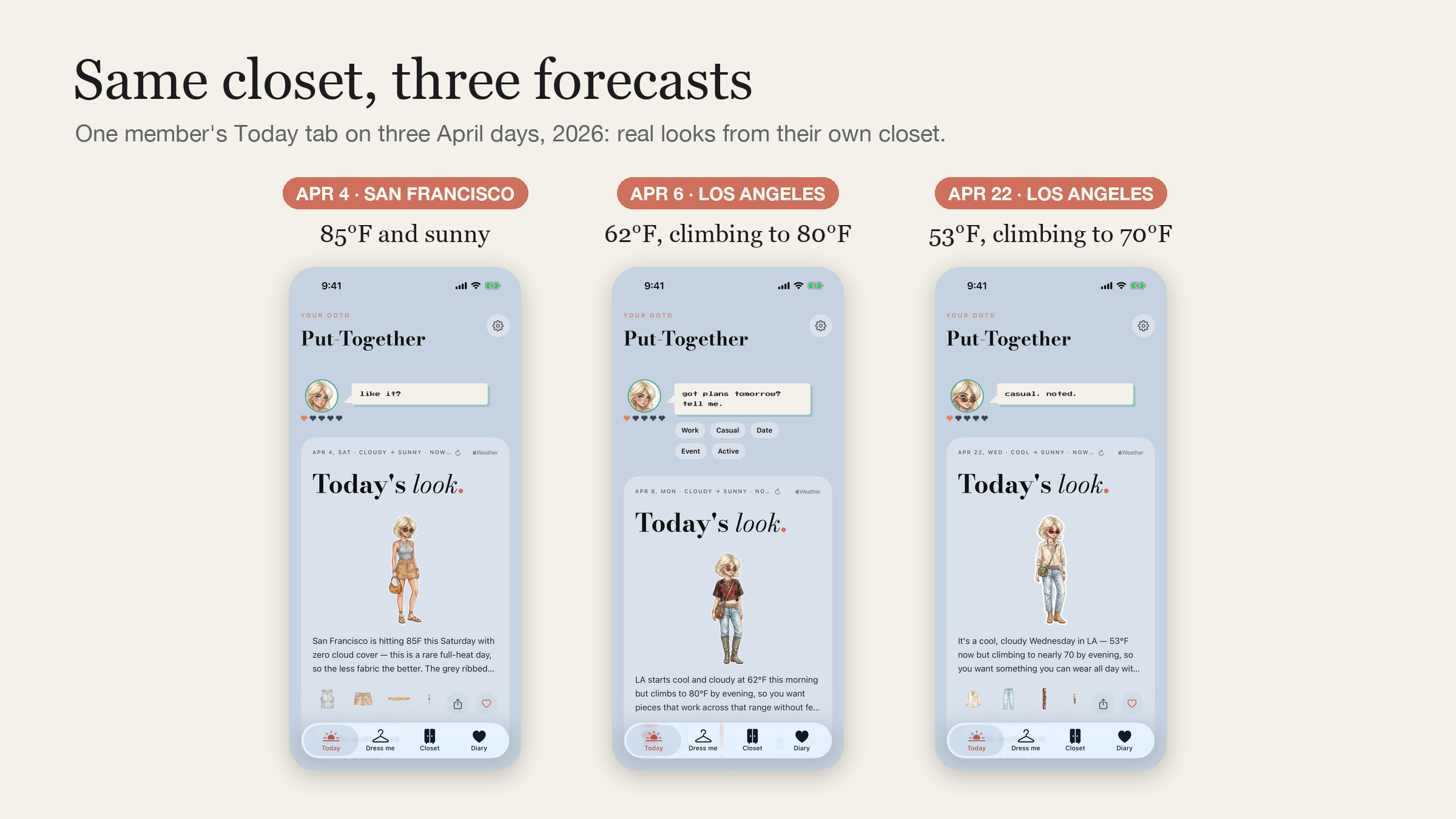
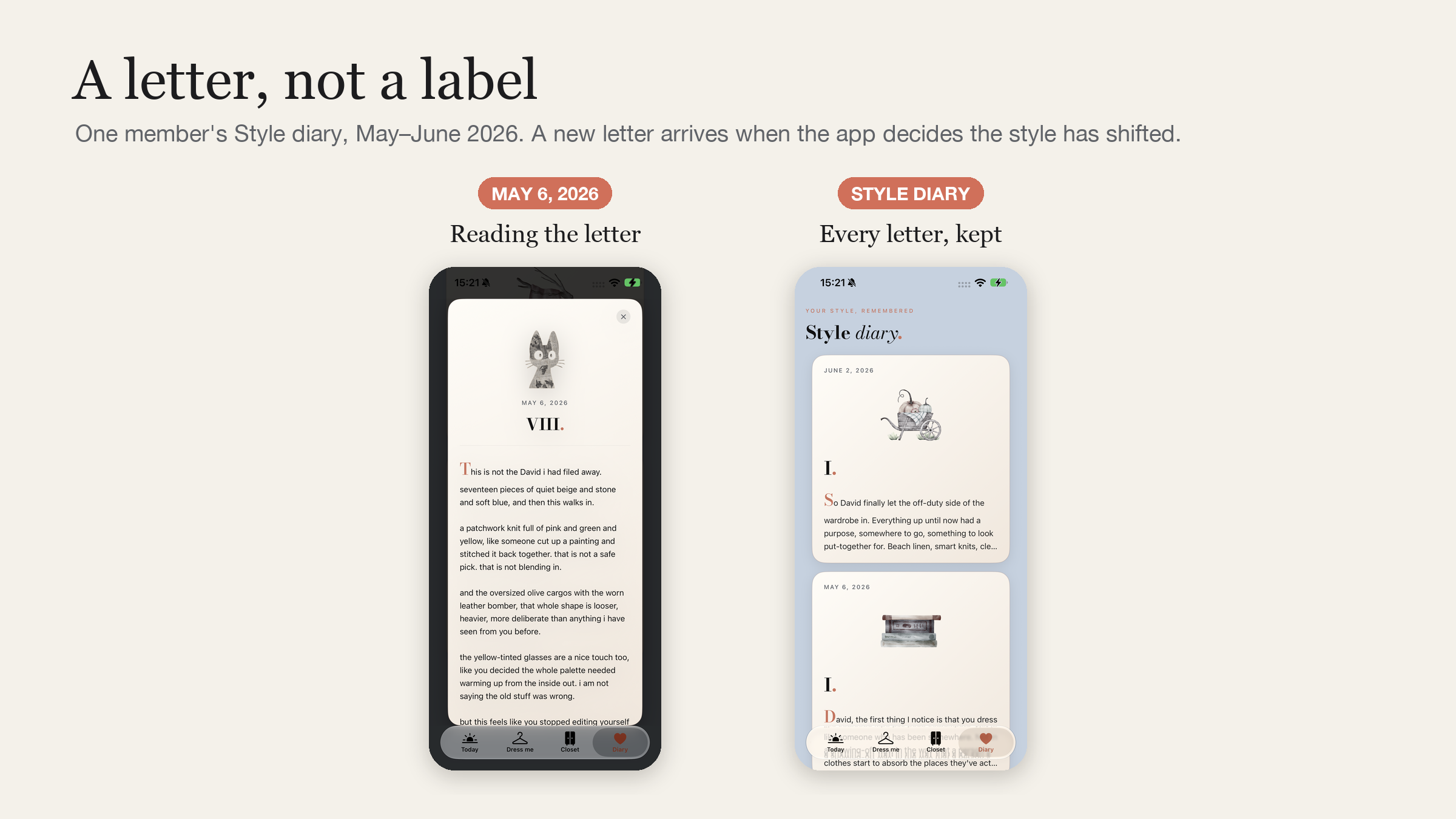
The second place taste shows up is in writing, and it is for subscribers only. After you add a few complete outfit photos, PutTogether writes you a letter about your style: the colors you keep returning to and the aesthetics taking shape in your closet. It does not arrive on a schedule. A new letter comes only when the app decides your style has shifted. A new account never sees one, which is the point: a style read needs a sample.
Where it falls short on this axis: the daily look needs interesting raw material. A purely uniform closet (twelve identical black t-shirts) produces uniform recommendations regardless of stylist intent.
Alta
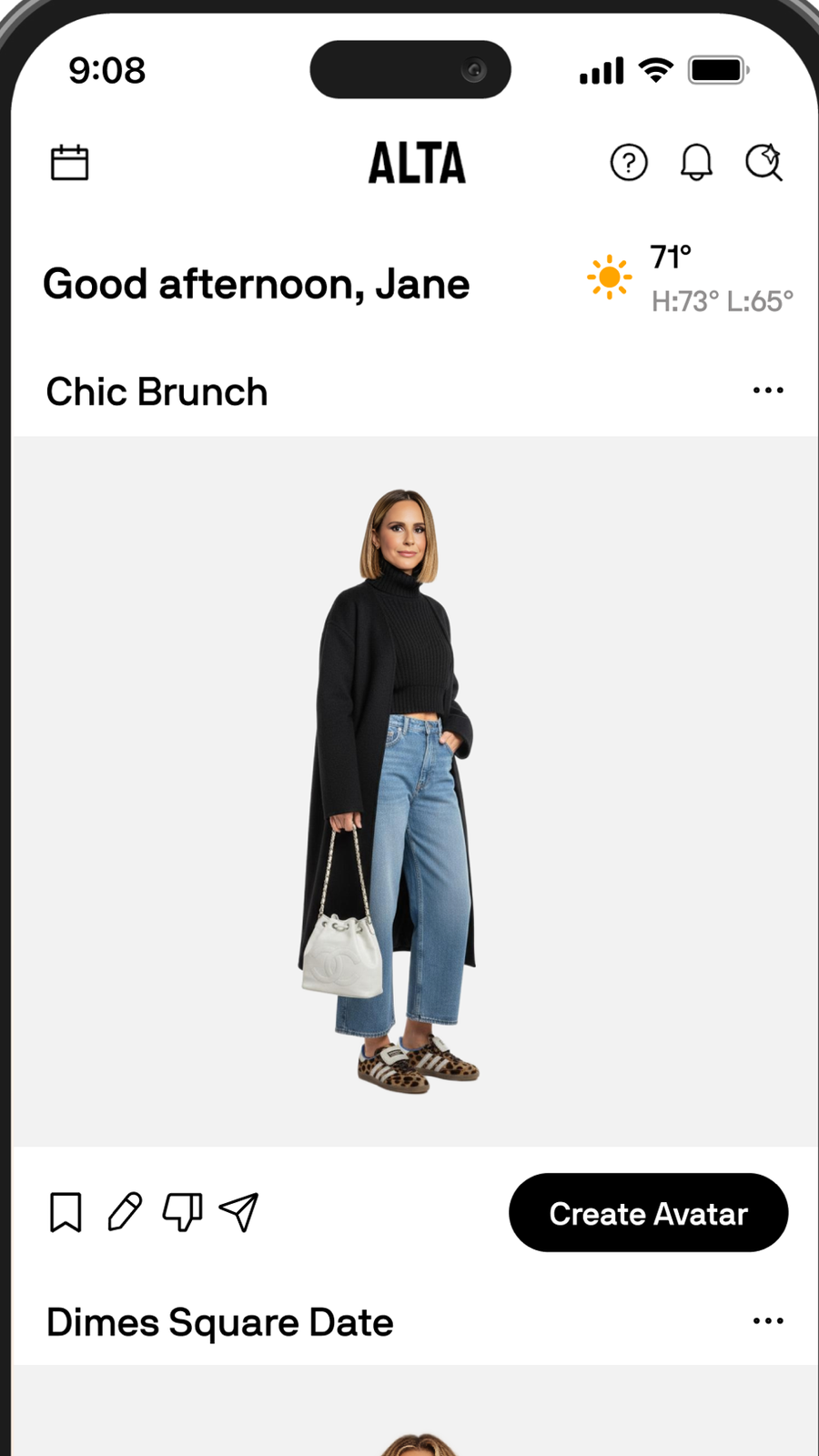
Alta's stylist input is documented in the trade press. Per WWD (April 2025), the AI's training data was informed by longtime stylist Meredith Koop — Michelle Obama's personal stylist for years, now an Alta investor and fashion consultant. That lineage shows up in the output. Alta's daily recommendations skew toward polished, confident, retail-ready compositions — the kind of look that reads cleanly in a press photo or on a feed.
The Koop register is a real editorial register, and it differs from PutTogether's archetype-naming approach in two ways. First, Alta doesn't surface the styling reference by name in user-facing copy — the polish is there, but the "this is a 1996 Bessette-Kennedy combination" call-out isn't. Second, Alta's recommendations often include pieces from its ~4,000 retail partners (the agentic-shopping loop), so the daily card is sometimes a buying suggestion as much as a styling suggestion.
Where it scored: Top on named stylist input (WWD), strong on polish and shoppable register, mid on cultural specificity within the styling text. Alta's tradeoff is that the shopping loop is the product — users who want pure closet-only recommendations get pulled toward purchase.
Whering
Whering has the strongest static visual design in the category — magazine-grade composition, off-white backgrounds, considered spacing. CEO Bianca Rangecroft (ex-Goldman Sachs) has publicly described Whering as a Clueless-inspired digital wardrobe (The Modems interview), and the screens carry that frame visibly.
The editorial energy, however, is directed at sustainability framing rather than styling references. Daily picks read as flat-lays with cost-per-wear callouts and a count of how much of your closet you actually wear; rarely do they read as styled outfits in a specific editorial register. The user gets this outfit costs $3.20 per wear at current rate rather than this combination evokes Phoebe Philo's Céline. Different editorial register; both legitimate.
The pricing model matters here too. Whering's core app is free for cataloging, outfit-logging, and the sustainability dashboard — but the AI styling actions (background removal beyond the monthly batch, AI lookups, the Outfit Maker styling tool at $4.99 one-time) consume credits or one-time IAPs. Since 23 September 2026 its Planner also suggests outfits based on your wardrobe and the weather, and plans ahead for trips when you change location; we have not re-tested it.
Where it scored: Top on design and sustainability tracking, mid on surprise rate, low on cultural specificity within the styling axis.
Acloset
Acloset's chat is the most fluent conversational AI in the category. You can text the app like a stylist friend and get back a context-aware answer with backup options. The editorial register is Seoul-minimalist: clean, considered, friendly. The Looko team (CEO Heasin Ko) claims 4 million users on its App Store listing; KoreaTechDesk counted 800,000 inside 18 months of launch.
The free-tier framing is worth getting right: Acloset's listing says you get every feature free up to 100 items, and the chat is in the free app. Basic, Premium and Expert add closet capacity, not taste. Under 100 pieces, the recommendation layer that distinguishes Acloset in this comparison costs nothing.
What Acloset doesn't reach for is specific cultural references. The user gets good color theory and silhouette logic; the user doesn't get a Bessette-Kennedy callout. That's a deliberate product choice (Acloset's audience is global, and culturally-specific references don't translate evenly), but it leaves a gap on this article's specific axis.
Where it scored: Top on chat fluency (free up to 100 items), mid on surprise rate (~25% honest), low on cultural specificity.
Pronti
Pronti is the strongest pure generator on this list. Feed it a closet, get a dozen novel combinations in a minute. The surprise rate is the highest of any 2026 closet app at roughly 50%.
The catch: Pronti generates on request. It learns your style and tracks what you wore, but each fresh batch still mixes deliberate pairings with random ones. About half of Pronti's surprises read as deliberate; the other half read as the algorithm tried something. For surprise me moods, the app is right. For a curated daily-pick habit, the curated surprise rate is more useful than the raw rate.
Where it scored: Top on raw novelty, bottom on curation, bottom on editorial voice.
Cladwell
Cladwell's recommendations are correct but rarely interesting, by design. The app's job is to rotate the user through their capsule, not expand the user's taste. Co-founder Blake Allsmith built the original product around capsule logic, and co-founder and CEO Erin Flynn, who bought Cladwell with her husband Colin in 2019 (per They Got Acquired), has kept it there; the philosophy rewards repetition, not novelty. Cladwell relaunched on 3 October 2026 with a style quiz, a colour season, an AI stylist tab and See it on me (outfits previewed on a photo of you); we have not re-tested it.
Where it scored: Low on surprise rate (~5%), bottom on cultural literacy, top on capsule efficiency (which this article isn't measuring).
Stylebook
Stylebook doesn't recommend. Its outfit generator shuffles your closet like a deck of cards, but no AI styles you, and every keeper is the user's call — co-founders Jess Atkins (who started in the fashion closets at Vogue and Modern Bride) and Bill Atkins have kept the app on the same "tools, not opinions" stance for over 15 years. The taste in a Stylebook closet is whatever taste the user brings to it. For users with strong taste already, this is the feature. For users learning, it's a limitation.
Where it scored: N/A on automated criteria; top on user-led control.
What PutTogether shipped after this taste test
Taste was scored here in May 2026 on four axes: surprise rate, editorial language, reference density, and register. One change since then lands directly on the language axis.
The letter. The Diary tab writes you one and delivers it as a sealed envelope on the Today screen. It types itself onto paper stock, paragraph by paragraph, in a lowercase deadpan that sits a long way from the briskly helpful register every other app in this comparison writes in. The article below scores the styling paragraph attached to a daily pick. The letter is a separate form, closer to a note from someone who has been watching your closet than to a recommendation.
Mood axes in Dress me. Outfit requests now take a position on bright against muted, polished against laid-back, and daring against demure, which are wardrobe properties a model can check a garment against rather than feelings it has to interpret.
The six other apps were not re-scored. The rankings above stand as measured in May.
When another app fits better
PutTogether leads on taste. Another app fits better when one of these matters more to you:
- iOS only. Alta, Acloset, Whering, and Pronti are the Android answers.
- Mini $9.99/mo for 25 pieces, up to Atelier $34.99/mo for 200. Alta is the free cross-platform answer if budget is the constraint; other free options are reviewed in the field guide.
- Not a generator. Pronti produces more raw novelty in a minute than PutTogether does in a week. Different product.
- The style letter is for subscribers, and it waits. You need a few complete outfit photos in before the first one arrives.
- Limited by the user's closet. The daily look needs interesting pieces to work with. Stylebook is the right answer for users who would rather curate their own taste than receive it.
Who should pick which
Frequently asked questions
Which closet app has the best fashion sense in 2026?
PutTogether scored highest in our May test: every look carries a written reason, and in May the daily card named editorial archetypes (Carolyn Bessette-Kennedy, Phoebe Philo, Sofia Coppola) in user-facing copy. Its knowledge base of stylists' insights, gathered by its editorial team, now shapes Dress me. Alta has the most externally documented stylist input: longtime Michelle Obama stylist Meredith Koop, per WWD (April 2025), and its recommendations skew polished and shoppable. Other reviewed apps make "AI stylist" marketing claims but do not publicly name a working stylist behind the model.
What is PutTogether's styling knowledge base?
A reference library of stylists' insights that PutTogether's editorial team gathered from Vogue and fashion writing: colour theory, silhouette balance, occasion register, and editorial archetypes such as Carolyn Bessette-Kennedy's summer whites. Through the summer of 2026 it shaped the daily look, which is why our May test saw references named on the card. In September the team moved it to Dress me, the trip planner. With a 25-piece closet the model leaned too hard on whatever the notes favoured (mention linen and linen came back every warm day), so the morning reason now runs on Claude's own fashion knowledge and talks plainly about the weather and the pieces. The archetypes themselves are published on this site as Style DNA.
Does PutTogether explain my style back to me?
Yes, for subscribers. After you add a few complete outfit photos, the app writes a letter about your style (the colors you keep choosing and the aesthetics taking shape) and sends a new one when it decides your style has shifted. New accounts do not get one; the free part of PutTogether is the first mini-you, a wardrobe check and Dress me's trip planning.
How do I tell if a closet app has actual taste?
Run it for two weeks and count the surprises. A closet app with taste pairs pieces unexpectedly about 35–40% of the time, and those pairings should read as deliberate. A zero-percent surprise rate means the AI is showing you what you already wear. A fifty-percent rate without curation usually means random combinations.
Are the recommendations the same for every user?
No. PutTogether builds each look from your closet, recent looks, weather and city; Alta adds its stylist-trained model and retail inventory. Two users with identical closets in different cities will get different recommendations on the same day.
What if I want full manual control and no AI?
Use Stylebook, $4.99 once on iOS. It has shipped without AI since 2009 and the absence is a position rather than a gap — the app gives you the catalogue, the calendar, the packing-list builder and the statistics, and leaves every styling decision to you. Whatever taste the wardrobe has is whatever taste you brought to it. On Android the closest equivalent is Pronti, which generates combinations on request and leaves the pick to you.
Does Whering name styling references?
No. Whering's editorial energy goes to sustainability rather than styling references: cost-per-wear, how much of your closet you actually wear, the share that is new, pre-loved, rented or handmade, and resale and donation through Thrift+. The recommendations are correct but not designed to be culturally specific.
Is Acloset's free tier good enough for a taste-focused user?
Yes, up to 100 items. Acloset's listing says every feature is free up to 100 items, and the chat-based AI styling that distinguishes Acloset on this article's axis is in the free app. Basic ($3.99/mo), Premium ($9.99/mo) and Expert ($24.99/mo) add closet capacity, so pay only once your closet passes 100 pieces.
Does PutTogether pick outfits for men?
Yes. Three of the five member videos above are men: a cognac bomber over a blue striped camp-collar shirt, a grey cardigan with navy wide-legs and a black scarf, and a blue mandarin jacket over a dusty pink cardigan. The picks come from the closet you upload, so they follow whatever you wear.
Sources & references
- PutTogether feature changes since the May test (Dress me, the letter, Closet QC, check-in) verified against PutTogether 2.4 (live 2 October 2026) on 5 October 2026, via the app and its App Store listing. Competitor apps were not re-tested; their scores are as measured in the dated test window above.
- Editorial testing across the apps on iOS 26, May 2026, 84-piece reference wardrobe.
- A PutTogether member's Today screens (April 2026) and Style diary (May–June 2026).
- Alta funding, founder, stylist partnership: TechCrunch, June 16 2025; WWD, April 2025.
- Founder context: Stylebook About page (Jess and Bill Atkins, Left Brain Right Brain); They Got Acquired, 2019 (Cladwell, Blake Allsmith → Erin Flynn); The Modems interview (Whering, Bianca Rangecroft); KoreaTechDesk (Acloset / Looko, Heasin Ko).
- Pricing accurate as of September 2026; Cladwell and Acloset re-checked on their live listings, October 2026.
- PutTogether is the publisher of this article and one of seven apps reviewed, as disclosed in the per-app card and the editorial note above.