Coastal Patrician Style Guide
Carolyn Bessette-Kennedy + Babe Paley
Anti-logo old-money urban — Carolyn Bessette-Kennedy in Tribeca and Babe Paley at the Manhattan dinner.
Coastal Patrician is Carolyn Bessette-Kennedy in Tribeca and Babe Paley at the Manhattan dinner — the urban old-money register.
- A navy crepe trouser — the CBK signature
- An ivory silk slip dress — Calvin Klein-era cut
- A brown leather loafer worn until soft — G.H. Bass or J.M. Weston
- A camel cashmere V-neck — Loro Piana weight
- A single strand of pearls — Mikimoto or vintage
- Visible logos — the archetype lives by anti-branding
- Gold hardware — silver-toned or no hardware only
- Prints louder than a navy stripe
- Anything cropped — coverage is the reading
What is Coastal Patrician style?
Coastal Patrician names the urban wardrobe Carolyn Bessette-Kennedy built between her 1996 marriage to John F. Kennedy Jr. and her death in 1999. CBK lived in Tribeca; her daily rotation was Manhattan-on-foot: the navy crepe trouser, the brown loafer worn until soft, the camel cashmere V-neck under a tailored coat, the Calvin Klein slip dress for evening. The defining moves: a 1996 Narciso Rodriguez-styled Yohji Yamamoto silk-crepe wedding slip dress photographed on the steps of a Cumberland Island chapel; a rotation of Calvin Klein under Calvin Klein's own creative direction (the F/W 1996 and S/S 1997 collections); Manolo Blahnik mules in ivory, taupe, or black; and a near-total refusal of visible branding. The archetype's older anchor is Babe Paley, who was a member of Truman Capote's 'swans' circle in the 1950s and 1960s, photographed across mid-century Vogue editorial at her Fifth Avenue Manhattan apartment and at the family's Round Hill estate in Jamaica. Paley wore Hermès, Mainbocher, and her own restraint, and her register was the New York dinner — Le Pavillon, La Côte Basque, the Capote 'swans' lunches — not the resort. The two figures don't share a decade, but they share the same anti-branding city-patrician grammar: ivory and navy and tobacco, one piece of jewellery, the silhouette holds because nothing announces it. The 2020s contemporary maintainers are The Row's Mary-Kate and Ashley Olsen, Toteme's Elin Kling, and Khaite's Catherine Holstein, all of whom cite CBK directly in editorial coverage. Coastal Patrician differs from Beach Patrician by being city-dominant (Manhattan and Tribeca, not Skorpios and Monaco) and from Quiet Sculptor by being more horizontal and less architectural (no heavy unstructured coat as the through-line).
Coastal Patrician is a three-decade arc anchored on Manhattan. Babe Paley's 1950s and 1960s wardrobe, photographed in Vogue across the Capote 'swans' era at her Fifth Avenue apartment and at the family's Round Hill estate, established the city-patrician rules: anti-branding, ivory and navy and tobacco, one piece of jewellery, the silhouette reads through restraint. Carolyn Bessette-Kennedy rebuilt the same grammar 40 years later in her 1996–1999 Tribeca rotation: the Yohji Yamamoto wedding slip, the Calvin Klein minimalism (the F/W 1996 and S/S 1997 collections were her core), the Manolo Blahnik mules in three colourways, the brown loafer worn until soft on the walk-to-lunch. Both wearers refused decoration and both kept the register urban. Vogue's archival coverage of Paley and the contemporary press cycle on CBK, including Business of Fashion's multiple retrospectives on her wardrobe's resurgence, converge on the same reading: the archetype is the city dinner and the office, not the boat. The 2020s maintainers (The Row, Toteme, Khaite) inherit the city register directly.
Coastal Patrician is what's not there — no logo, no hardware, no print, no cropped piece. The silhouette reads through restraint.
Signature palette
The capsule
- 01Navy wool or crepe trouser
The CBK signature. Mid-rise, straight-leg, hem breaks once over the shoe. Calvin Klein's late-90s mainline cut is the reference; Theory and The Row both deliver the contemporary version. Skip slim cuts and skip wide-leg — straight-leg is the move.
- 02Ivory silk slip dress
Calvin Klein under Calvin Klein's own creative direction (F/W 1996, S/S 1997) is the reference. Bias-cut, mid-calf, thin straps. Worn alone in warm weather or layered under a tailored coat. Skip satin polyester — the silk weight is what reads.
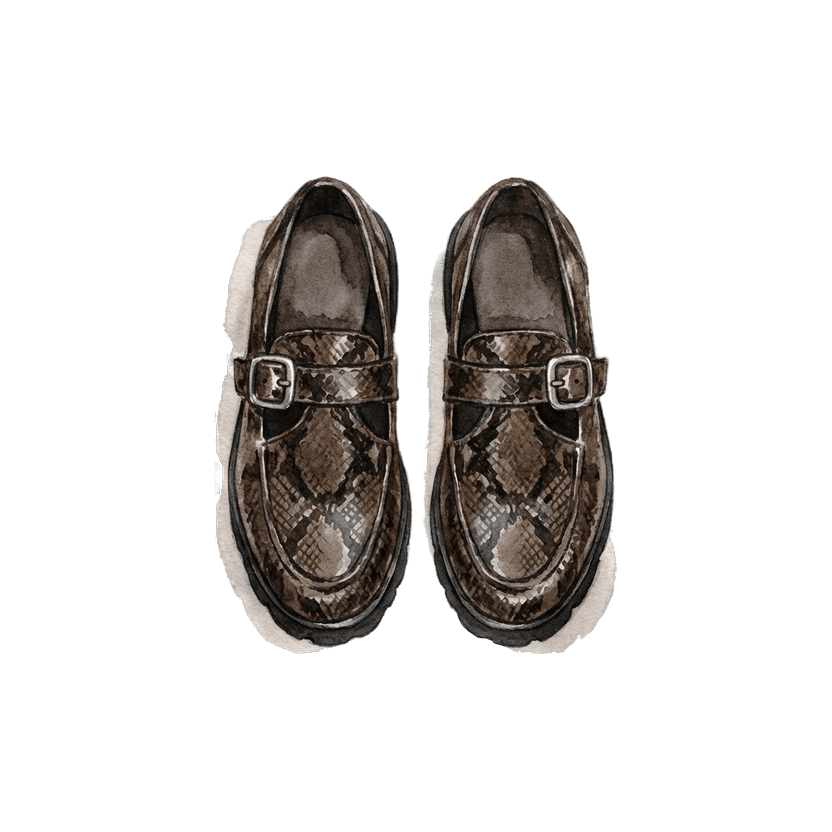 03Brown leather loafer worn until soft
G.H. Bass 'Larson' penny loafer or J.M. Weston 180. The shoe acquires its character through wear, not purchase. Tortoiseshell brown, no embellishment. Skip horsebit hardware and skip square-toe — the archetype walks on a rounded almond toe.
- 04Camel cashmere V-neck
Loro Piana, Brunello Cucinelli, or N.Peal — the heavier the cashmere, the better. Worn over the slip dress, over a white shirt, or alone with the navy trouser. Skip crewnecks (wrong coverage) and skip oversized fits (wrong silhouette).
- 05Single strand of pearls
Mikimoto's 7-8mm Akoya is the standard; any vintage strand at the right length (just above the collarbone) works. One strand only — Babe Paley's signature was the single line. Skip stacked pearls and skip baroque (wrong era).
- 06Navy double-breasted wool blazer
Brooks Brothers' archive cut or a vintage Yves Saint Laurent men's blazer one size up. Gold buttons acceptable only on the most-traditional cut (the Brooks Brothers '346'); otherwise plain horn. Skip notched lapels with strong shoulders.
- 07White cotton poplin shirt
Anne Fontaine or Brooks Brothers' Original Polo button-down. Crisp, no embellishment, tucked into the navy trouser. Worn open over a white tank for the CBK-summer rotation. Skip ruffles, embroidery, or any decorative element at the collar or cuff.
What to avoid
- Visible logos — CBK and Paley both refused them
- Gold hardware — silver-toned or no hardware only
- Prints louder than a navy stripe
- Cropped tops — coverage is the reading
- Stacked jewellery — one strand of pearls is the rule
Frequently asked questions
Coastal Patrician is Carolyn Bessette-Kennedy's 1996–1999 wardrobe (the Yohji Yamamoto wedding slip, the Calvin Klein minimalism, the Manolo Blahnik mules) through Babe Paley's mid-century coding. The archetype reads as anti-branding old money: ivory and navy and oat, no logos, one piece of jewellery, the silhouette holds through restraint.
Both share the anti-branding old-money grammar, but Coastal Patrician is city-dominant — Carolyn Bessette-Kennedy in Tribeca, Babe Paley at the Manhattan dinner, the navy crepe trouser, the brown loafer, the silk slip for evening. Beach Patrician is resort-dominant — Jackie Kennedy Onassis on Skorpios, Caroline of Monaco by Helmut Newton, the capri trouser, the Hermès scarf, the ballet flat. The same shopper can own pieces from both, but the daily register splits cleanly along city vs resort.
Quiet luxury is the broader 2020s category — anti-logo, high-cost, heritage-fabric dressing — that crystallized in the press around 2023. Coastal Patrician is one of its specific lineage forms: the CBK + Babe Paley urban-patrician grammar, anchored on Manhattan rather than the Philo-built Quiet Sculptor architecture. The Row and Khaite serve both archetypes from different angles.
The Row (Mary-Kate and Ashley Olsen), Toteme (Elin Kling), Khaite (Catherine Holstein), Brunello Cucinelli, Loro Piana, Anne Fontaine, Brooks Brothers (the heritage mainline), and Manolo Blahnik for the mules. Calvin Klein's 90s archive is the reference but the current mainline is not the answer; vintage is.
Yes. The cashmere V-neck and the silk slip translate at high-street weight; the loafer requires patience (G.H. Bass at $200 worn for two years reads better than a $1,200 designer loafer worn twice). The pearl strand is the easy luxury — Mikimoto Akoya at the entry level or any vintage cultured strand. The navy trouser scales from Theory to The Row at every price point.
Carolyn Bessette-Kennedy's wedding photographs (September 21, 1996, Cumberland Island, Georgia — Denis Reggie). The Slim Aarons portraits of Babe Paley at Round Hill, Jamaica (1950s–1960s). Vogue's mid-century coverage of the Capote 'swans.' Business of Fashion's retrospective coverage of CBK's wardrobe resurgence in the 2020s.