Published by PutTogether, which makes one of the seven apps below. No affiliate links. Every app was tested on iOS 26 against an 84-piece reference wardrobe over 30 days in May 2026.
Scope: this article is about which closet AI has actual fashion knowledge in the model — not which is cheapest, not which has the prettiest design. The full field map (10 apps, every price tier, every visual register) is in Every Digital Closet App in 2026, Ranked and Compared; a parallel piece on which app has the strongest editorial taste in daily picks is at The Closet App With Actual Taste.
The phrase "AI stylist" is used so loosely in 2026 closet-app marketing that it has stopped meaning much. Most closet-app "AI" is a rule engine wearing a chat costume: color-match table, basic silhouette grammar, weather mapped to category. The rules are not wrong; they are simply not what working stylists actually know.
What stylists actually know is harder to ship. The small differences between a Phoebe Philo–era pairing and a contemporary Loewe pairing. How a Carolyn Bessette-Kennedy summer office outfit pulls together. The rules for breaking color theory in a way that reads as deliberate rather than chaotic. The kind of polished, on-camera composition Meredith Koop built dressing Michelle Obama for nearly a decade. That knowledge is held in working stylists' heads; until 2024–2025 it had not been translated into structured reference libraries that closet-app AIs could use.
Two apps have now done that translation, in two different registers. The rest don't name who, if anyone, trained the model.
How we measured fashion knowledge
Four criteria, each scored 0 to 10. Same 84-piece test wardrobe, parallel testing for 30 days, May 2026, on iOS 26.
- Fashion knowledge baked in. Does the AI know editorial codes, designer references, and occasion registers — or does it only know color matching and "warm weather = sandals"?
- Personalization depth. Does the AI learn the individual user (preferred contrast, wear patterns, real wardrobe) — or does it run identical rules for every user?
- Recommendation specificity. Are the suggestions specific to this user's closet on this day — or generic templates?
- Editorial language. When the AI explains a pick, does the explanation sound like a stylist or like a generator?
What we couldn't test. Alta's stylist work with Meredith Koop is documented in WWD (April 2025) but the contents of the training data are private; we evaluated Alta's output, not its inputs. We did not test enterprise / styling-pro tiers (such as Indyx's Lookbook styling services). The fashion-knowledge score is a directional read from a single 84-piece test wardrobe and a single reviewer's editorial calibration.
The 2026 scoreboard
| Rank | App | Fashion Knowledge | Personalization | Specificity | Editorial Language |
|---|---|---|---|---|---|
| 1 |  PutTogether PutTogether | Editorial team's knowledge base of stylists' insights; named Bessette-Kennedy / Philo / Coppola in our May test | Agent learns the user | Outfit-level | Named archetypes in May; plain-language reason since September |
| 2 |  Alta Alta | Trained with Meredith Koop (verified in WWD, April 2025); polished, retail-ready register | Learns wardrobe + body inputs | Outfit-level on the avatar | Koop register, not surfaced as named references |
| 3 |  Acloset Acloset | General fashion rules | Learns saved outfits | Closet-level | Conversational chat |
| 4 |  Pronti Pronti | Generation rules | Style learning; scored low in May | Generation-level | Functional |
| 5 |  Cladwell Cladwell | Capsule rules | Rotation tracking | Capsule-level | Functional |
| 6 |  Indyx Indyx | Analytics | Archetype quiz at signup | Wardrobe-level | Analytical |
| 7 |  Pureple Pureple | Basic rules | Basic | Generic | Functional |
A rule engine knows that navy goes with cream. A stylist knows when to break the rule for a Sunday brunch in a Phoebe Philo register, and when not to. Two apps in 2026 have a stylist's knowledge in the model. The rest are not lying when they say "AI stylist" — they just mean a different thing by it.
What "a stylist inside" actually means
A stylist-trained closet AI does three things at once. First, it knows the rules — color theory, silhouette balance, occasion register. Second, it knows when to break them, when an unusual pairing works because it lands in a specific editorial register. Third, it knows the user: the pieces in their closet, how they wore them last time, the occasions they actually build outfits for.
Two apps in 2026 put working stylists' knowledge into the model, enough to do all three of those things. They reach for different aesthetic registers, and the difference is the whole story.
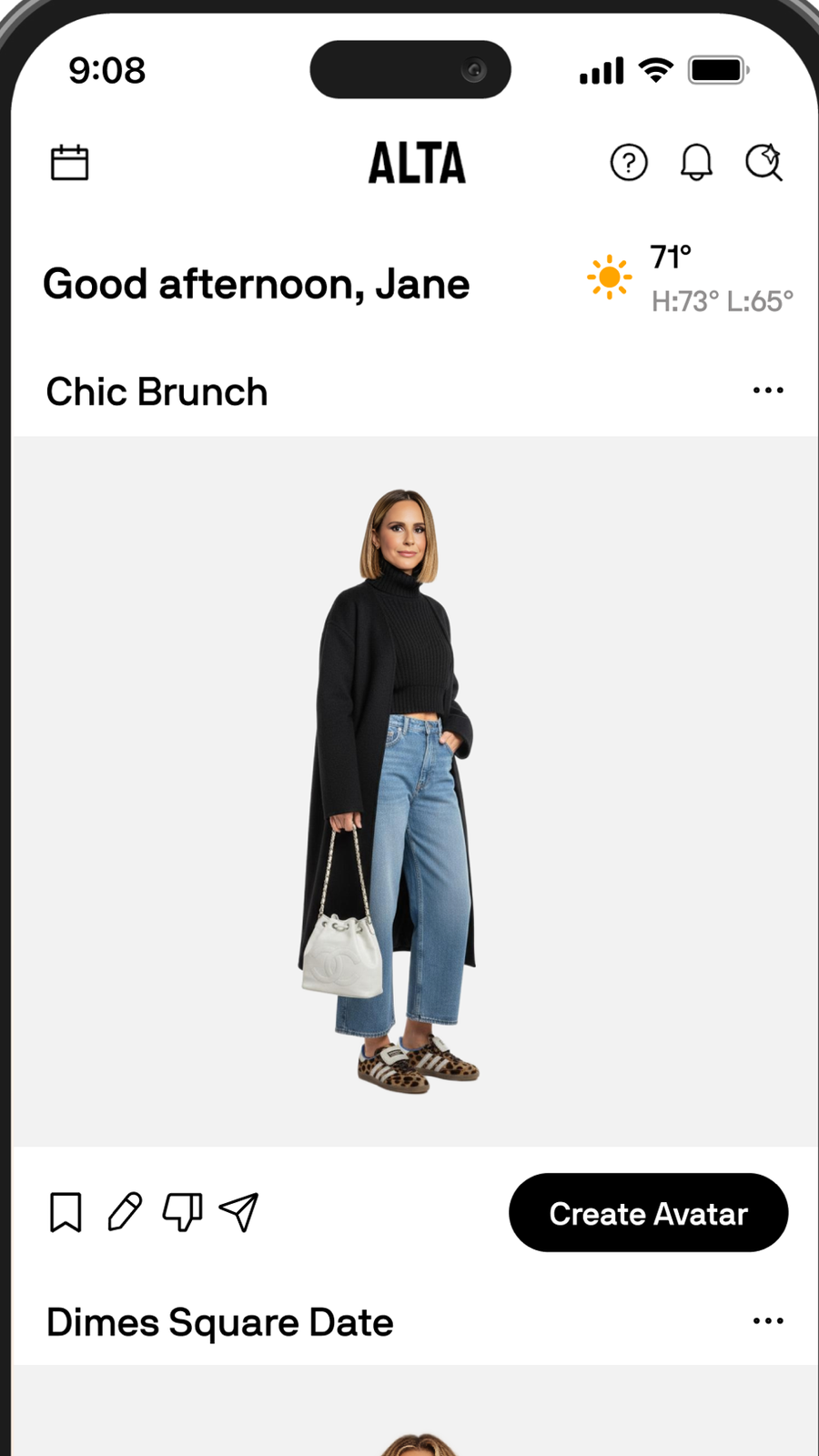
- Alta trained its AI with Meredith Koop — Michelle Obama's personal stylist for nearly a decade, now an Alta investor and fashion consultant. Per WWD (April 2025), Koop's styling logic informed Alta's training data. Koop's professional register is confident, on-camera, retail-shoppable — exactly aligned with Alta's agentic-shopping product. The AI's daily recommendations skew toward polished, lookbook-clean compositions, often featuring pieces from Alta's ~4,000 partner brands.
- PutTogether's editorial team built a styling knowledge base from working stylists' insights, gathered from Vogue and fashion writing, with editorial archetypes among them: Carolyn Bessette-Kennedy summer office, Phoebe Philo–era Céline, Sofia Coppola pastels. In our May test those references surfaced by name in the daily card's styling paragraph.
The other apps don't make this kind of claim. Acloset markets an AI stylist chat but doesn't name a stylist behind the training. Pronti, Cladwell, Pureple, and Indyx don't name a stylist behind their models either; in our May test they scored as rule engines, generators, or analytics tools that happen to live in the same App Store category.
The apps, one by one
PutTogether
PutTogether ranks first on the four criteria in our May test. Its fashion knowledge came from people: the editorial team gathered working stylists' insights from Vogue and fashion writing into a reference library, and the model applied it to each closet.
In May the knowledge base surfaced specific editorial archetypes by name in user-facing copy. A daily-card styling paragraph reads "Cream silk cami + slate trousers — a summer-office combination Carolyn Bessette-Kennedy wore in 1996. The contrast level suits your usual register." That last sentence is the personalization on top of the knowledge base's reference. The Los Angeles team built its own pipeline around Claude, Anthropic's model, to apply the knowledge base to each user's wardrobe and patterns.
In September the team moved the knowledge base out of the morning and into Dress me. With a closet of 25 or 50 pieces, the model leaned on whatever the notes praised (name linen and linen came back every warm day). The daily reason now runs on Claude's own fashion knowledge and talks plainly about the weather and the pieces; The Closet App That Tells You What to Wear, and Why covers that change. The archetypes are published on this site as Style DNA archetype essays, unrelated to the Style DNA app.
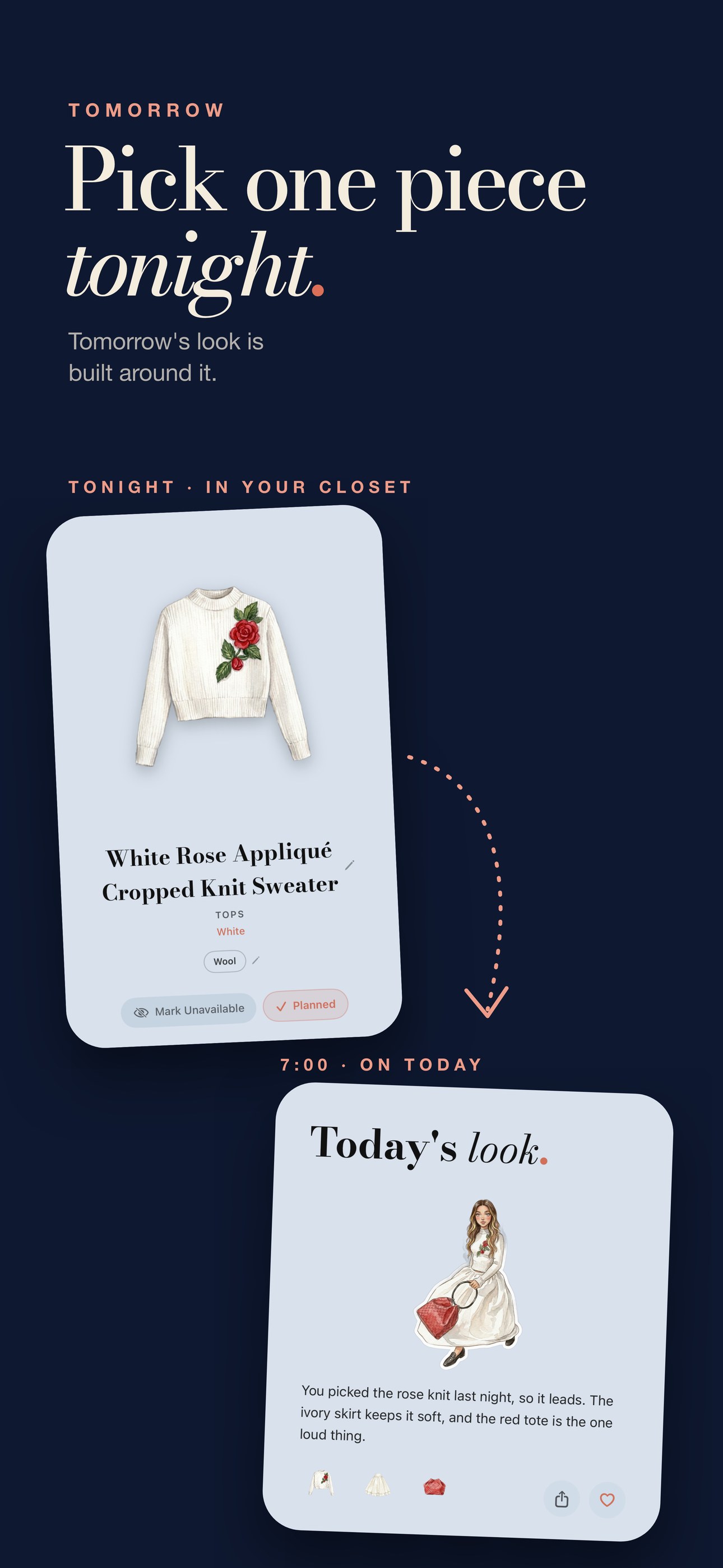
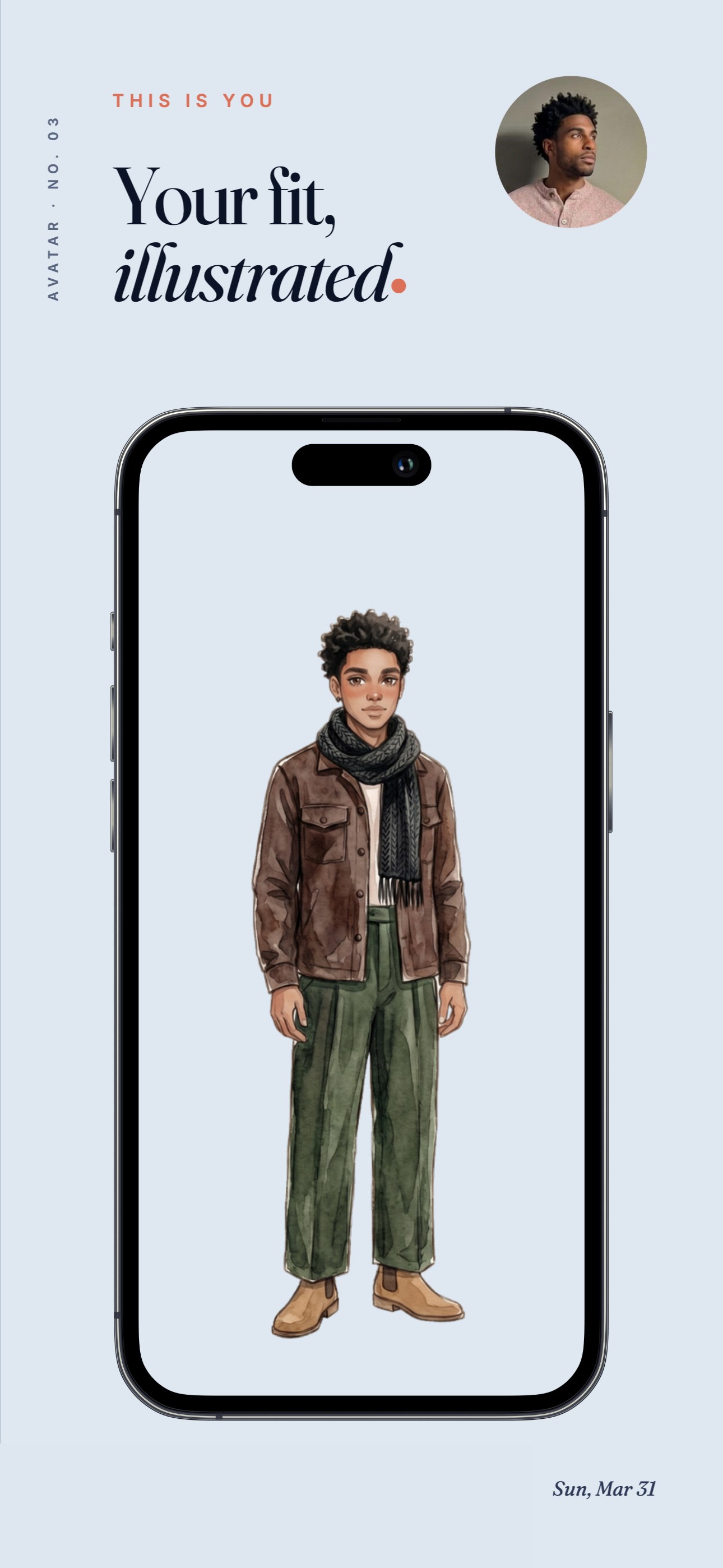
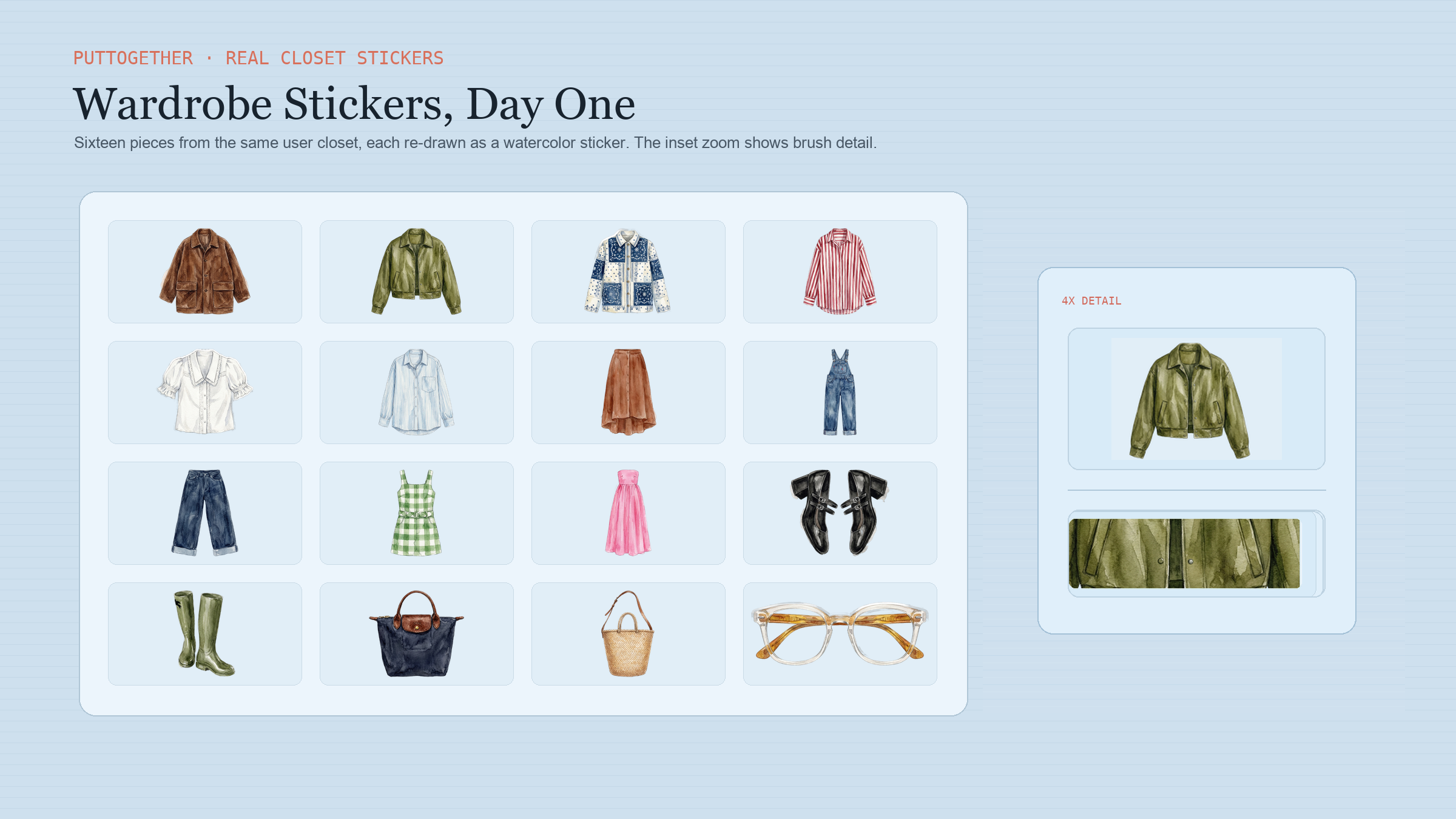
The visual layer matches the editorial intent: every piece in the closet is re-rendered as a hand-drawn watercolor sticker, and the user is re-rendered as a watercolor portrait wearing those pieces. New subscribers on any tier get welcome credits on top of the first month's credits, enough to fill the tier's closet or a comfortable rotation in month one; monthly credits add more pieces over time, and retiring a piece frees its room.
Where it falls short: PutTogether is iOS only; daily looks start at Mini, $9.99/mo for 25 pieces. The styling needs interesting raw material from the user's closet to work — a uniform closet produces uniform recommendations regardless of stylist intent. PutTogether has no chat box: the daily card arrives decided and Dress me takes a short brief, so readers who want to argue with the AI will prefer Acloset.
Alta
Alta credits a named stylist. Per WWD (April 2025), the AI's training data was informed by longtime stylist Meredith Koop — Michelle Obama's personal stylist for nearly a decade, now an investor and fashion consultant to the company. That lineage shows up in the output. Alta's daily recommendations skew toward polished, confident, retail-ready compositions — the kind of look that reads cleanly in a press photo or on a feed.
Two things distinguish Alta's stylist-trained AI from PutTogether's. First, in our May test, Alta did not name the styling reference; PutTogether's daily card then did. Second, Alta's recommendations often include pieces from its ~4,000 retail partners (the agentic-shopping loop), so the daily card is sometimes a buying suggestion as much as a styling suggestion. That's a feature for users who want the closet to also be a shopping surface; it's a friction for users committed to wearing only what they already own.
Where it scored: Top on named stylist input (WWD), strong on polish and shoppable register, mid on cultural specificity within the user-facing styling text. Alta's trade-off is that the shopping loop is the product — users who want pure closet-only recommendations get pulled toward purchase.
Acloset
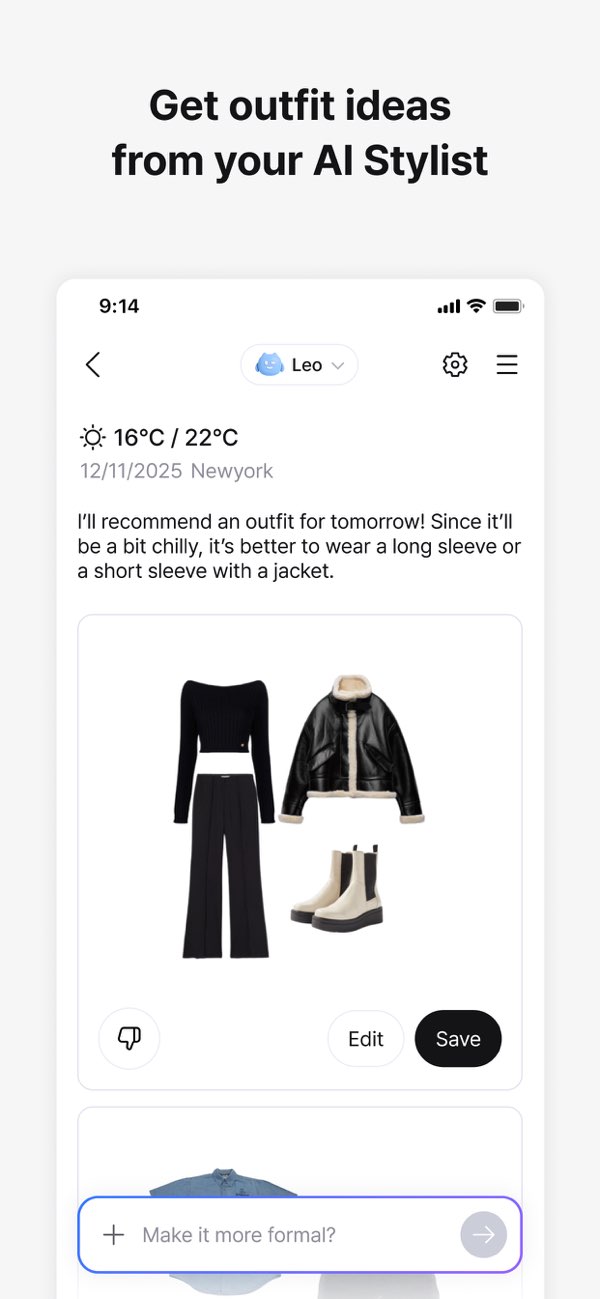
Acloset's AI is the friendliest conversational layer in the category — you can text the app like a stylist friend and get back AI-generated outfit suggestions, styling answers, and backup options. The underlying knowledge is general fashion rules (color theory, silhouette logic, occasion register, weather-aware fits) rather than a publicly named stylist's playbook. The AI is real and useful; it just hasn't been trained with a named working stylist the way Alta's has.
The Looko team (CEO Heasin Ko, Seoul) ships technically fluent chat-based AI styling; its App Store listing claims 4 million users, and KoreaTechDesk counted 800,000 inside 18 months of launch. Recommendations are correct and often genuinely helpful, but rarely reach for specific cultural references the way PutTogether's archetype-naming does. For users who want to converse with the AI for outfit advice, Acloset is the best answer in 2026 — the conversation is with a competent fashion generalist.
The free tier matters here: Acloset gives you every feature, the AI styling chat included, free for up to 100 items. Basic ($3.99/mo), Premium ($9.99/mo) and Expert ($24.99/mo) buy closet space, not features.
Where it scored: Top on chat fluency and AI conversational style, mid on cultural specificity (no named stylist behind the model), mid on personalization (saved-outfit learning but no per-piece wear inference).
Pronti
Pronti's AI is the strongest pure generator on this list — feed it a closet, get 12 novel outfit combinations from a single wardrobe in under a minute. Its listing says it learns your style and tracks what you wore. In our May test the combinations were interesting at a high rate, but only about half worked for the user specifically.
Pronti makes no public claim of stylist-trained AI. Its strength is the generation engine, not the styling knowledge.
Where it scored: Top on raw generation, bottom on personalization, bottom on cultural specificity.
Cladwell
Cladwell's AI is rule-based rotation. It rotates the user through their capsule, avoids back-to-back repeats, respects basic color matching. The editorial layer is absent by design: co-founder Blake Allsmith built the original product around capsule logic (current CEO Erin Flynn, a co-founder who bought the company with her husband Colin Flynn in 2019, per They Got Acquired). Cladwell's job is to make capsule-wardrobe daily decisions, not to expand the user's sense of style.
Cladwell relaunched on 3 October 2026 with a style quiz, a color season, an AI stylist tab and See it on me (outfits previewed on a photo of you); we have not re-tested it.
Where it scored: Top on capsule logic, bottom on editorial voice (intentionally).
Indyx
Indyx's "AI" is mostly analytics: cost-per-wear projections, dead-weight flags, archetype quiz at signup. Founder Yidi Campbell came from retail strategy and operations at Gap and Athleta plus investment banking (Indyx founder page) — the analytical lens shows up in the product, not as a daily-styling AI. Use Indyx alongside a daily-pick app, not as one.
Where it scored: Top on analytical depth, low on daily-styling utility (by design).
Pureple
Pureple's recommendation engine is the oldest on this list. It works. The free tier handles closet management and basic outfit creation. The fashion-knowledge layer is minimal — Pureple makes no public stylist claim, and the product doesn't pretend to.
Where it scored: Mid on functional correctness, bottom on editorial voice.
What PutTogether shipped after this stylist test
This article asks what "a stylist inside" means and scores seven apps on it, in May 2026. Two things shipped since then that change what PutTogether is doing on that question.
The letter. The Diary tab writes you one and sends it as a sealed envelope to the Today screen, where it types itself onto paper stock. A stylist who works with you for a year does not only tell you what to wear on Tuesday. They notice what you keep reaching for, and they say so. The letter is that second thing, which no other app in this comparison attempts in written form.
Mood axes. Dress me takes bright against muted, polished against laid-back, and daring against demure. Those are properties a model checks each garment against, not moods it interprets, which is closer to how a working stylist narrows a rail than to how a recommendation engine filters a catalog.
The six other apps were not re-scored. The rankings above stand as measured in May.
Where PutTogether falls short on this list
The leader of this article is not the right answer to every stylist question:
- iOS only. Android users default to Alta on this article (and Acloset for chat-style fluency).
- Not the best chat. Acloset is more fluent if conversation is the primary interaction the user wants.
- Doesn't generate at Pronti's volume. PutTogether produces one daily look, and up to five per Dress me request; Pronti produces 12 in a minute. Different product.
- 2026-young. Both Alta and PutTogether are 2025–2026 products. Cladwell (2011), Pureple (2014), Stylebook (2009) have had longer to refine — though none of them names a stylist behind the model.
Who should pick which
Frequently asked questions
Who is behind PutTogether's styling?
PutTogether's editorial team in Los Angeles. They gathered working stylists' insights from Vogue and fashion writing into a styling knowledge base: colour theory, silhouette balance, occasion register, and editorial codes such as Phoebe Philo–era pairings and Carolyn Bessette-Kennedy's summer combinations. Through the summer of 2026 the daily look drew on it. Since September it informs Dress me, the trip planner, and the morning reason is written by Claude from your closet and the forecast.
Which closet app's AI is trained with a real stylist in 2026?
Two apps put working stylists' knowledge into the model. Alta credits Meredith Koop, Michelle Obama's longtime stylist, who is named in WWD (April 2025) as having informed the AI's training data. PutTogether draws on a knowledge base its editorial team built from stylists' insights in Vogue and fashion writing. Acloset markets an AI stylist chat without naming a stylist behind it; Pronti, Cladwell, Indyx, and Pureple don't name a stylist behind their models either.
Is the AI in closet apps actually intelligent or just rule-based?
It varies. Alta's AI was trained with input from stylist Meredith Koop; PutTogether's Dress me draws on a knowledge base its editorial team built from stylists' insights, and Claude writes its daily reason. Acloset uses an AI chat trained on general fashion rules. Cladwell and Pureple are closer to rule engines. Pronti is the strongest generator. Indyx is analytics. The fast test: use the app for three weeks and see if recommendations improve.
Can an AI closet app replace a personal stylist?
Not entirely. Alta and PutTogether come closest in 2026 because they have stylist input in the model. But a human stylist still wins on in-person body-type judgment, shopping curation, and complex life-stage transitions. The AI handles the daily 80%; a human stylist handles the strategic 20%.
How does PutTogether's AI learn my style?
The AI agent tracks which daily picks the user accepts versus rerolls, which pieces are worn most often, which combinations are saved, and which occasions the user sets the night-before vibe for. Over the first two to four weeks the agent's picks become increasingly tuned to the user's preferred contrast level, color register, and silhouette tendencies.
Which AI closet app has the best chat interface?
Acloset, by a clear margin. The conversational AI is fluent and friendly, and the chat lets the user push back on recommendations ("too formal," "swap the shoes") and get useful new answers. PutTogether has no chat box: the daily card arrives decided and Dress me takes a short brief, so readers who want to argue with the AI will prefer Acloset. Alta's interaction model is the avatar plus the shopping loop, not chat.
Can I see PutTogether's styling knowledge base?
Not as a document inside the app. Its archetypes are published on this site as Style DNA archetype essays, from Coastal Patrician (Carolyn Bessette-Kennedy) to Quiet Sculptor (Phoebe Philo), and the knowledge base shows up in the looks Dress me builds. Alta's training data is private too; only Koop's involvement is public.
Sources & references
- PutTogether feature changes since the May test (Dress me, the letter, Closet QC, check-in) verified against PutTogether 2.4 (live 2 October 2026) on 5 October 2026, using the shipping iOS build and the App Store listing. Competitor apps were not re-tested; their scores are as measured in the dated test window above.
- Editorial testing across the apps on iOS 26, May 2026, 84-piece reference wardrobe.
- Alta stylist partnership and funding: WWD, April 2025 (CFDA partnership + Meredith Koop training); TechCrunch, June 16 2025 ($11M seed, Menlo Ventures + Anthropic Anthology + LVMH-linked Aglaé Ventures).
- Founder context: KoreaTechDesk (Acloset / Looko, Heasin Ko); They Got Acquired, 2019 (Cladwell, co-founders Blake Allsmith and Erin Flynn; Erin and Colin Flynn bought it in 2019); Indyx founder page (Indyx, Yidi Campbell).
- Pricing accurate as of September 2026, US App Store list prices, monthly tier only.
- PutTogether is the publisher of this article and one of seven apps reviewed, as disclosed in the editorial note above and in its per-app card.