Four Madame X Looks at the 2026 Met Gala: Why Sargent's 1884 Scandal Keeps Coming Back
Sargent painted her in two sittings, lost her right strap to scandal, repainted it upright, and exiled himself to London. 142 years later, four women independently chose her for the carpet — and three of them put the strap back where Sargent first painted it.
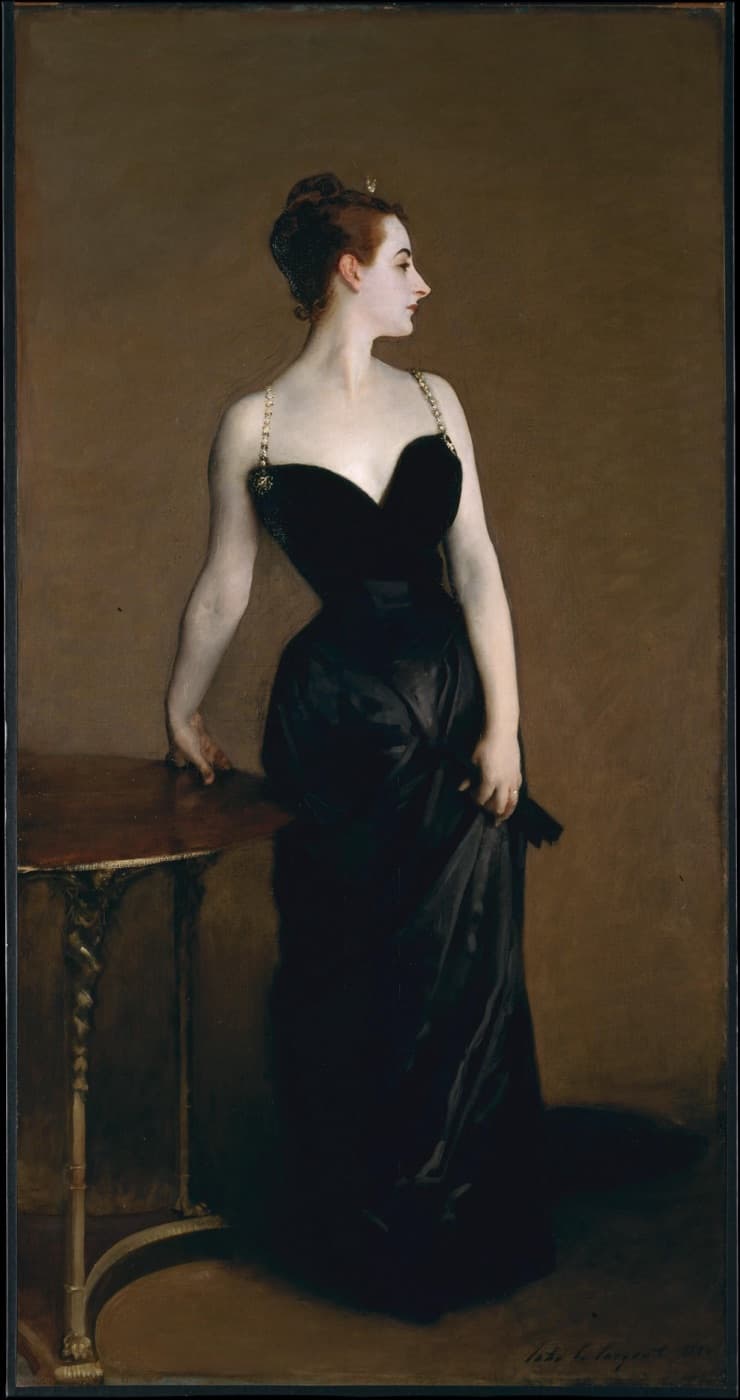
Four 2026 Met Gala attendees came as Madame X. The painting they were citing is the most famous failure in Sargent's career — and it's been hanging in the Met since 1916.
- Read the strap first — Lauren Sánchez and three others give you four different answers to whether the strap is up, down, or invisible
- Notice the posture — Madame X's right arm twists awkwardly onto a side table; Rosie Huntington-Whiteley copied it, Julianne Moore did not
- Treat the colour as the citation — Madame X is solid black silk satin against lavender skin; the gown's surface is the painting
- Read this with the pillar piece if you want the other 26 references
- Don't read the original 1884 strap-down version as Sargent's 'mistake' — it was deliberate, and the corrected version is the compromise
- Don't confuse Madame X with Sargent's other Salon scandals — there were several, but Madame Gautreau is the only one that drove him out of Paris
- Don't assume the painting was lost or hidden — Sargent kept it in his London studio for 32 years before selling it to the Met in 1916
The painting (1883–84)
Sargent began painting Virginie Amélie Avegno Gautreau — a New Orleans–born American who had married into Paris society and become one of the city's most photographed faces — in February 1883. He worked without commission. Madame Gautreau sat for him in her own apartment over two summers; Sargent wrote to a friend that her skin was "a uniform lavender or blotting paper colour all over" and that he was struggling to paint her without flattening the lavender into greyness.
When the painting reached the 1884 Paris Salon — the year's only juried exhibition that mattered — the right shoulder strap was painted falling off the shoulder onto the upper arm. The Salon hang was at eye level in a packed central room. Within hours the press had the title (Sargent had refused to identify the sitter publicly, calling the picture only Portrait of Mme***), the sitter (everyone in Paris knew Madame Gautreau on sight), and a full moral indictment of both. The fall of the strap, in the visual grammar of 1884 Paris, was a pictorial euphemism for sexual availability. Madame Gautreau's mother visited Sargent's studio days later asking him to remove the painting — he refused but did, that summer, repaint the strap upright, where it stays today.
The four 2026 readings
Lauren Sánchez Bezos chose the original 1884 hang. The strap on her right shoulder is painted in Sargent's first scandalised position — fallen onto the upper arm. The black satin column copies the painting's silhouette closely; the skin tone is matte powdered pearl-lavender, not red-carpet bronze. Of the four, hers is the most archival reading.
Rosie Huntington-Whiteley chose the posture. Madame Gautreau's right arm twists onto a small table to her right, her left hand finding the table's edge — the angle Sargent's contemporaries called affected, even ugly. Huntington-Whiteley copies the angle in silk velvet rather than satin (a textile substitution that softens Sargent's harsh light) and skips the strap detail entirely.
Julianne Moore chose the surface. Sargent's wet-on-wet handling of the satin reads as one solid black mass with a single highlight running the length of the body; Moore's gown reproduces that surface, drapes the dropped shoulder Sargent painted, and leaves the strap question unanswered.
Claire Foy chose the corrected version — the painting that has hung at the Met since 1916, with both straps upright. The bodice is satin, the waist tighter than Madame Gautreau's actual silhouette, the neckline geometry exact. Foy's reading is the only one that doesn't restage the scandal.
Why Sargent's scandal travels
Madame X is the rare canonical painting that contains its own publicity. The picture's premise (society portrait of a beautiful woman) is the same premise as the red carpet itself. Sargent's risk (showing the body's skin tone literally rather than flatteringly) is a risk modern celebrities still take. The painting's failure (it ran Sargent out of Paris) and its eventual triumph (Sargent's letter to the Met in 1916 calling it "the best thing I have done") map onto the rehabilitation arc that defines a long career on a public stage.
The four 2026 readings together make the painting legible in a way no single citation could. Sánchez stages the scandal; Huntington-Whiteley stages the awkwardness; Moore stages the surface; Foy stages the museum compromise. To stand in the Met's European Paintings galleries today and look at the picture is to see only Foy's version. To understand why the picture matters, you need the other three.
Where the painting lives
The Metropolitan Museum of Art, gallery 771 (European Paintings, second floor). Acquired in 1916 from Sargent himself, who sold it to the Met for $1,000 — well below market rate for a major Sargent — on the condition that the painting be hung as Portrait of Madame X rather than Madame Gautreau's name. The Met has held to that wall label for 110 years. Madame Gautreau died in 1915, the year before Sargent sold the painting; her family was relieved.
I suppose it is the best thing I have done.— John Singer Sargent, in a 1916 letter to the Met, on selling Madame X
Frequently asked questions
Four attendees independently chose Sargent's Portrait of Madame X (1883–84) as their reference: Lauren Sánchez Bezos, Rosie Huntington-Whiteley, Julianne Moore and Claire Foy. Sánchez restored the original 1884 fallen-strap composition; Foy followed the corrected upright-strap version that hangs at the Met today; Huntington-Whiteley copied the painting's hand-on-table posture; Moore copied the painting's surface and palette without the strap detail.
When Sargent first showed the painting at the 1884 Paris Salon, the right shoulder strap was painted falling off the shoulder onto the upper arm. In the visual grammar of 1884 Paris, this read as a euphemism for sexual availability. Madame Gautreau's mother asked Sargent to withdraw the picture; he refused, but later repainted the strap upright. The Salon scandal effectively ended Sargent's Paris career and prompted his move to London.
The Metropolitan Museum of Art in New York, in gallery 771 (European Paintings, second floor). Sargent kept the painting in his London studio for 32 years and sold it to the Met in 1916 — under the title Portrait of Madame X rather than the sitter's name. He wrote in the sale letter that he supposed it was "the best thing I have done."
Virginie Amélie Avegno Gautreau (1859–1915), born in Louisiana to a Confederate army officer who died in the American Civil War. Her mother moved the family to Paris in the early 1870s; Virginie married French banker Pierre Gautreau in 1878 and became one of the most photographed faces in Paris society. She lived another 31 years after the Salon scandal, dying in Paris in 1915 at age 56.
Yes — there are at least 30 known preparatory studies, including watercolours and oil sketches. Sargent's Madame Gautreau Drinking a Toast (c. 1882–83), now at the Isabella Stewart Gardner Museum in Boston, shows the same sitter raising a glass; the strap is in a third position. He never painted her formally again after the 1884 Salon.
Many — we've sourced 27 of the most legible pairings on the pillar piece. Two were Klimts (Adele Bloch-Bauer I and Mada Primavesi); two were Van Goghs (Irises and The Starry Night); one was a Monet Water Lilies panel split between two attendees; one was Kohei Nawa's PixCell-Deer rendered in mirror-sphere appliqué. The full list is at /journal/red-carpet-art/met-gala-2026-27-looks-27-artworks.
Sources
- The Metropolitan Museum of Art — Madame X (Madame Pierre Gautreau), 1883–84 — accessed 2026-05-06
- Wikimedia Commons — John Singer Sargent, Portrait of Madame X (1884), Met Museum collection — accessed 2026-05-06
- People — Met Gala 2026 arrivals: every celebrity red carpet photo — accessed 2026-05-05
- The Metropolitan Museum of Art — Costume Art exhibition page — accessed 2026-05-06
- NPR — At the 2026 Met Gala, 'Fashion is Art.' Here's what to expect (May 4, 2026) — accessed 2026-05-06