What Was the 2026 Met Gala Theme? Costume Art, Explained
The exhibition is Costume Art. The dress code is "Fashion is Art." The new gallery is the Condé M. Nast. Here's what each of those things actually means.
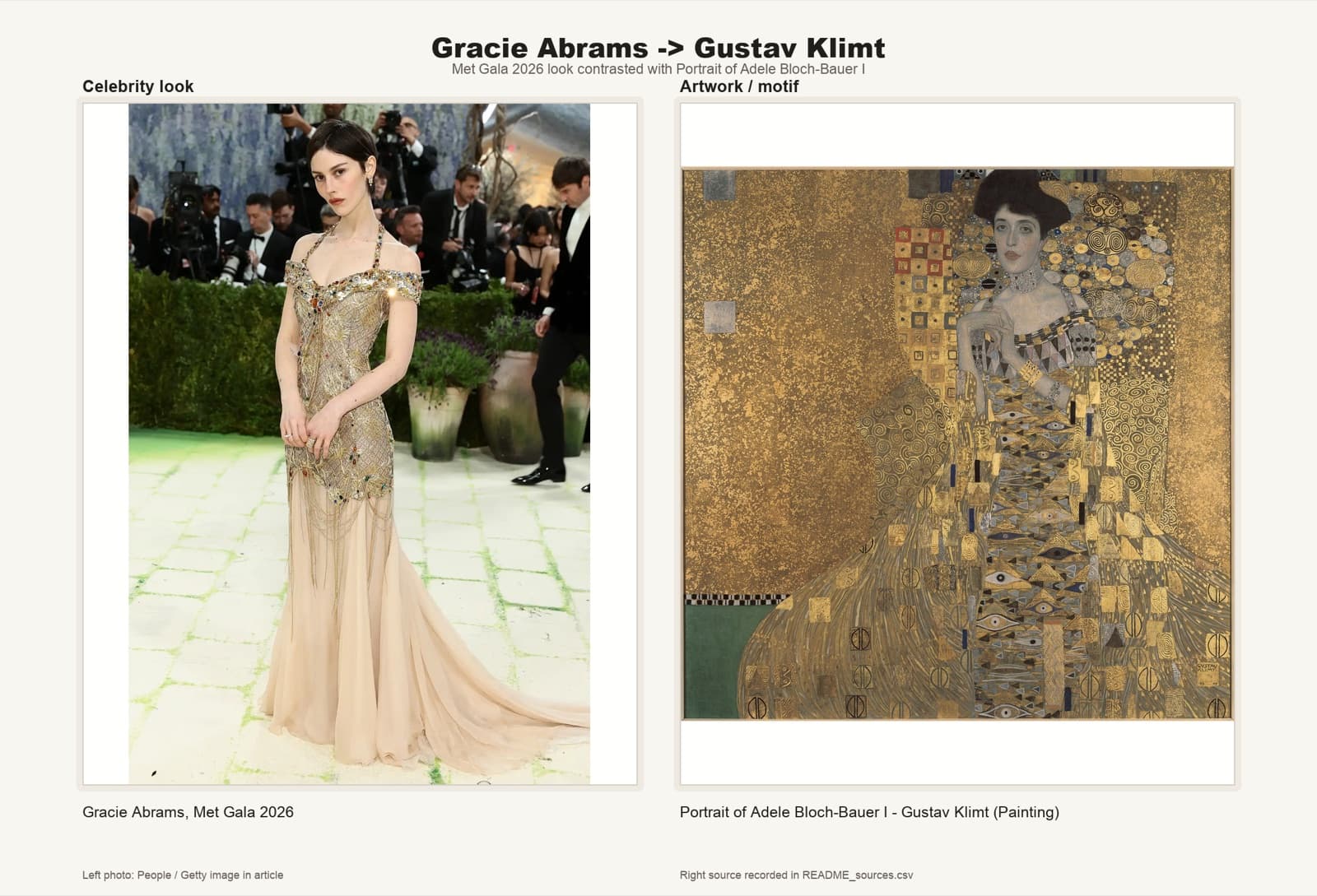
The 2026 Met Gala (Monday May 4) opened the Costume Institute's spring exhibition Costume Art and inaugurated the Met's new Condé M. Nast Galleries; the dress code that went out to attendees was "Fashion is Art."
- Read "Costume Art" as the exhibition title and "Fashion is Art" as the dress code — they aren't the same thing
- Mark May 10, 2026 to January 10, 2027 if you want to see the show in person; tickets release through metmuseum.org
- Expect ~400 garments paired against ~400 paintings, sculptures and objects from the Met's other departments
- Treat the new Condé M. Nast Galleries (~12,000 sq ft) as the headline — it's the Costume Institute's first dedicated permanent space at this scale
- Don't confuse this year with 2024 (Sleeping Beauties: Reawakening Fashion) or 2023 (Karl Lagerfeld: A Line of Beauty) — Costume Art is broader and not designer-monographic
- Don't read the dress code as "come as the painting" — most attendees did, but the brief was looser
- Don't assume the gala chairs equal the show's editorial framing — Anna Wintour chaired, Andrew Bolton curated, those are two different jobs
The exhibition: Costume Art
Costume Art is the Spring 2026 exhibition of the Met's Costume Institute, curated by Andrew Bolton (Curator-in-Charge). It runs May 10, 2026 through January 10, 2027 — eight months, longer than the typical Costume Institute show. The press release describes the premise as juxtaposing roughly 400 garments with roughly 400 works of art drawn from the Met's other curatorial departments: European Paintings, Greek and Roman Art, Modern and Contemporary, the Cloisters. The show argues a single thesis: that fashion and fine art share a vocabulary the Met has historically displayed in separate buildings, and the wall between them was a curatorial habit, not an art-historical fact.
The exhibition inaugurates the Met's nearly 12,000-square-foot Condé M. Nast Galleries, named for the publisher's late founder in recognition of a lead gift. This is the Costume Institute's first dedicated permanent gallery space at this scale — the department had been working out of below-ground rotation rooms since 1971. The new space sits in the Met's Lila Acheson Wallace Wing on the museum's north side.
The dress code: "Fashion is Art"
The Costume Institute publishes one dress code per gala year on the engraved invitation that goes out to attendees in late winter. For 2026 the code was "Fashion is Art" — three words that match Bolton's curatorial thesis without prescribing a specific era, designer, or movement. Compared to 2024's "The Garden of Time" (which gave attendees a J. G. Ballard short story to interpret) or 2022's "Gilded Glamour" (which mapped to a single American historical moment), 2026's code is unusually open.
Most attendees read it as instructions to come dressed as a specific artwork — and a remarkable number arrived as the same handful of paintings. Sargent's Portrait of Madame X (1884) showed up on four guests independently. Two Klimts walked the carpet (Adele Bloch-Bauer I and Mada Primavesi). Two Van Goghs appeared (Irises and The Starry Night). The full list of 27 sourced pairings, with each one traced back to its museum, is in our pillar piece.
A pivotal moment for the department, one that acknowledges the critical role that fashion plays not only within art history but also within contemporary culture.— Andrew Bolton, Curator-in-Charge, The Costume Institute
How this differs from recent Costume Institute years
2026 is broader than the four immediately prior shows. 2024 (Sleeping Beauties: Reawakening Fashion) was about technique — fragile garments rehoused with multimedia conservation tools. 2023 (Karl Lagerfeld: A Line of Beauty) was a single-designer monograph. 2022 (In America: An Anthology of Fashion) closed out the two-part Anna Wintour-led American fashion sequence. 2021 (In America: A Lexicon of Fashion) opened it. Costume Art steps away from both monograph and national-survey formats and back toward the cross-departmental framing the Costume Institute used in its earliest years (1946–60) under Polaire Weissman.
It's also the first Met Gala held in the Costume Institute's own permanent galleries rather than borrowed Met space. The previous Met Gala layouts threaded through the Anna Wintour Costume Center on the lower floor; this year's reception spaces sit at ground level, opening directly into the new exhibition halls.
The numbers, in one place
Date: Monday, May 4, 2026. Exhibition open to the public: Sunday, May 10, 2026 through Sunday, January 10, 2027. Curator: Andrew Bolton, Curator-in-Charge of the Anna Wintour Costume Center. Gala chairs: Anna Wintour leads as always. Galleries: Condé M. Nast Galleries, ~12,000 sq ft. Objects on view: ~400 garments + ~400 works of art and design objects. Met departments contributing loans: European Paintings, Greek and Roman Art, Modern and Contemporary, the Cloisters. Average ticket donation for the gala (per recent reporting): $75,000 individual, around $350,000 for a table of ten — these go directly to the Costume Institute's annual operating budget, which the gala has funded since the gala itself was launched by Eleanor Lambert in 1948.
Frequently asked questions
The exhibition title is Costume Art and the dress code (printed on the invitation) is "Fashion is Art." Both are curated by Andrew Bolton, Curator-in-Charge of the Met's Costume Institute. The exhibition opens to the public on May 10, 2026 and runs through January 10, 2027 in the new Condé M. Nast Galleries.
The Met intentionally left it open to interpretation, but most 2026 attendees read it as instructions to dress as a specific artwork — a painting, sculpture, or known motif from the canon. Four attendees independently came as Sargent's Portrait of Madame X; two came as different Klimts; two came as different Van Goghs. We've sourced 27 of the most legible references back to the museum that holds the original on our pillar piece.
Sunday, May 10, 2026. It runs through Sunday, January 10, 2027. Tickets are released in waves through metmuseum.org; the exhibition is included with general Met admission, and the Anna Wintour Costume Center has historically released audio tours and digital companions through the Met's website.
Inside the Met's Lila Acheson Wallace Wing, on the museum's north side, ground level. The galleries occupy nearly 12,000 square feet — the Costume Institute's first dedicated permanent space at this scale, named for the publishing founder in recognition of a lead gift to the Met.
Curator-in-Charge of the Met's Anna Wintour Costume Center since 2015. Bolton has curated every major Costume Institute exhibition for the last decade, including Heavenly Bodies (2018), Camp: Notes on Fashion (2019), and Sleeping Beauties (2024). He is married to the designer Thom Browne; the couple split their time between New York and a converted Brutalist house in Connecticut.
The gala is the Costume Institute's primary annual fundraiser — proceeds fund the department's full operating budget for the year, including conservation, acquisitions, and exhibition production. This is unusual among the Met's curatorial departments, which generally receive funding through the museum's general endowment. The structure was set up by fashion publicist Eleanor Lambert in 1948 and has run continuously since.
Sources
- The Metropolitan Museum of Art — press release, Spring 2026 Costume Institute exhibition — accessed 2026-05-06
- The Metropolitan Museum of Art — Costume Art exhibition page — accessed 2026-05-06
- CBS New York — What is the 2026 Met Gala theme? 'Costume Art' explained — accessed 2026-05-06
- NPR — At the 2026 Met Gala, 'Fashion is Art.' Here's what to expect (May 4, 2026) — accessed 2026-05-06
- People — Met Gala 2026 arrivals: every celebrity red carpet photo — accessed 2026-05-05
- Wikipedia — Met Gala (background reference; verified against Met press) — accessed 2026-05-06