27 Looks, 27 Artworks: The Met Gala 2026 Side-by-Side
The 2026 Met Gala dress code was "Fashion is Art." We sourced 27 of the most legible references back to the museum that holds them — and put them next to the look they sired.
27 looks; 27 specific paintings, sculptures and motifs; one museum behind each. The reference wasn't a vibe — it was a wall label.
Do
Skim the eight clusters first (Sargent, Klimt, sculpture, painters of light, surrealist, body-as-canvas, portraits) — each is its own logic
Hover the museum line under each pairing if you want to see the source in person — most of these are public collection
Read the Madame X cluster as one — four celebrities all chose the same 1884 painting
Click through to the four companion pieces if a single thread (Madame X, Klimt, theme history, wearable translation) catches you
Don’t
Don't read it as a worst-dressed list — the brief was costume, not couture
Don't assume "inspired by" — Andrew Bolton's exhibition asked attendees to copy specific objects, and most did
Don't skip the smaller references (Durieux, Pruitt, Waring) for the famous ones — they're the curatorial point
The 2026 Met Gala (Monday, May 4) opened Andrew Bolton's spring exhibition Costume Art and inaugurated the Met's nearly 12,000-square-foot Condé M. Nast Galleries. The show puts roughly 400 garments next to roughly 400 paintings, drawings and objects from the Met's other departments — Greek and Roman, European Paintings, Modern and Contemporary, the Cloisters — and asks one question: where does the dress end and the artwork begin? The dress code that travelled out to celebrities was "Fashion is Art," which most of them read literally. They came as paintings.
Below are 27 pairings we were able to trace back to the specific reference. Each entry names the look, the artwork, the museum that holds the original (when public), and the smallest visible thing that connects them — a strap, a palette, a posture, an outline. Where the same reference shows up more than once (Sargent's Madame X four times, Klimt twice, two different Van Goghs), we've grouped them. Where the reference is more obscure than the celebrity (Caroline Wogan Durieux, Robert Pruitt, Laura Wheeler Waring, Rachel Ruysch), we've kept the museum line short and let the painter's name carry the weight.
The references below were sourced from People's red-carpet roundup of the gala plus public collection pages at the Met, the Louvre, MoMA, the Getty, the National Gallery in London, the Art Institute of Chicago, the National Portrait Gallery, the National Gallery of Art (D.C.) and the Neue Galerie New York. Where a Wikimedia file is the cleanest available scan, we've cited that.
The Sargent Sisterhood
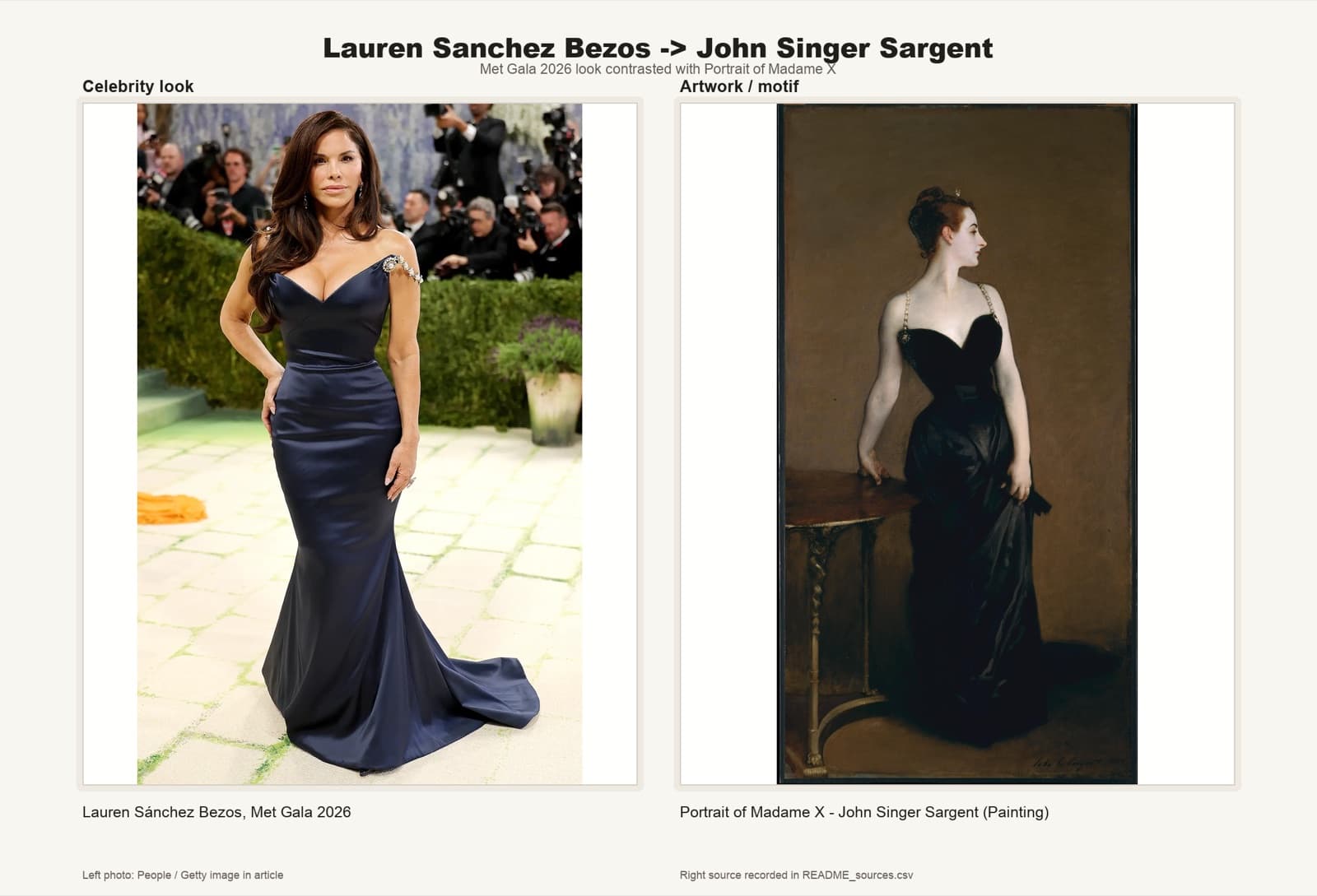
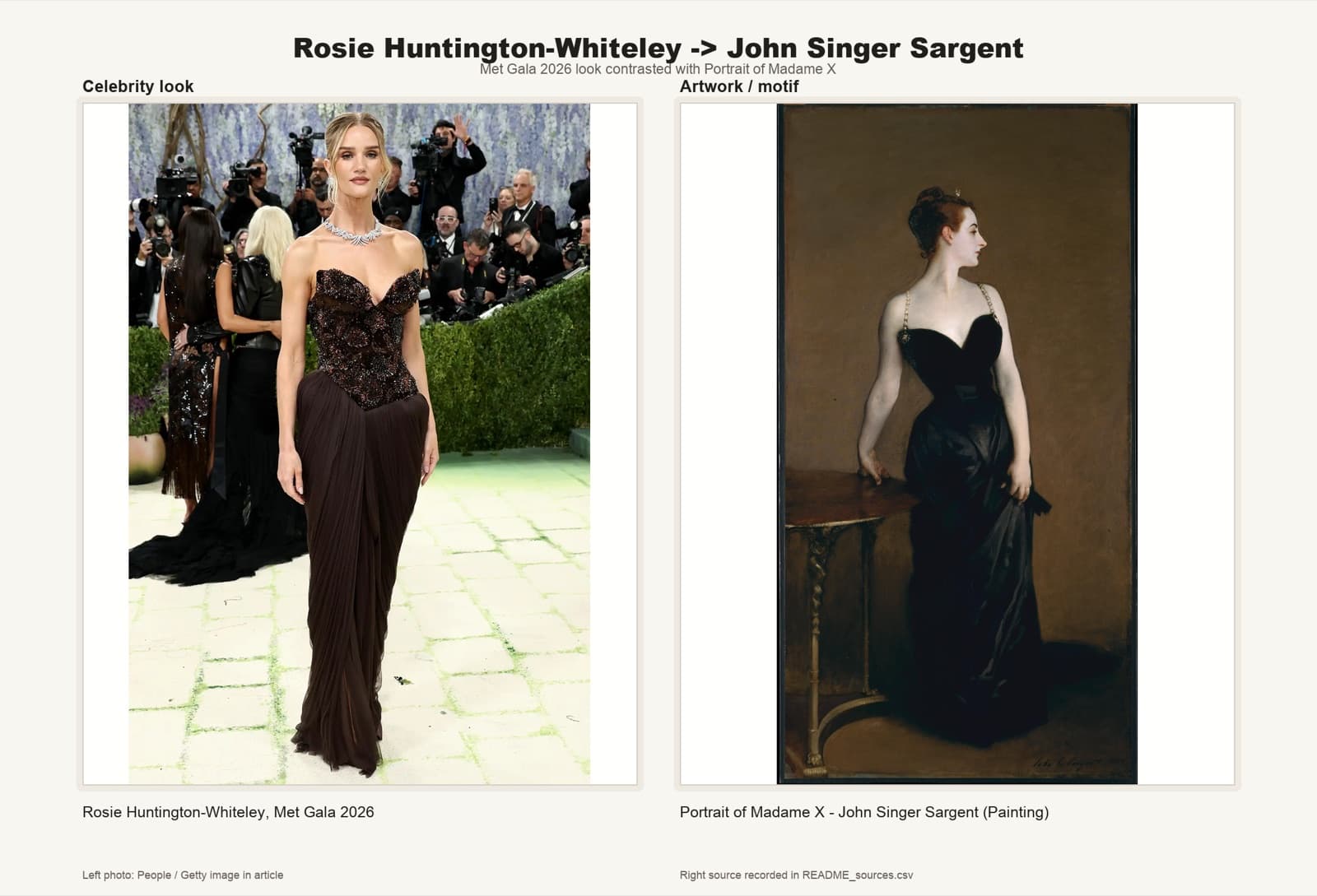
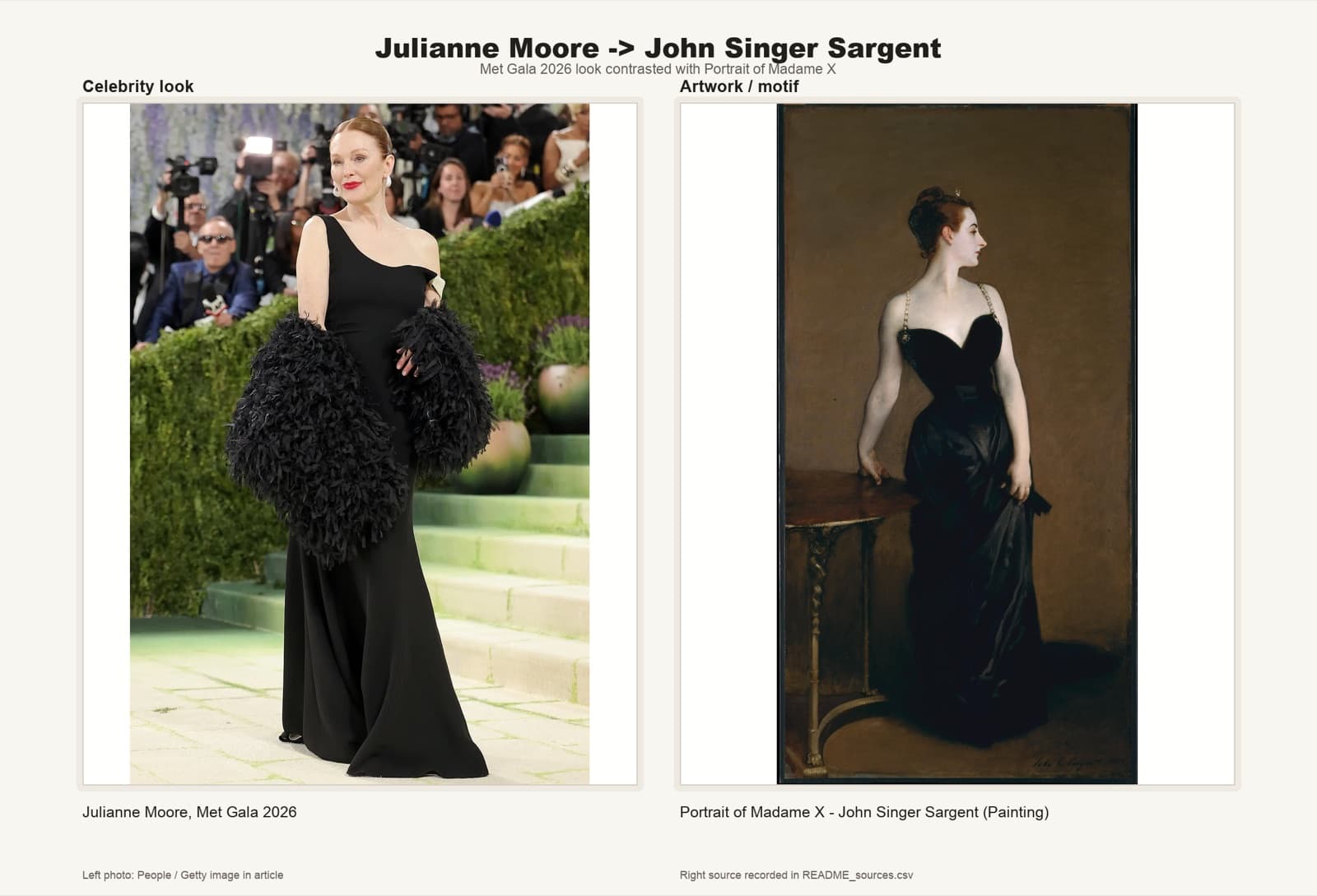
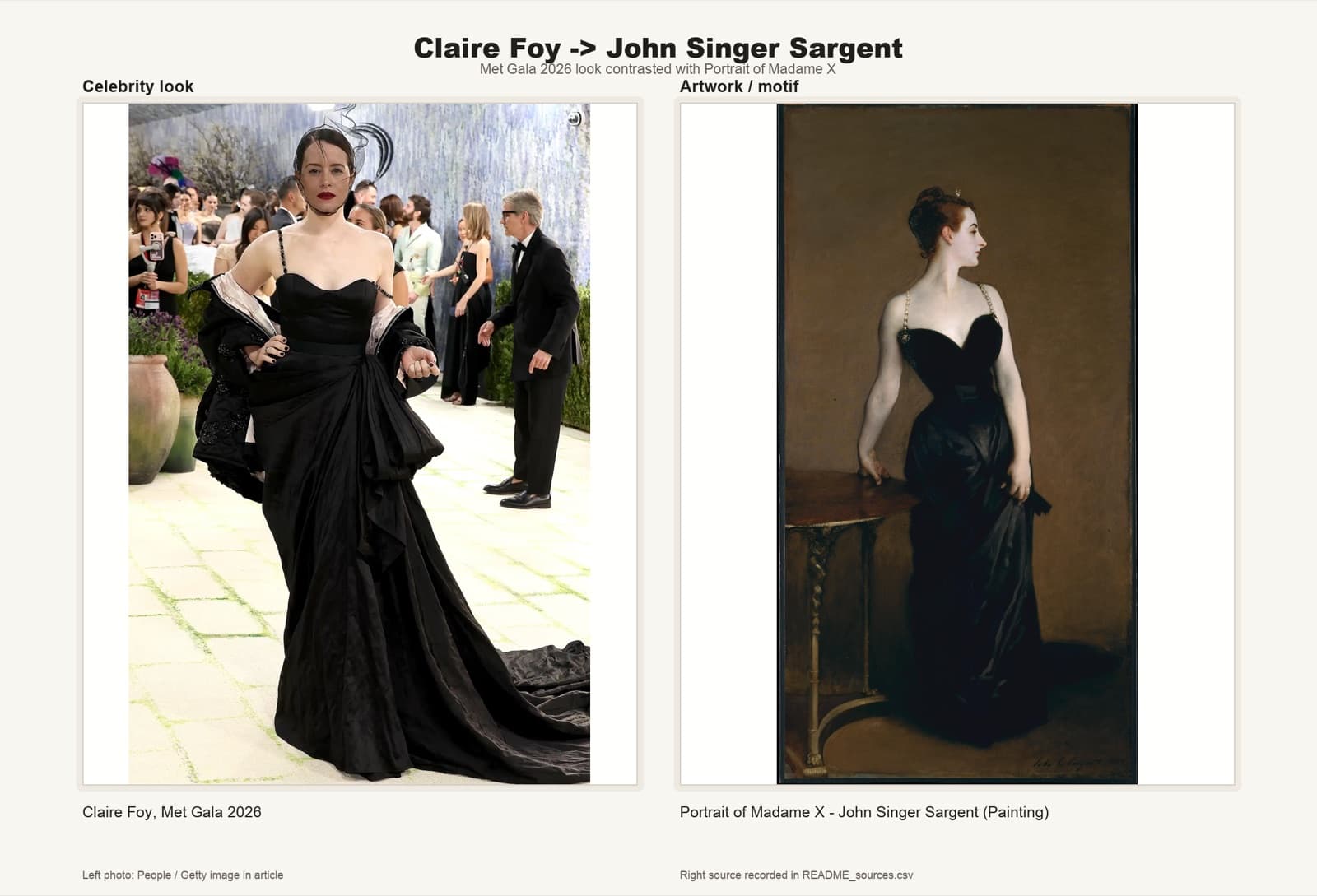
Four women came as Madame X. The painting is John Singer Sargent's Portrait of Madame X (1883–84), now in the Met's European Paintings collection — a black satin sheath, a single jeweled strap, and a face turned away from the viewer. When Sargent first showed it at the 1884 Paris Salon the right strap was painted falling off the shoulder; the scandal effectively ran him out of Paris and to London, where he repainted the strap upright. Three of the four interpretations below put the strap back where Sargent first painted it.
03
Lauren Sánchez Bezos · John Singer Sargent, Portrait of Madame X (1883–84)
The Metropolitan Museum of Art
The look. A black satin column, low square neckline, single jeweled strap on the right shoulder painted in the original fallen position — the closest of the four reads to Sargent's first 1884 hang.
The match. The right-shoulder strap sits in Sargent's original (scandalised) position, not the corrected upright version that hangs in the Met today. The skin is powdered to the same lavender-pearl Sargent used on Madame Gautreau.
The art. Madame X is Virginie Amélie Avegno Gautreau, a New Orleans–born Paris socialite. Sargent painted her without commission across two sittings; the Salon-version strap was repainted vertical only after the Paris press destroyed both sitter and painter.
15
Rosie Huntington-Whiteley · John Singer Sargent, Portrait of Madame X (1883–84)
The Metropolitan Museum of Art
The look. Black silk-velvet column, hand-on-tabletop posture borrowed straight from the painting; a deeper neckline than Sánchez's, no visible strap.
The match. Stance over costume — Huntington-Whiteley copies Madame Gautreau's awkward right-arm-on-table angle, the detail Sargent's contemporaries called affected. The fabric reads silk velvet rather than the painting's satin, but the silhouette is unmistakable.
The art. Sargent painted at least 30 preparatory studies before the final canvas; in the studies, the strap migrates between three different positions before settling on the falling one he showed at the Salon.
19
Julianne Moore · John Singer Sargent, Portrait of Madame X (1883–84)
The Metropolitan Museum of Art
The look. Charcoal-black satin with a draped dropped shoulder; less literal than the other three Madame X reads — the colour and surface sheen do the citation work.
The match. The painting's surface — Sargent's wet-on-wet satin handling, where the dress reads as solid black mass with a single highlight — is what Moore's gown reproduces, not the strap or the pose.
The art. When Sargent's painting reached the Met in 1916, the museum specifically asked him not to identify the sitter; Madame Gautreau's family was still alive, and the Salon scandal had never been allowed to die quietly.
21
Claire Foy · John Singer Sargent, Portrait of Madame X (1883–84)
The Metropolitan Museum of Art
The look. Crisp black satin, two thin jeweled straps (corrected — both up), a tighter waist than Madame Gautreau's silhouette but the same neckline geometry.
The match. Foy's interpretation is the only one that mirrors the corrected painting hanging at the Met today rather than the 1884 Salon version. Both straps upright, no scandal.
The art. Sargent kept the canvas in his London studio for 32 years before selling it to the Met. He wrote in 1916 that he supposed it was "the best thing I have done" — the closest he ever came to defending the picture publicly.
Klimt Gold
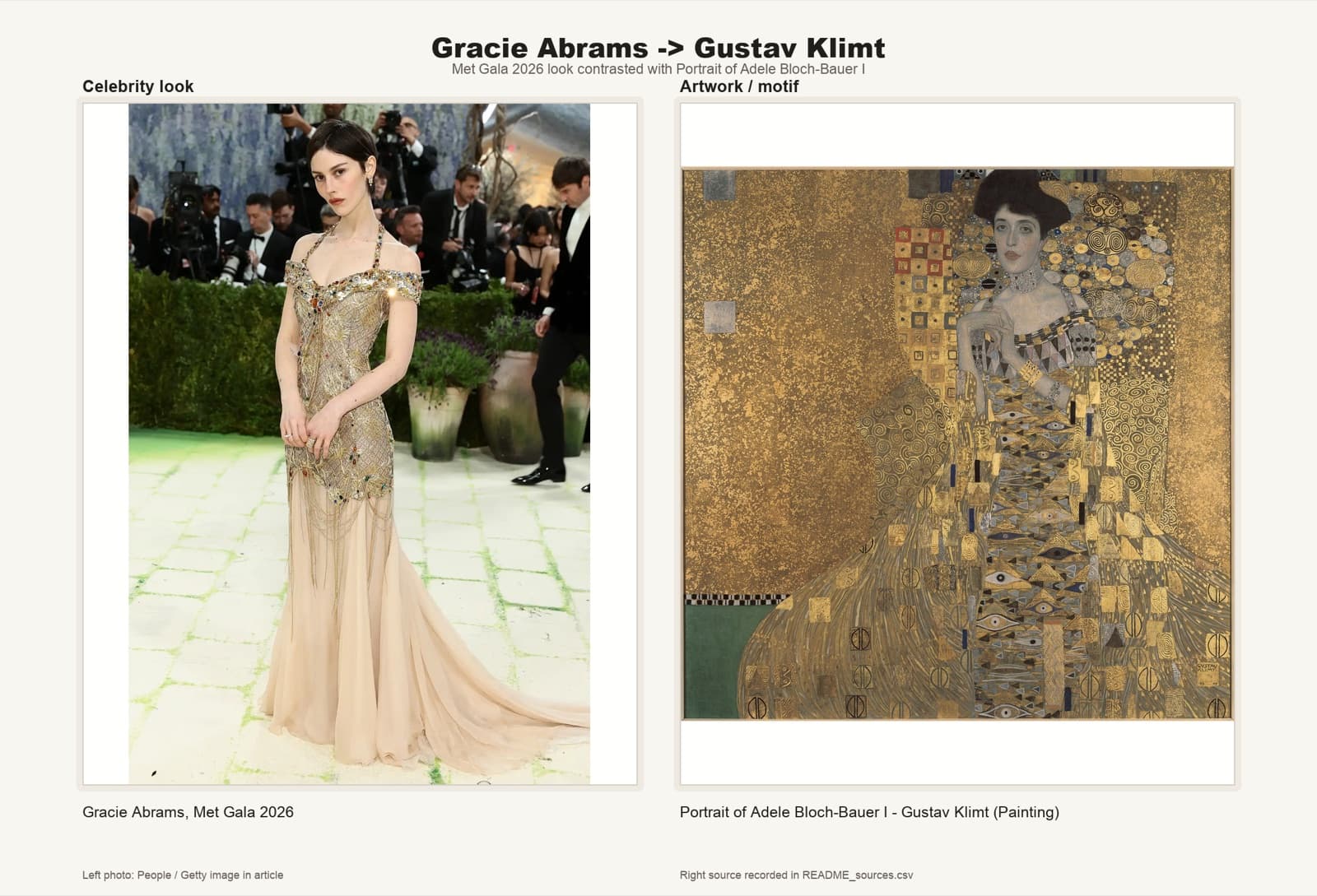
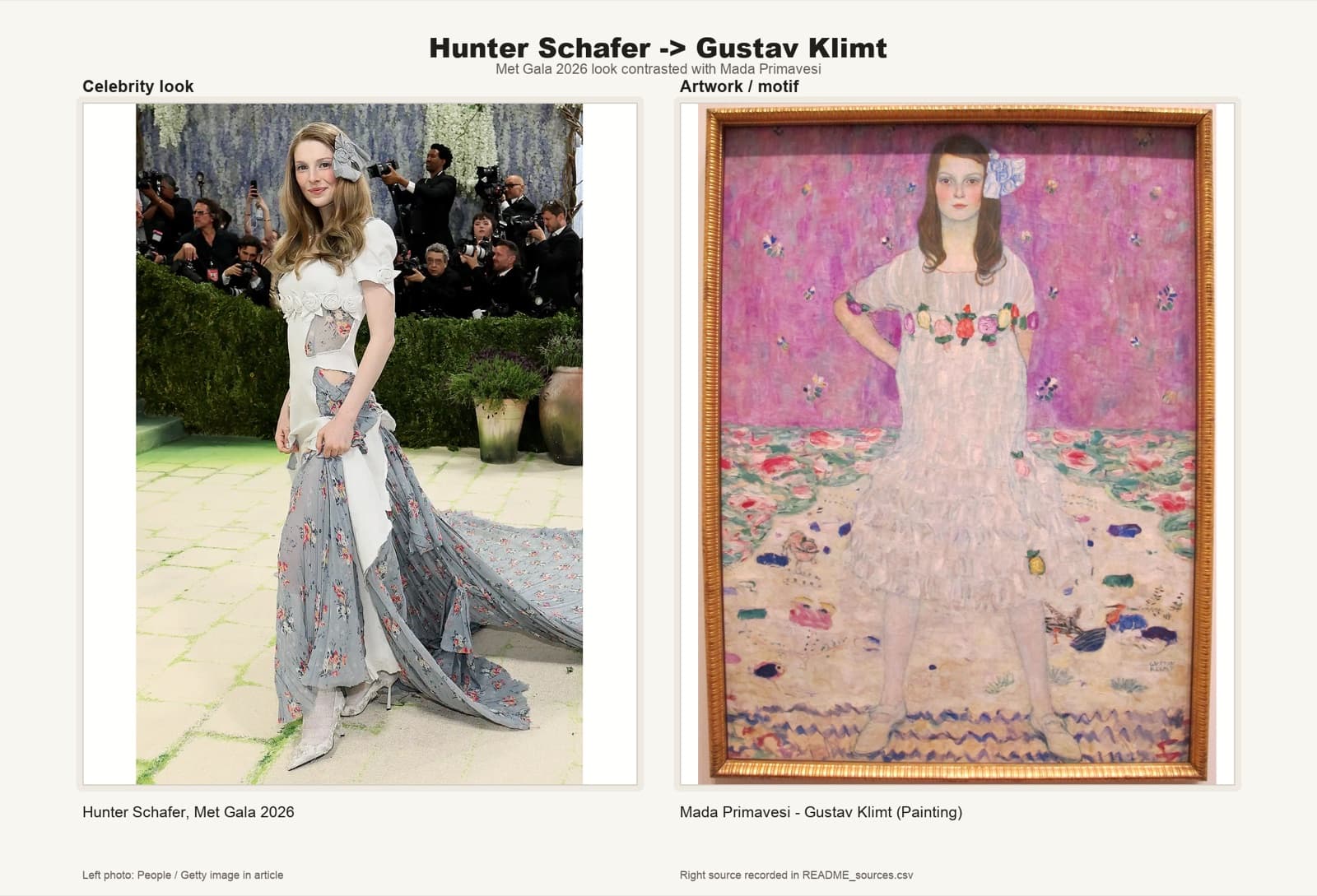
Two Klimts on the carpet. Gracie Abrams came as the most contested painting in restitution history; Hunter Schafer came as the painting's child-portrait counterpoint. Both date from Vienna's Secession years (1907 and 1912). The full Klimt branch piece linked at the bottom unpacks the Maria Altmann story.
09
Gracie Abrams · Gustav Klimt, Portrait of Adele Bloch-Bauer I (1907)
Neue Galerie New York
The look. Gold lamé sheath flat across the front, geometric Byzantine paneling at the bodice, head-to-shoulder gold leaf-tone halo of fabric — close to a textile reproduction of the painting.
The match. The Byzantine eye-and-square motif from Klimt's bodice reappears at Abrams' waist; the gold-on-gold layering with no contrast colour copies the painting's flatness — Klimt deliberately denied perspective in this portrait.
The art. The painting was looted by the Nazis from the Bloch-Bauer Vienna home in 1938. After a seven-year US Supreme Court case (Republic of Austria v. Altmann), it was returned to Maria Altmann in 2006 and sold to Ronald Lauder for the Neue Galerie for $135 million.
20
Hunter Schafer · Gustav Klimt, Mada Primavesi (1912–13)
The Metropolitan Museum of Art
The look. White cotton bodice with hand-painted floral panels, tiered skirt with the same loose blocky brushwork Klimt used for fabric in the 1912 child portrait — closer to a wearable copy than a costume.
The match. Schafer is the rare attendee who picked the painting's silhouette (loose-bodied tent dress, planted feet, head tilted) over its colour. The pose carries the citation as much as the textile.
The art. Mada Primavesi was nine when Klimt painted her. The Met acquired the portrait in 1964 from her later in life; Klimt produced at least 200 preparatory drawings of Mada in different poses before settling on the standing one.
Sculpture Made Soft
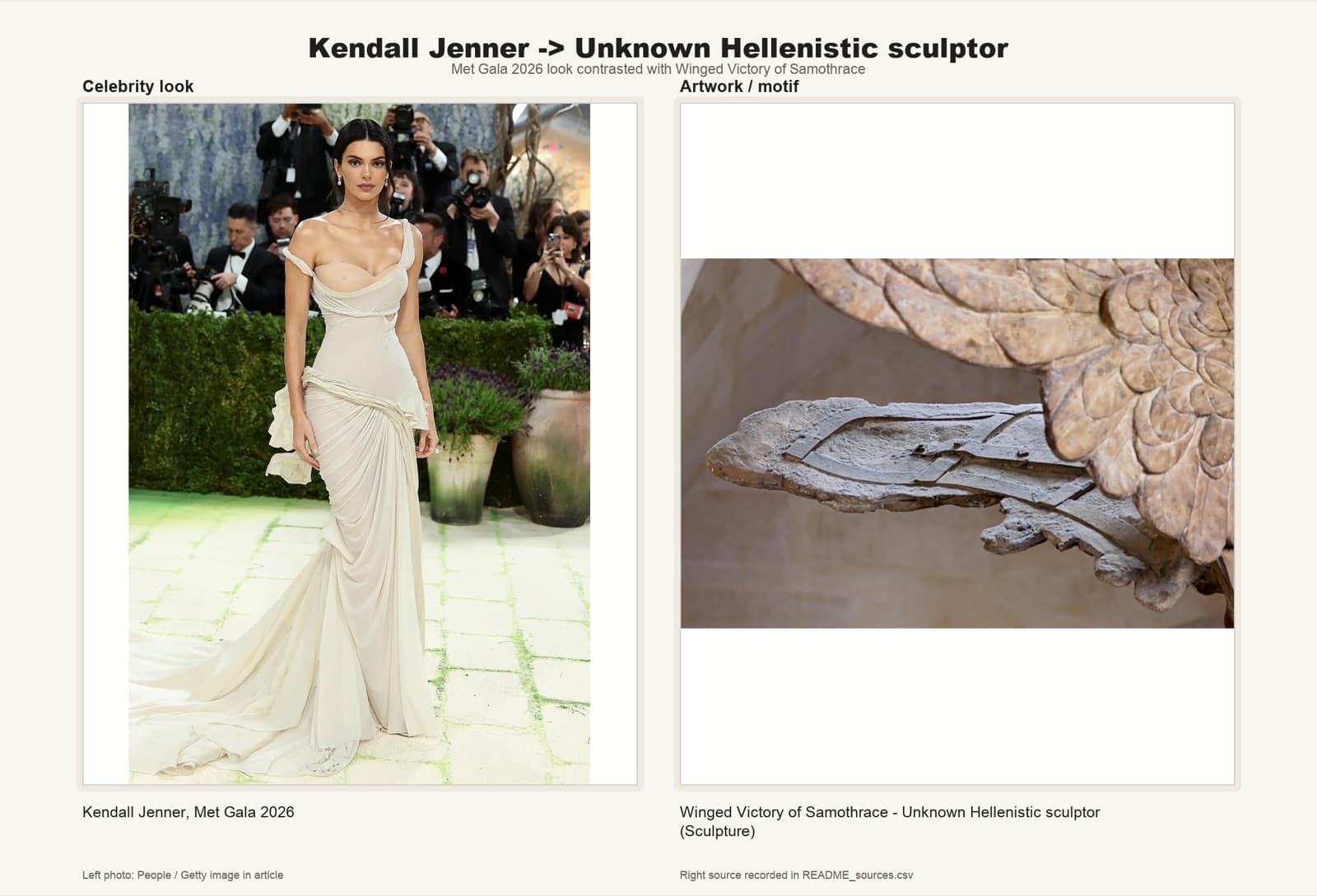
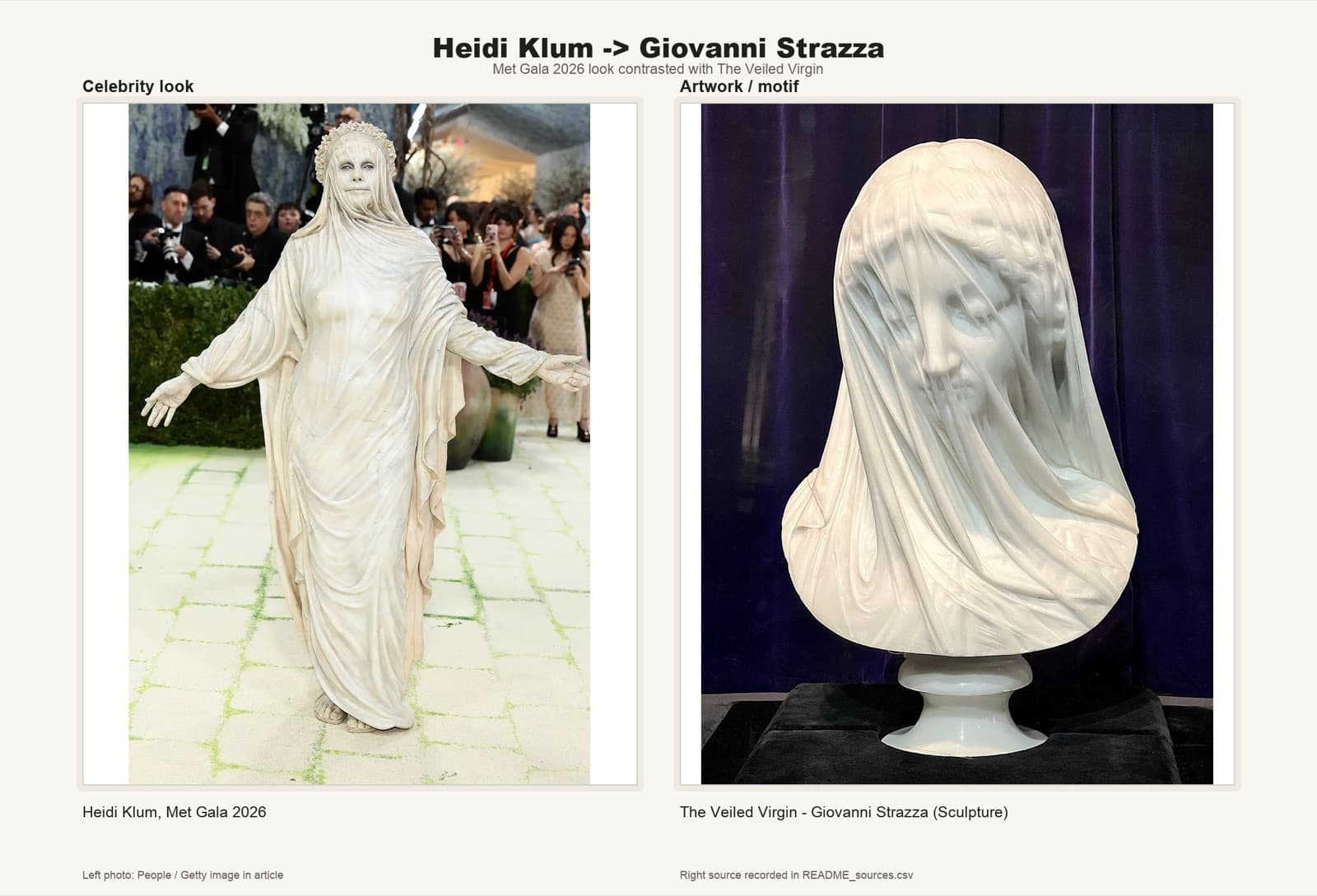
Three statues turned into garments — one Hellenistic marble (Louvre), one veiled Italian Carrara (Newfoundland), one contemporary Japanese mirror-sphered taxidermy (Kohei Nawa). The trick in all three is wearing the negative space the sculpture implies.
The look. Pleated cream silk with a wing-shaped train falling from the shoulder blades; bodice carved tight to the ribs to mirror the sculpture's wet-drapery effect.
The match. The Louvre's Nike has no head and no arms; the dress acknowledges that by leaving the shoulders bare and reading entirely through pleats and forward motion. Wearing a headless statue means leaning into the implied wind.
The art. The Winged Victory was found in 118 fragments on Samothrace in 1863. The right wing in the Louvre installation today is plaster — the original was never recovered. The pose celebrates a naval victory; the wet-drapery technique is Rhodian.
11
Heidi Klum · Giovanni Strazza, The Veiled Virgin (c. 1850s)
Presentation Convent, St. John's, Newfoundland
The look. Floor-length translucent veil over a pale nude bodice; the veil is heavier than tulle and falls in single planes the way Strazza's marble does.
The match. Strazza's veil is solid marble carved so thin it appears wet — the gown copies that one-plane, no-folds drape rather than tulle's pliable fall. Klum's face stays unobstructed under the veil exactly as the marble's does.
The art. The bust arrived in Newfoundland in 1856, gifted to the Sisters of the Presentation. Strazza carved it in Rome from a single block of Carrara; the veil and the face are continuous stone, with no joins.
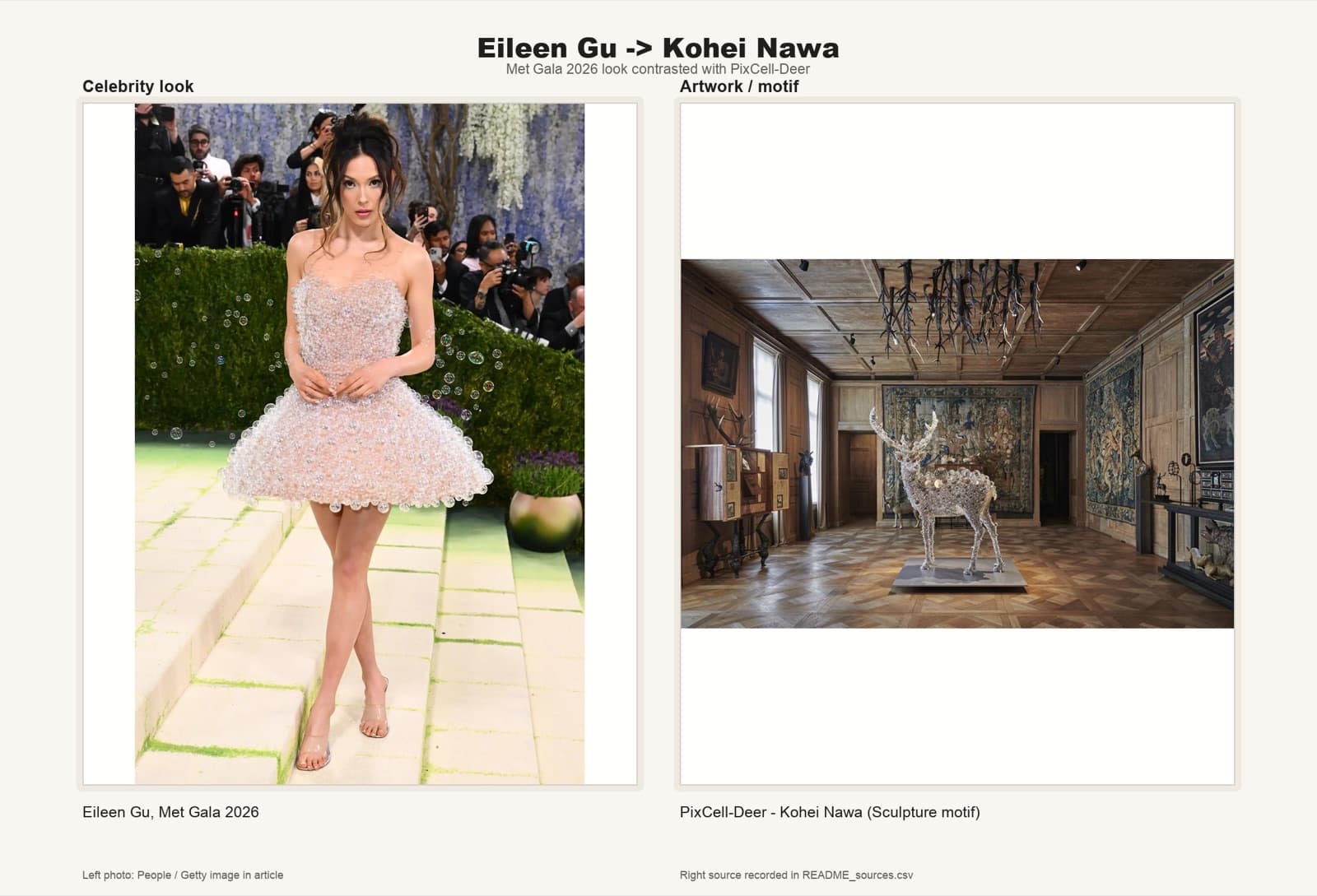
Sandwich Studio, Kyoto (series held in multiple collections incl. Mori Art Museum)
The look. Silver mirror-sphere appliqués clustered across a pale columnar gown — the bodice and skirt read as one continuous beaded surface from a few feet away.
The match. Nawa's PixCell sculptures coat existing forms (deer, plants, animals) in glass beads of varying size; Gu's gown copies the technique on a body. The point isn't the deer — it's the surface treatment.
The art. Nawa coined PixCell from "pixel" + "cell"; the work asks how a screen-mediated image differs from the body it photographed. The deer is bought taxidermy, then beaded — never killed for the work.
Painters of Light
Four post-Impressionist and Impressionist canvases turned into garments. Two Van Goghs (one violet, one cobalt), one Monet (water lilies), one Seurat (pointillist Sunday afternoon). The technique in each painting — the brushstroke or dot — became the textile.
13
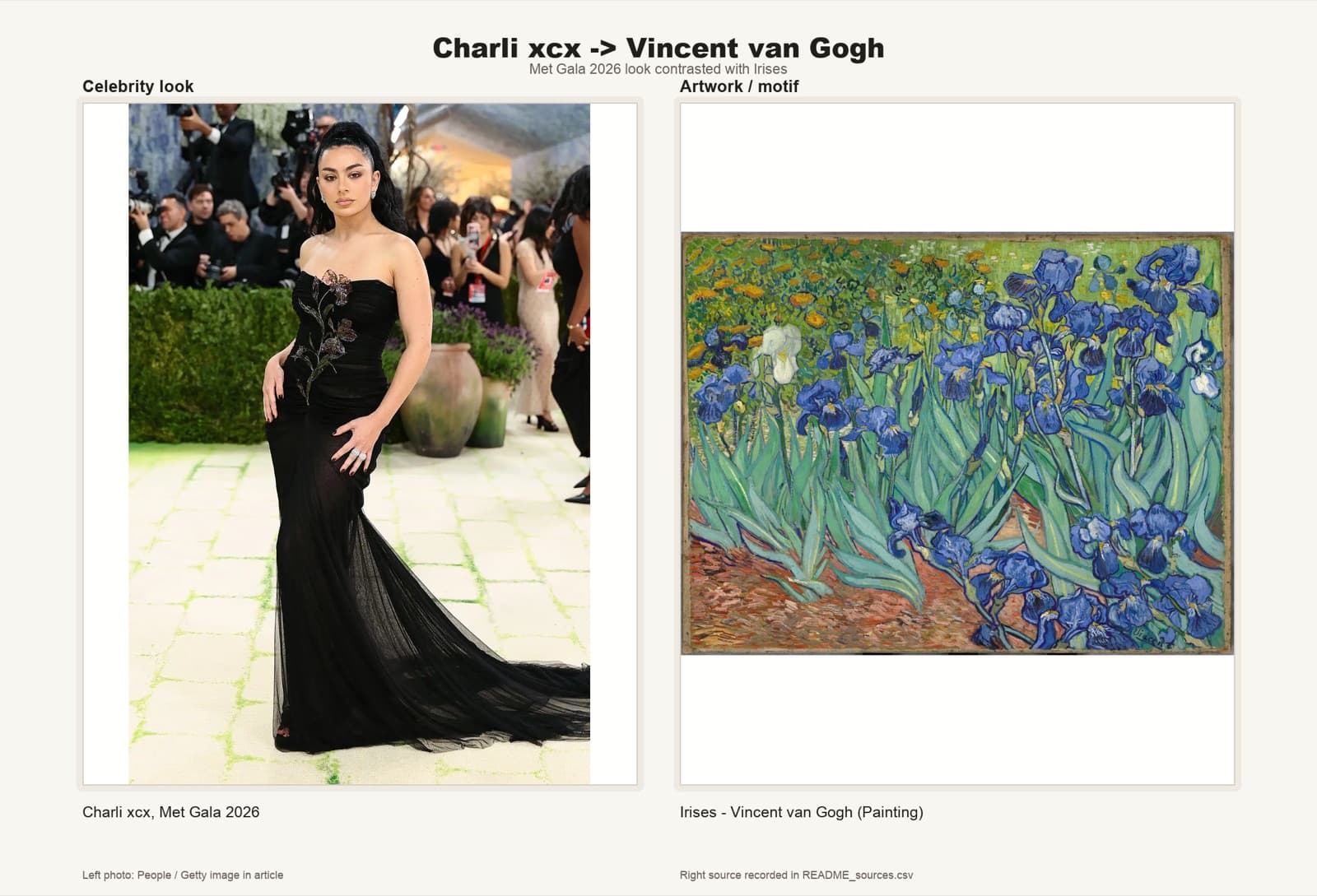
Charli xcx · Vincent van Gogh, Irises (1889)
J. Paul Getty Museum, Los Angeles
The look. Saturated violet-into-blue silk with curling iris-leaf appliqués that bend across the bodice the way Van Gogh's flowers bend on the canvas.
The match. Van Gogh painted Irises in the first week of his stay at Saint-Paul-de-Mausole asylum; the curl of the iris leaf is the painting's signature shape, and Charli's gown reproduces that curl in cut-fabric form.
The art. Sold at Sotheby's New York in 1987 for what was then the highest price ever paid for a painting ($53.9 million). Acquired by the Getty in 1990, where it has been on continuous display since.
26
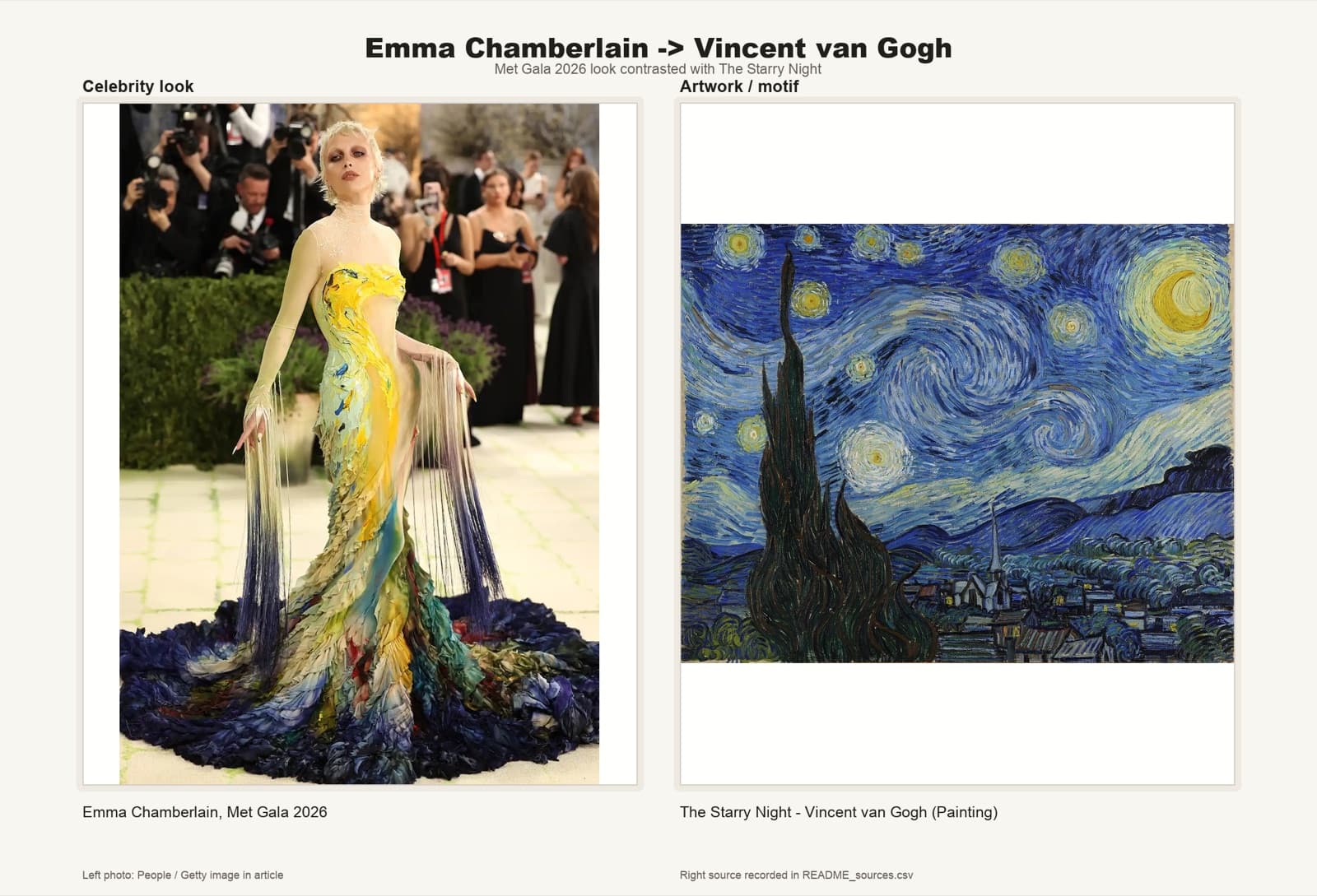
Emma Chamberlain · Vincent van Gogh, The Starry Night (1889)
Museum of Modern Art, New York
The look. Cobalt-and-cypress swirling beaded skirt over a pale bodice — the skirt's bead density echoes Van Gogh's directional impasto.
The match. Starry Night's brushwork rotates in long curls; the gown's skirt reproduces that rotational direction in beadwork rather than colour-matching the canvas literally. The cypress on the left of the painting maps to the gown's seam line.
The art. Van Gogh painted Starry Night from the east-facing window of his asylum room at Saint-Rémy in June 1889. The view is a real one — the village below is Saint-Rémy-de-Provence — but the swirling sky was added from imagination.
27
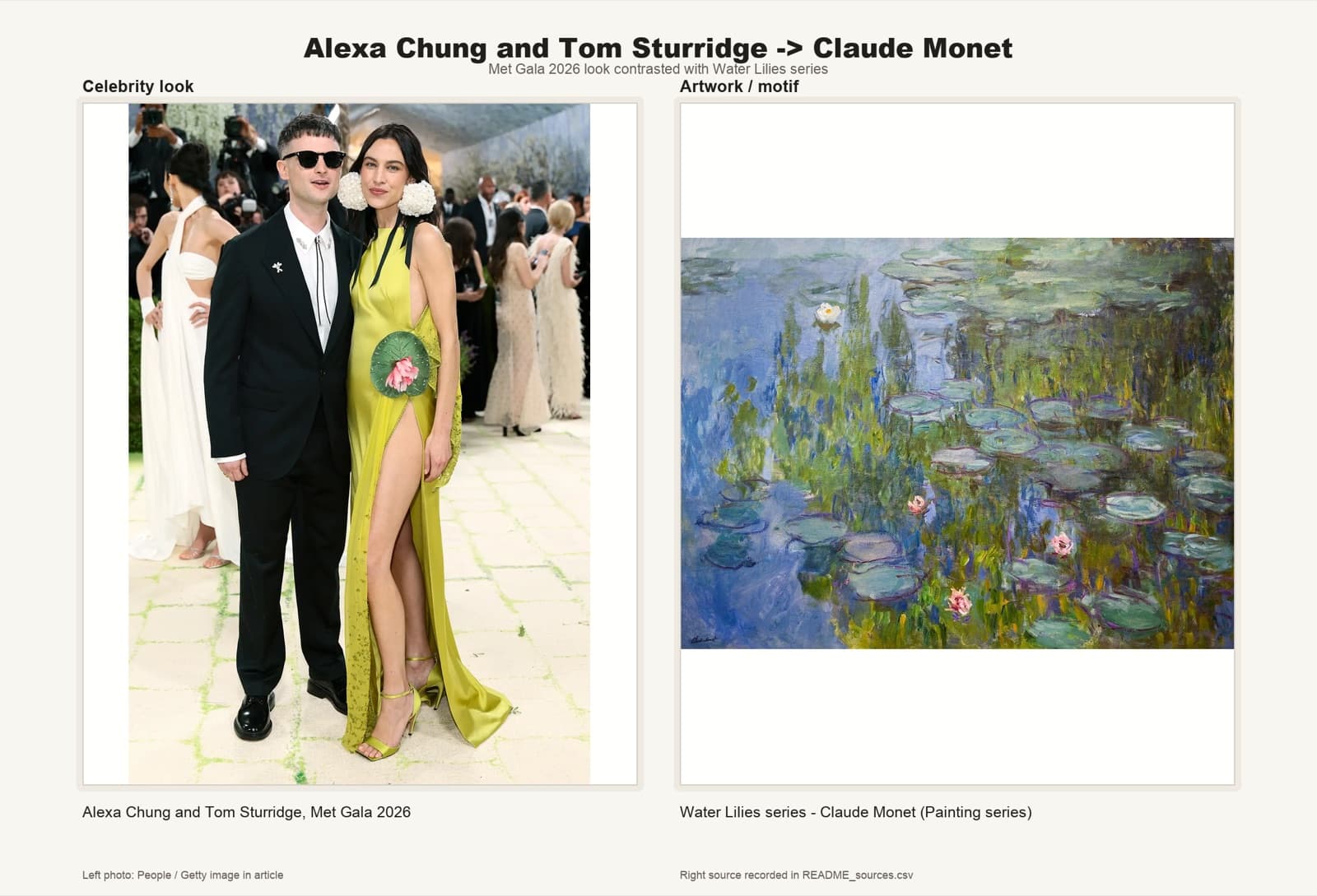
Alexa Chung and Tom Sturridge · Claude Monet, Water Lilies (Nymphéas) (1914–26 series)
Musée de l'Orangerie, Paris (large panels); MoMA holds individual panels
The look. Chung in pale aqua and dusty pink florals over silver tulle, Sturridge in muted indigo-green tailoring; the pair read as one canvas.
The match. Chung wears the painting's surface (florals, pinks, silvers); Sturridge wears the water (deep blue-green). Together they reproduce one of Monet's panel halves — a curatorial choice, not a couple's coincidence.
The art. Monet painted around 250 oil paintings of his Giverny pond between 1897 and his death in 1926, going almost blind from cataracts in the final decade; the Orangerie's eight panels were the gift he made to France after the First World War.
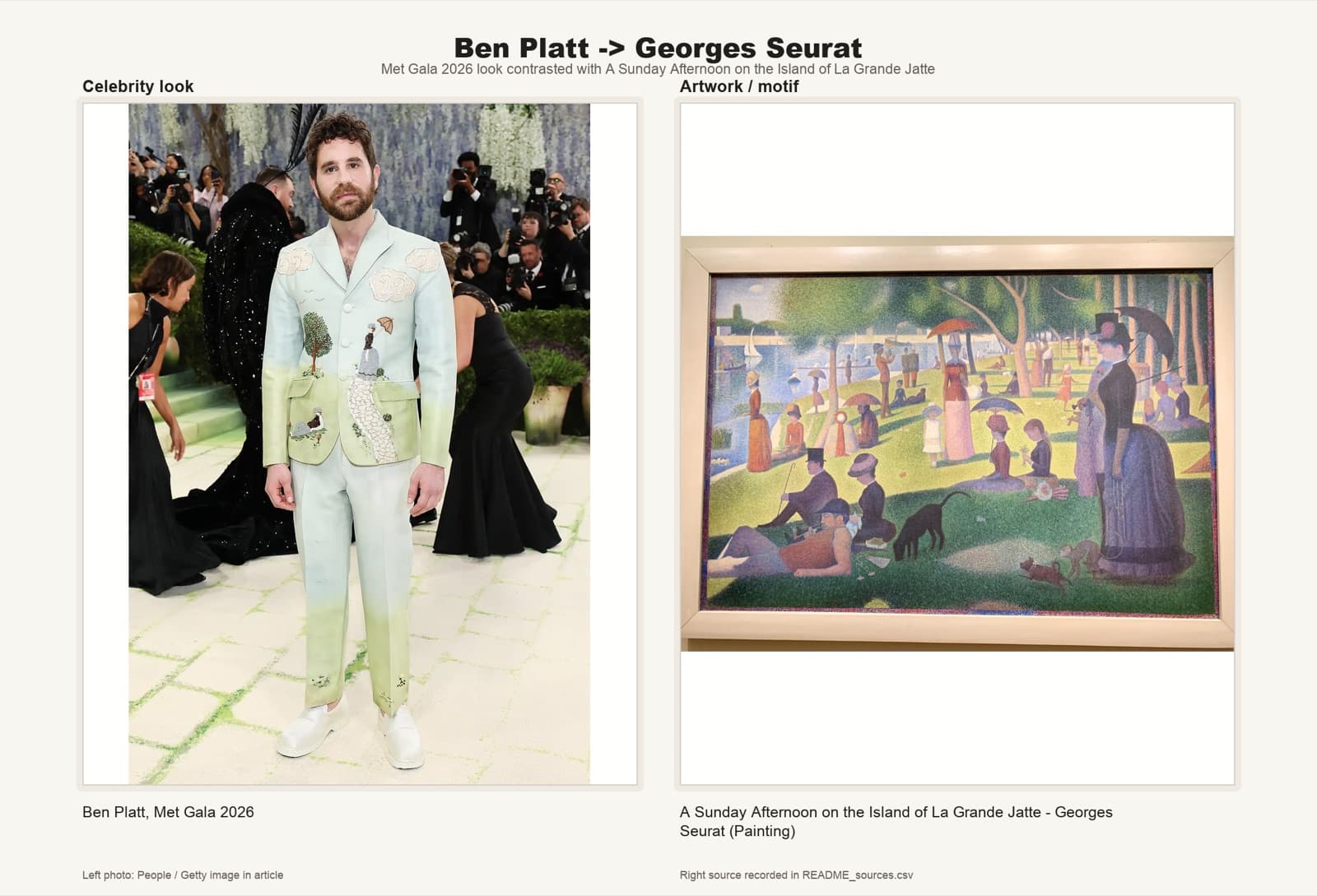
25
Ben Platt · Georges Seurat, A Sunday on La Grande Jatte (1884–86)
Art Institute of Chicago
The look. Cream linen suit with a faintly pointillist-printed waistcoat and a stiff straw boater hat — a Sunday-afternoon-on-the-Grande-Jatte gentleman, transposed to 2026.
The match. The boater carries the citation alone — every man in Seurat's foreground is wearing one. The waistcoat's printed dot pattern is the only place the canvas's pointillism reaches the textile.
The art. Seurat used roughly 3.5 million dots across the canvas, applied over two years. He died at 31, five years after finishing the painting. The Art Institute of Chicago acquired it in 1924 and has not lent it out since 1958.
Surrealist Subversion
Three Surrealist citations — one painfully literal (Bellmer's broken doll), one mythological (Carrington's Saint Anthony), one conceptual (Baldessari's flying saucer). Surrealism on a red carpet is hard; you have to look unsettled, not in costume.
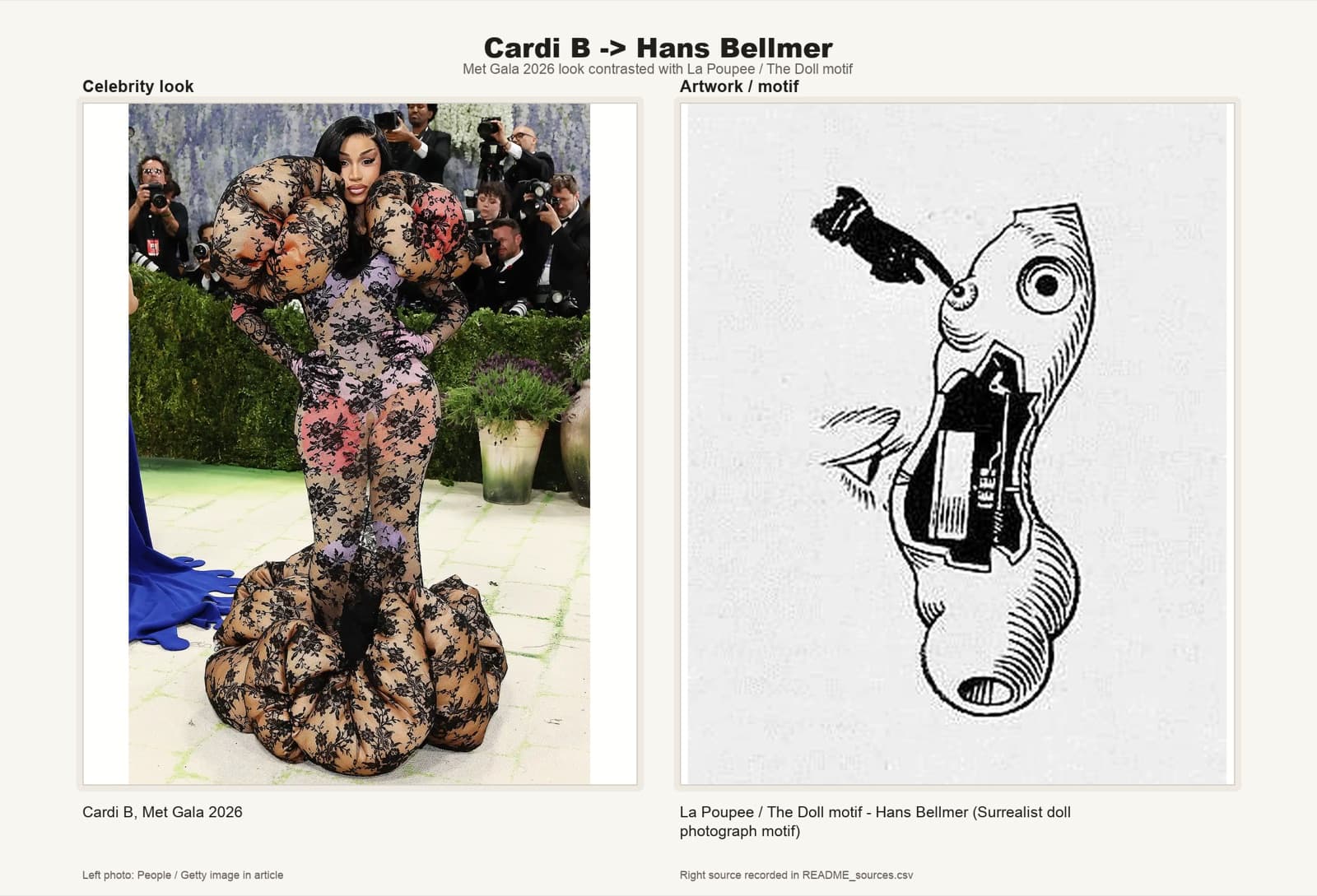
05
Cardi B · Hans Bellmer, La Poupée (The Doll) motif (1933 onward)
Tate, MoMA, Centre Pompidou (variants in major collections)
The look. Lacquered bone-white bodice articulated at the joints (shoulder, elbow, hip) like a porcelain doll — the seams are the dress's primary feature, not a defect.
The match. Bellmer made his doll out of disjoined plaster and ball-jointed wood; the dress's visible articulation is a citation of those joints. The white-lacquer surface copies Bellmer's photographic finish.
The art. Bellmer built the first Poupée in Berlin in 1933 as a private protest against the Nazi state's idealised body; the work was photographed and published in the Surrealist journal Minotaure in 1934. The doll has remained one of the more contested Surrealist objects in the canon.
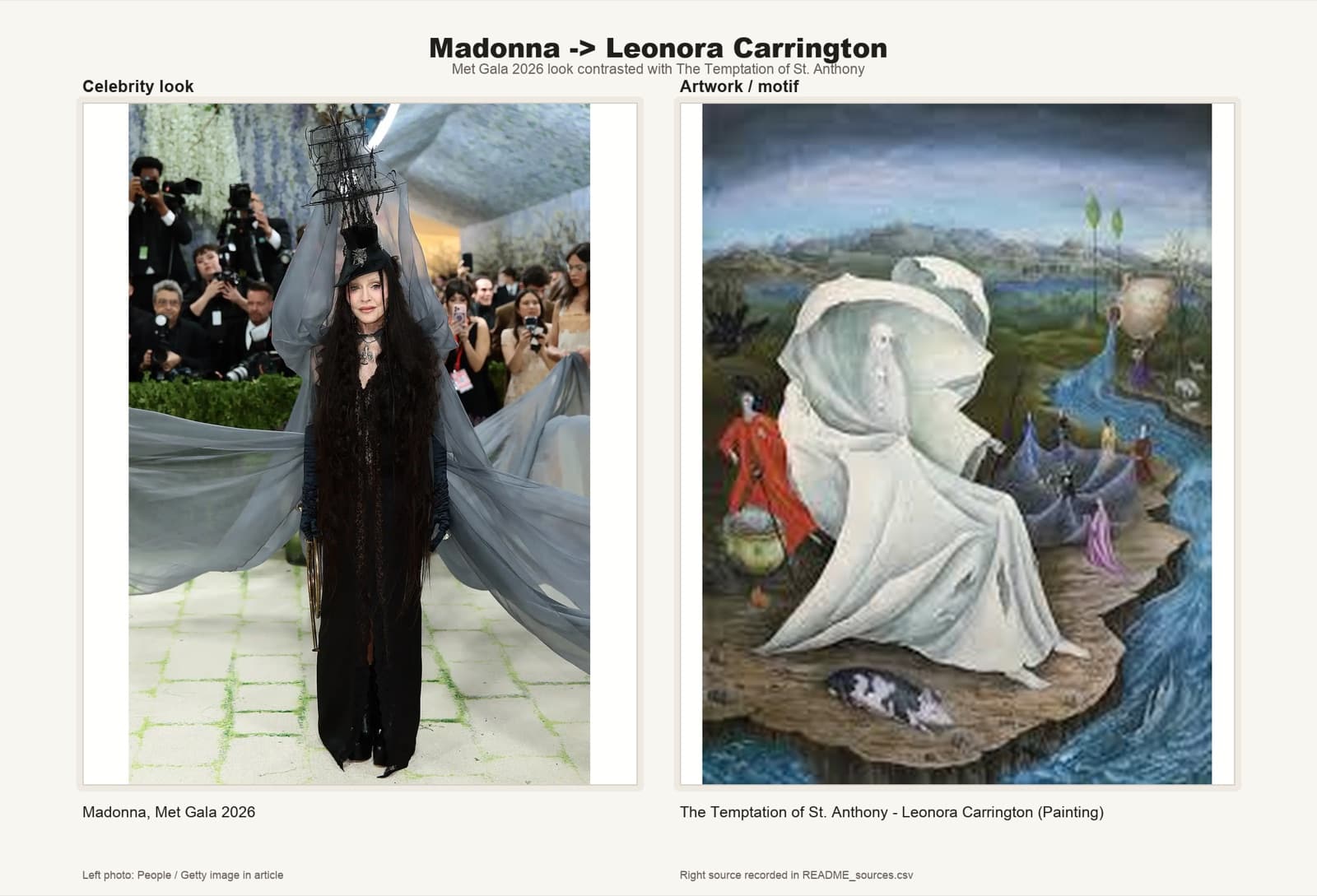
07
Madonna · Leonora Carrington, The Temptation of St. Anthony (1947)
Museo Nacional de Arte Moderno, Madrid (held privately for decades; Carrington's late-career mythology work)
The look. Robed black-and-bone tiered gown with a multi-tiered cone-shaped headdress; the whole silhouette reads as a moving column rather than a fitted dress.
The match. Carrington's Saint Anthony is a column of robed figures stacked into one body; Madonna's silhouette copies the verticality and the cone-stacking. The headdress is the citation, not an accessory.
The art. Carrington painted Temptation in Mexico City in 1947, the year after she settled there permanently. She kept her Surrealist commitments long after the European movement dispersed; her Saint Anthony is unique in showing the saint outnumbered by his temptations rather than resisting them.
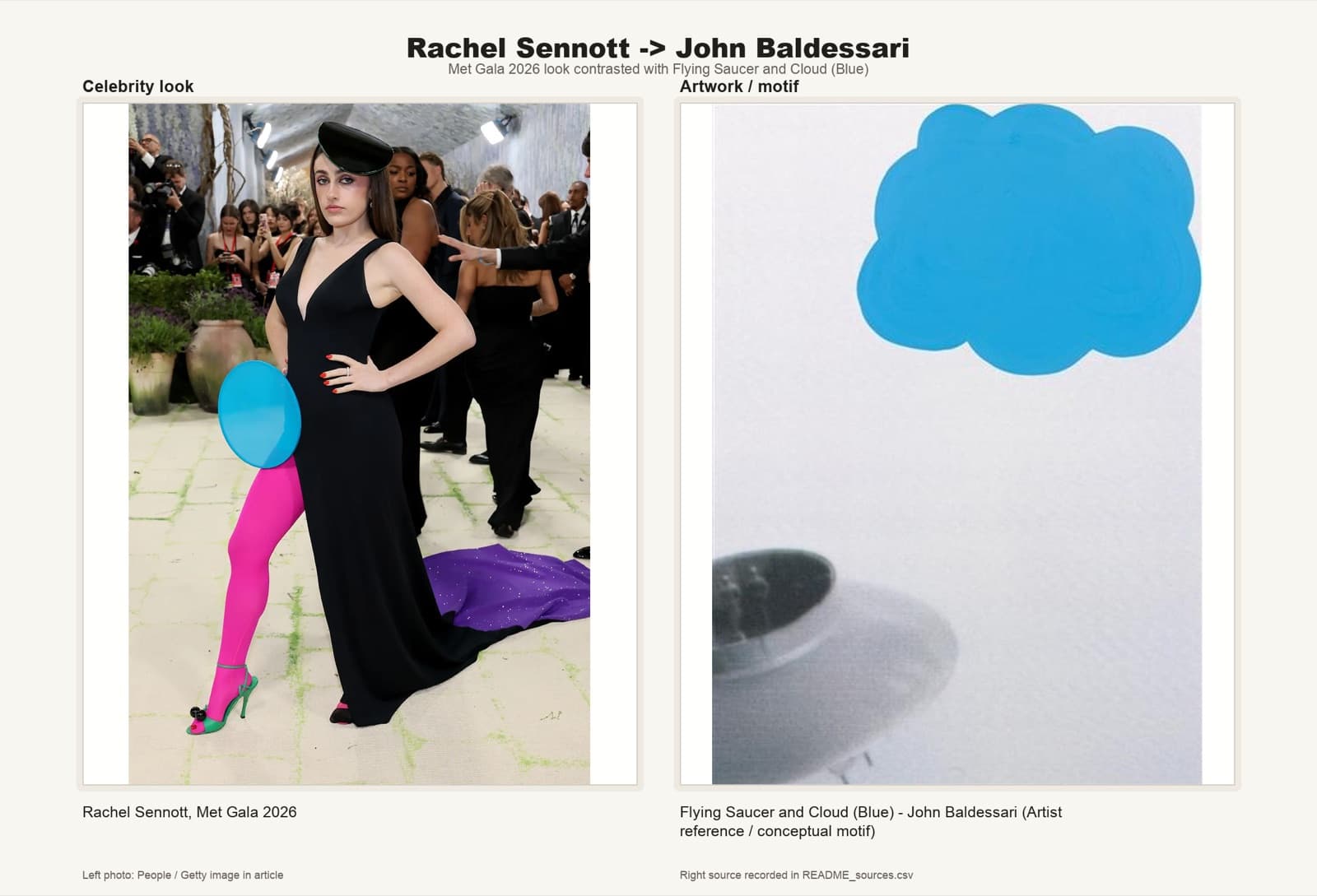
18
Rachel Sennott · John Baldessari, Flying Saucer and Cloud (Blue) (1990)
Marian Goodman Gallery edition; private collections
The look. Pale blue cotton dress with a flat round disc appliqué on the front bodice and white cloud-shaped panels at the hem — the literal flying saucer, the literal cloud.
The match. Baldessari's joke is the same as Sennott's: the saucer and the cloud are both flat shapes printed on flat ground. The dress declines to resolve them into perspective. Conceptual fidelity, not visual mimicry.
The art. Baldessari said he made the work because "every kid knows a flying saucer is round and a cloud is fluffy." His broader mid-career project was teaching American adults to look at images the way American children look at images — without irony.
Body as Canvas
Four entries where the artwork is a body (Allen Jones), a leather drawing (Tom of Finland), a print made by a body (Yves Klein) or a record of a body's motion (Pollock). The carpet, in this cluster, is the painting's plane.
06
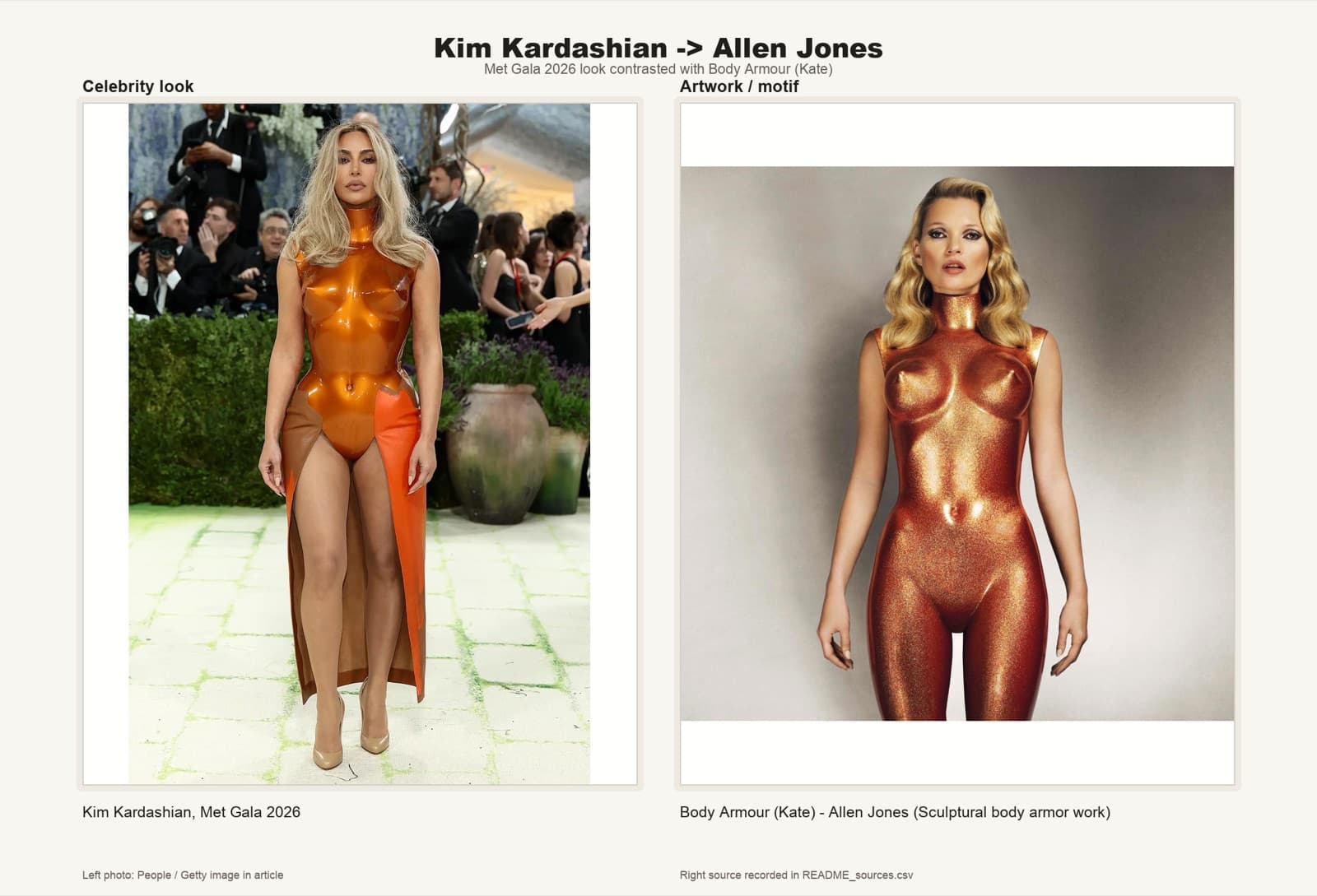
Kim Kardashian · Allen Jones, Body Armour (Kate) (2010s)
Christie's lot record; multiple private collections
The look. Hyper-glossy black moulded bodice fitted to the torso with armour-plate seams at the bust, hip and thigh — the gown is sculpted onto the body the way Allen Jones casts his armour onto a mannequin.
The match. Jones casts armour as a critique of how Pop art objectified the female body; the dress reproduces that armour without the critique, which is itself the citation. Kardashian's silhouette is the artwork, not a commentary on it.
The art. Jones's body armour series began in the 1960s with the Hatstand–Table–Chair sculptures, which were removed from Tate's display in 1986 after public protest. The 2010s armour series read as the artist returning to the question, this time without furniture.
22
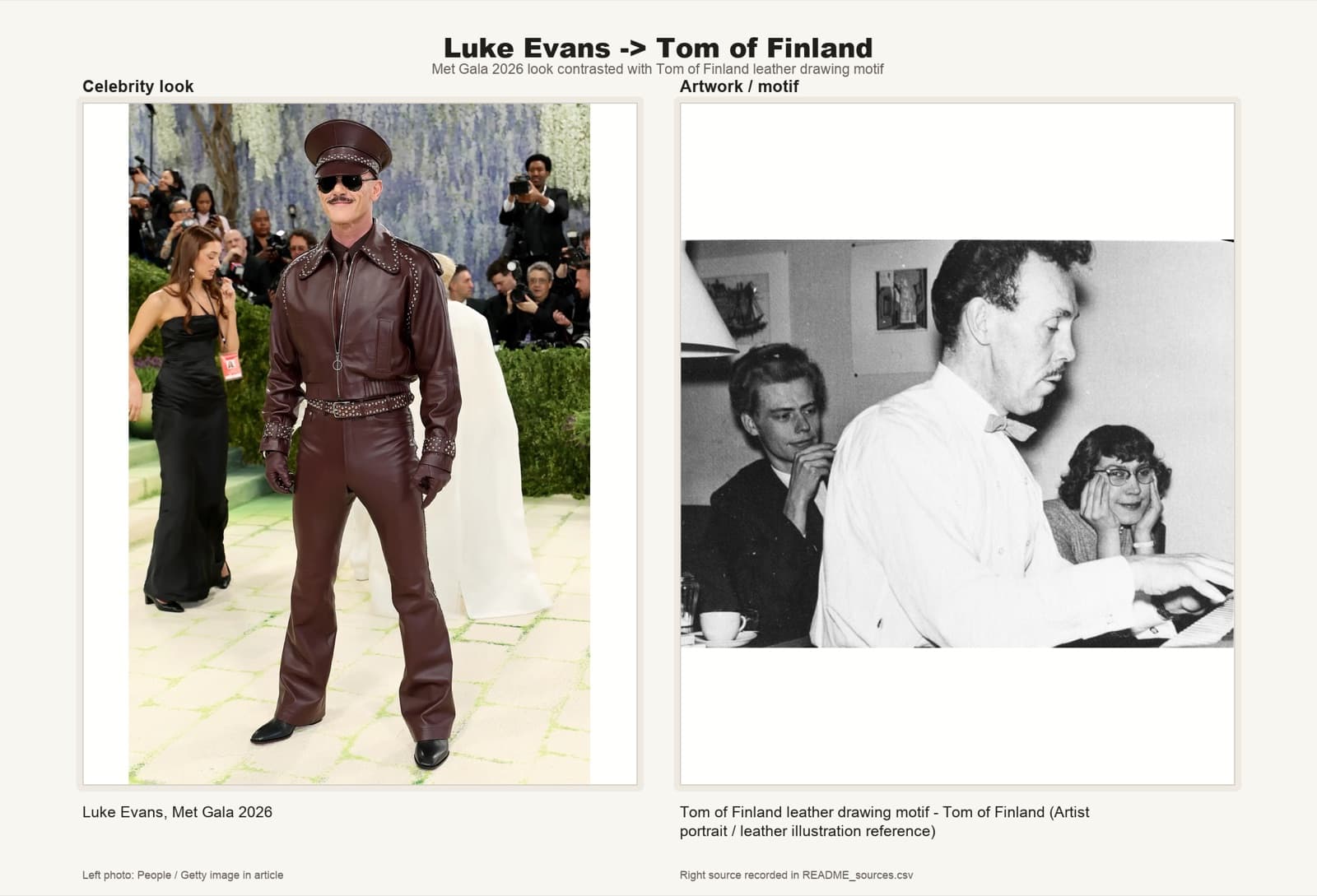
Luke Evans · Tom of Finland (Touko Laaksonen), Leather illustration vocabulary (1957 onward)
Tom of Finland Foundation, Los Angeles
The look. Black leather harness over a fitted leather waistcoat, peaked motorcycle cap, leather trousers — the costume is a Tom of Finland drawing line by line.
The match. Tom of Finland built the visual codex for postwar gay leather culture (cap, harness, boot). Evans wears the codex unedited — the citation is to a vocabulary, not a single drawing.
The art. Touko Laaksonen drew under the Tom of Finland name from his Helsinki apartment from the late 1950s until his death in 1991. The Tom of Finland Foundation in Los Angeles holds his complete archive and was named to the National Trust for Historic Preservation's list in 2016.
24
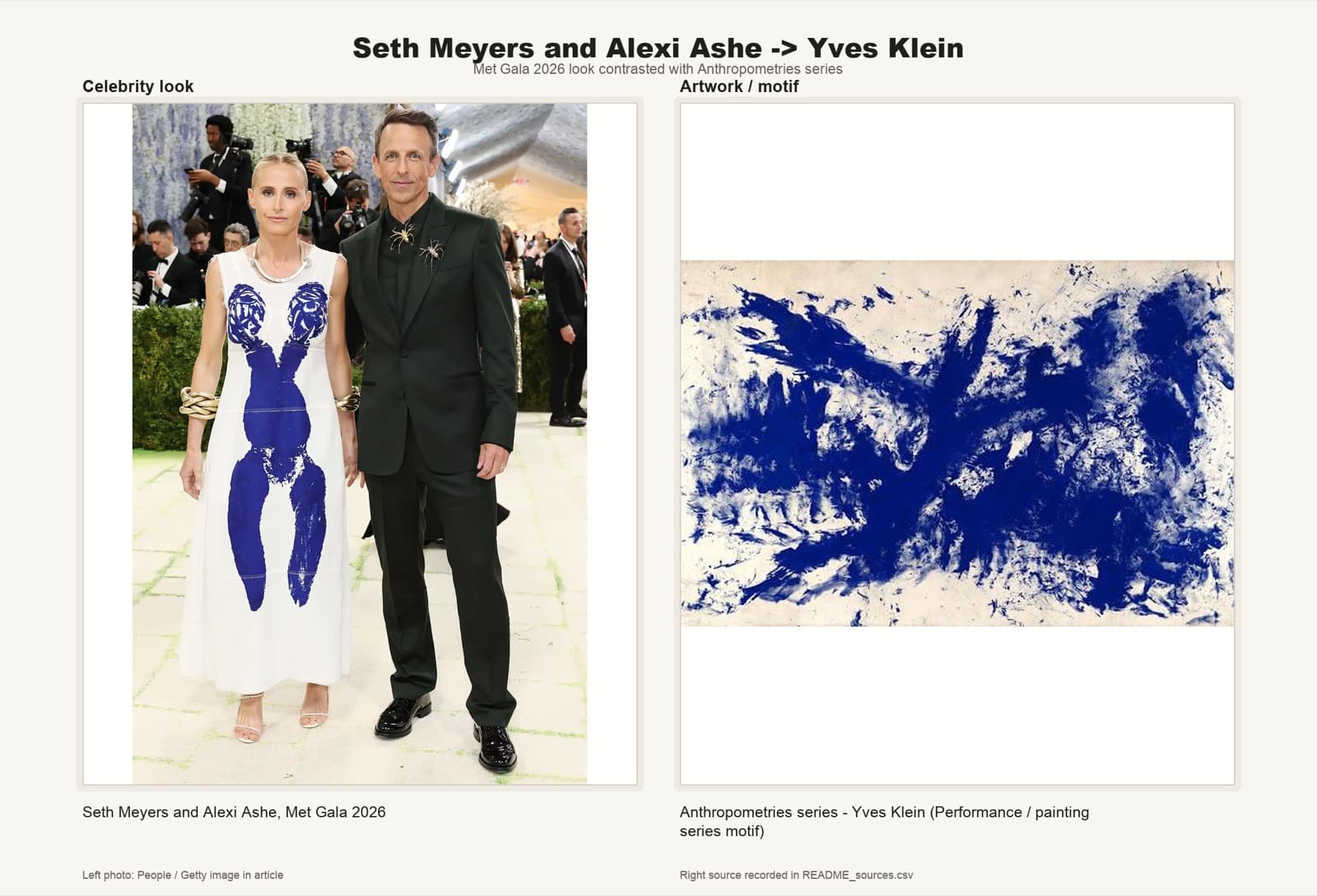
Seth Meyers and Alexi Ashe · Yves Klein, Anthropometries series (1960)
Multiple collections incl. MoMA, Centre Pompidou; Google Arts & Culture indexes the series
The look. Both in white tailored suits printed with deep International Klein Blue body imprints — the prints sit in different positions on each suit, so the couple reads as two prints from one Klein performance.
The match. Klein's Anthropometries were made by women coated in IKB pressing themselves onto canvas during live performance. The suits flatten the canvas onto the body — a return loop. Couple-as-canvas-pair is the curatorial joke.
The art. Klein patented International Klein Blue (IKB) in 1960, a specific ratio of ultramarine pigment in synthetic resin that retained the rawness of dry pigment when dry. He died of a heart attack at 34 in 1962, two years after Anthropometries began.
16
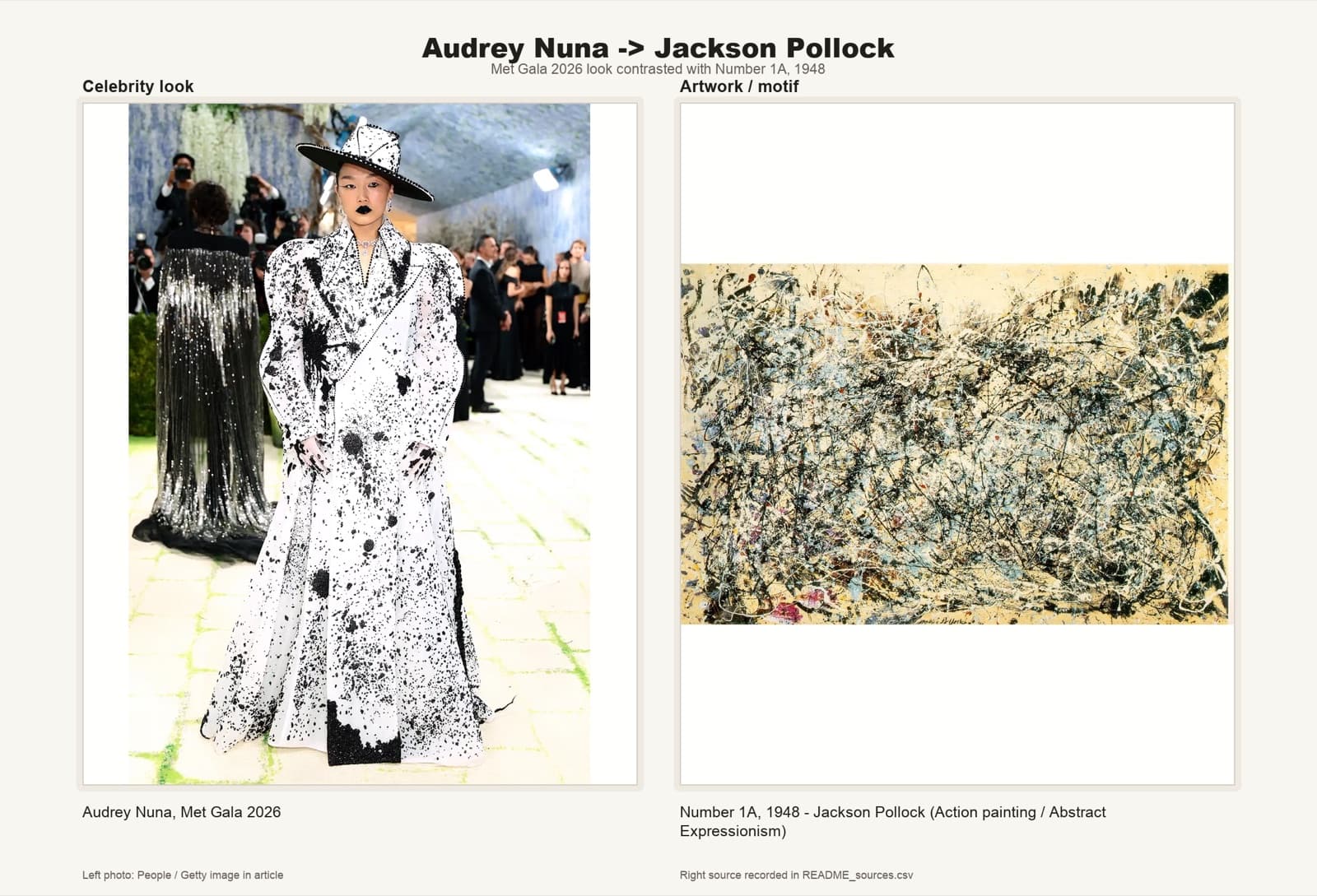
Audrey Nuna · Jackson Pollock, Number 1A, 1948 (1948)
Museum of Modern Art, New York
The look. Cream sheath densely splattered with thrown black, oxblood and ochre paint marks — the drips reach the floor, the pattern wraps the back continuous with the front.
The match. Pollock's signature is the drip, not the colour palette; Nuna's gown reproduces the drip method on textile. The painting wraps continuously front to back the way Pollock's canvas refused a top or bottom.
The art. Number 1A, 1948 was the first painting in which Pollock signed and dated by handprinting his palms in the upper-left corner — visible to this day in the MoMA hang. The whole canvas is on the floor of his Springs, Long Island studio.
Storied Portraits
Seven citations to a specific painted portrait. The references this cluster pulled from include three twentieth-century African American painters (Caroline Wogan Durieux, Robert Pruitt, Laura Wheeler Waring), one Cubist late-period (Braque), one Dutch Golden Age (Ruysch), one Picasso Blue Period (Harlequin), and one Romantic-history-painting (Delaroche's Lady Jane Grey).
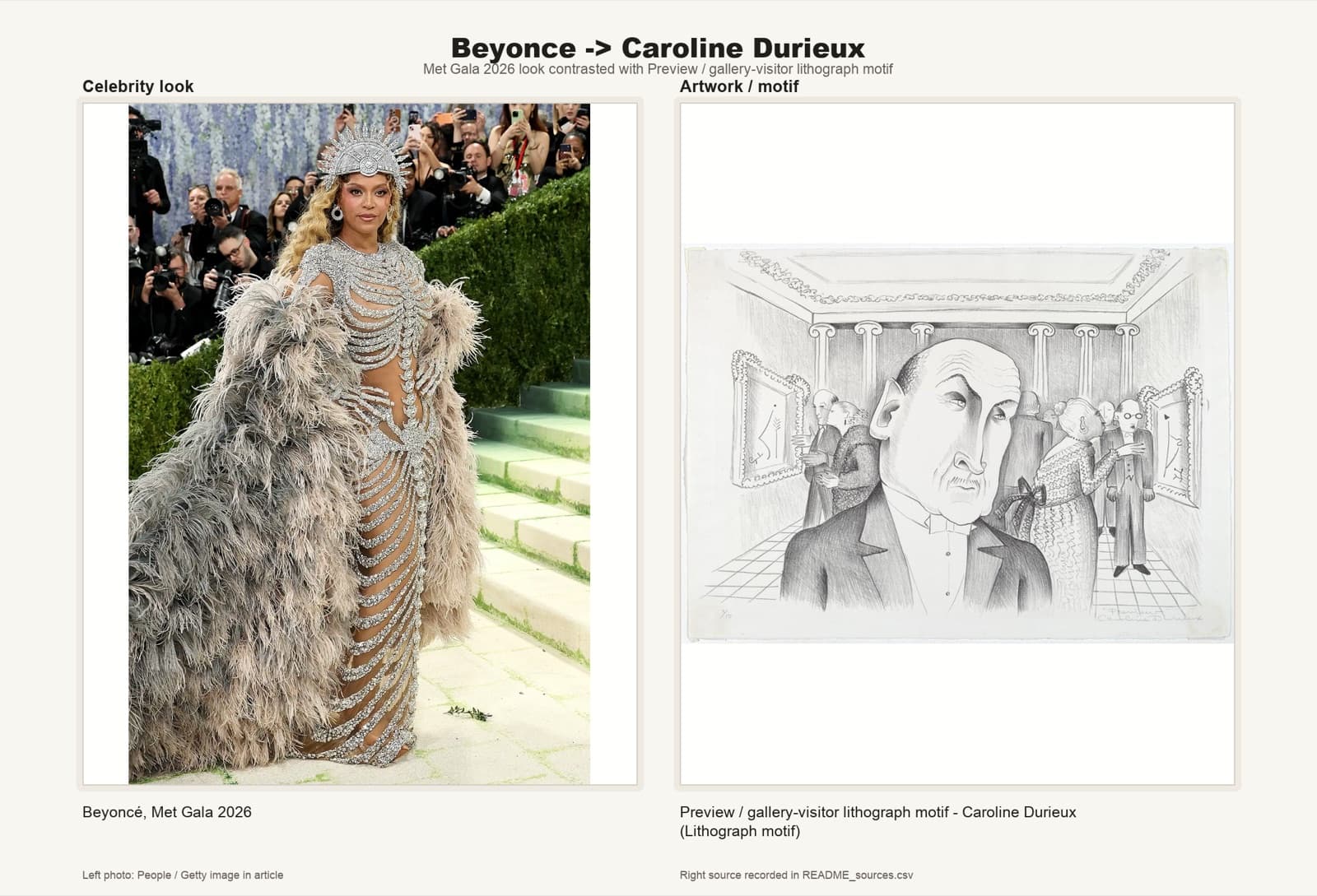
National Gallery of Art, Washington (artist holdings)
The look. Sober dark-toned gown styled with the gallery-visitor's stillness — head tilted slightly, hand near the chin, posture borrowed from Durieux's lithograph figure.
The match. Durieux's New Orleans–trained satirical lithographs feature a recurring composed female figure observing rather than performing — Beyoncé's pose is the citation, not the costume.
The art. Durieux (1896–1989) was the first woman to teach printmaking at the Newcomb Art School at Tulane and a major figure in Louisiana modernism. The NGA holds a complete archive of her lithographs and electroprints.
02
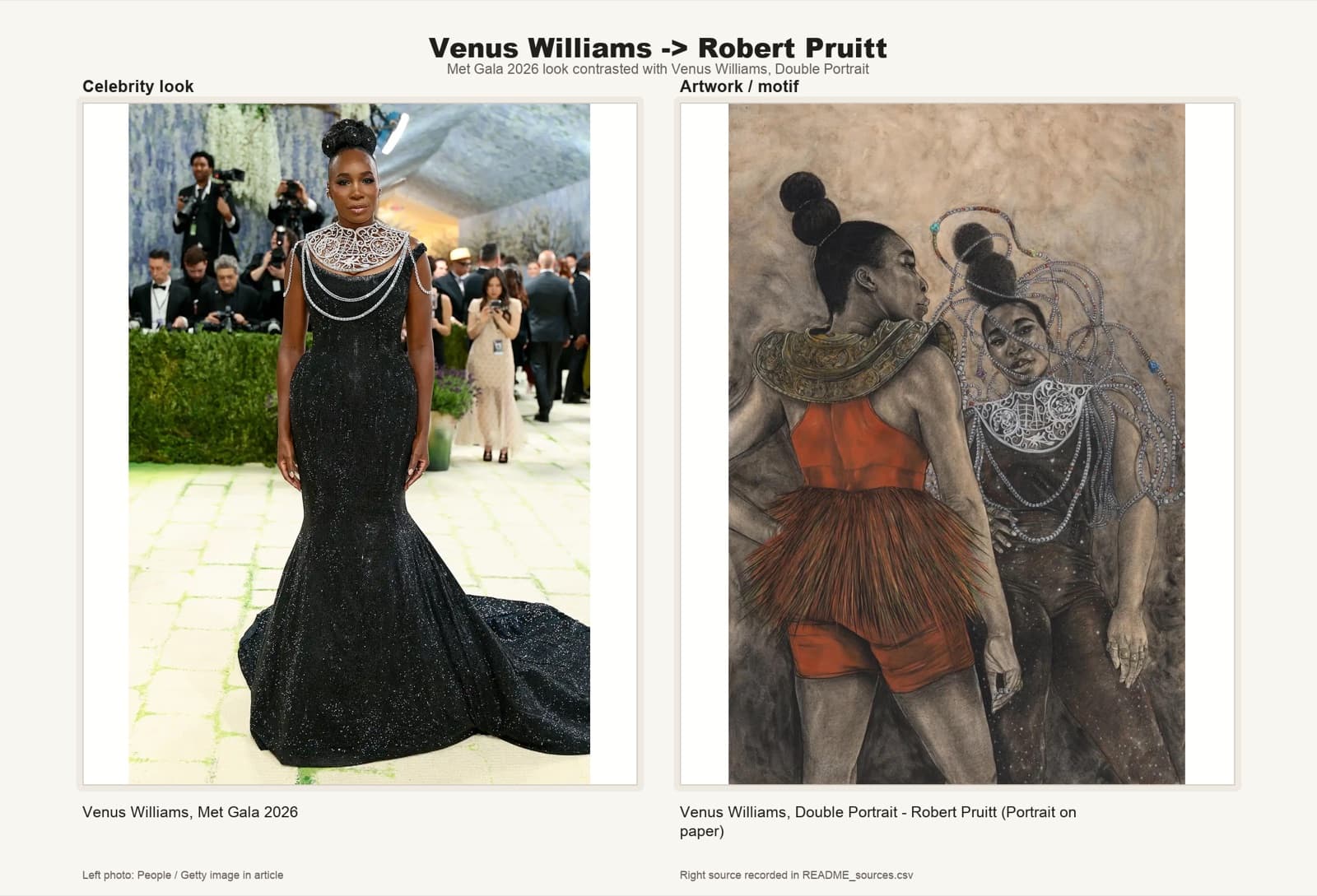
Venus Williams · Robert Pruitt, Venus Williams, Double Portrait (2022)
National Portrait Gallery, Smithsonian
The look. Earth-toned drape with conté-crayon-textured surface print; head wrapped in matching fabric; the look reads as a moving graphite portrait.
The match. Pruitt's portrait — paper, conté crayon, and coffee — already lives at the NPG. Williams is the only attendee at the gala wearing a portrait of herself. The look acknowledges Pruitt's surface (textured, drawn, layered) rather than miming a specific frame of the picture.
The art. Pruitt's Double Portrait shows Venus seated, twice, in ceremonial robes that draw on Yoruba and Black Sci-Fi iconography. The Smithsonian acquired it in 2023; it remains one of the few NPG holdings of a sitter still active in their original profession.
08
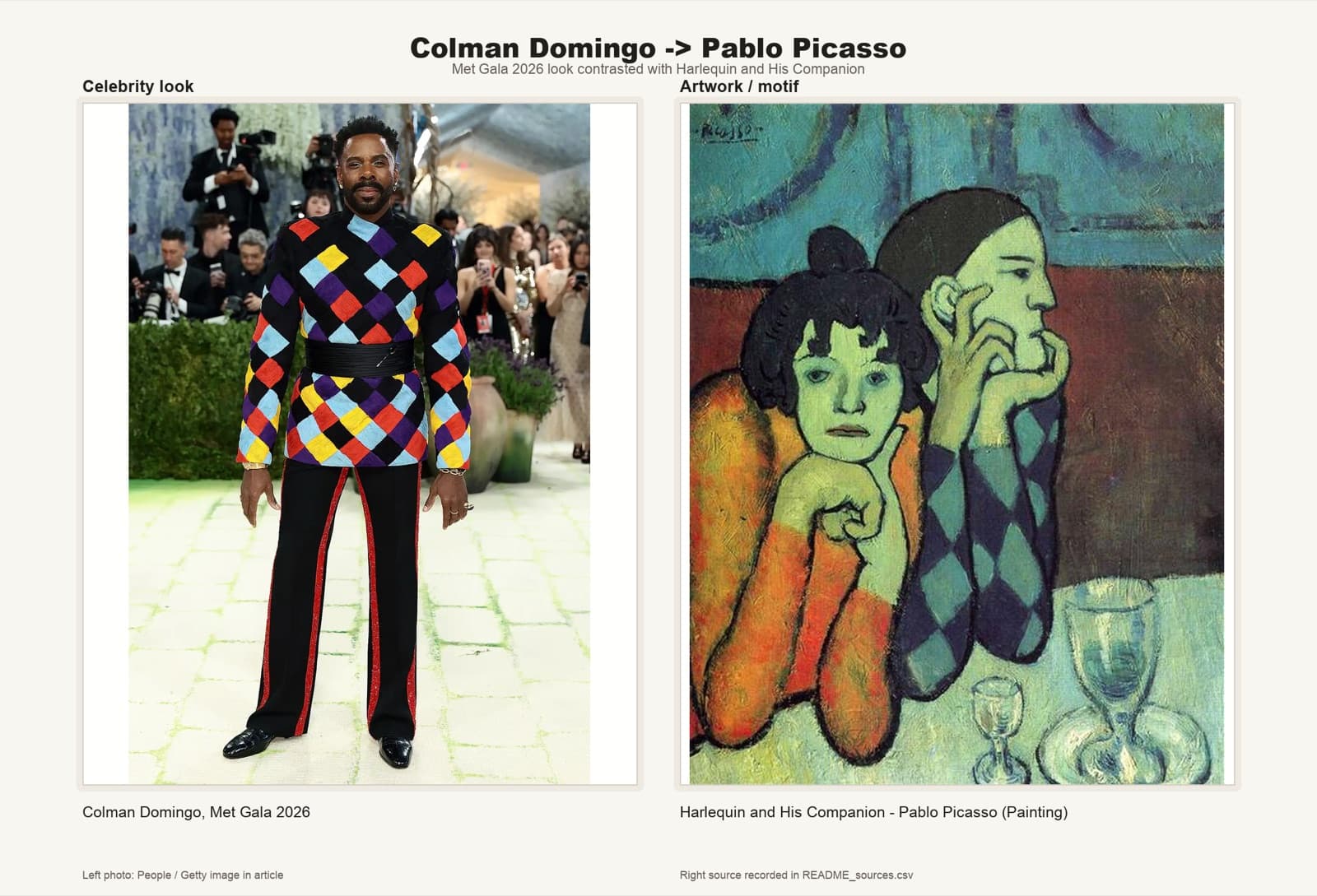
Colman Domingo · Pablo Picasso, Two Acrobats (Harlequin and his Companion) (1901)
Pushkin Museum, Moscow (verified in WikiArt's catalogue)
The look. Diamond-checked harlequin tailoring in muted olive-and-rust, soft brimmed hat, the sleeves set wide at the wrist — Picasso's 1901 Harlequin gone full bespoke.
The match. Domingo wears Picasso's Blue Period mood (subdued tone, melancholic stance) inside the Harlequin's check pattern. The colour mute is what tells you it's the 1901 Harlequin and not the Cubist later versions.
The art. Picasso painted Two Acrobats in Paris when he was 19, weeks into his Blue Period; the harlequin became his lifelong recurring self-portrait device, returning across at least 30 canvases through 1971.
10
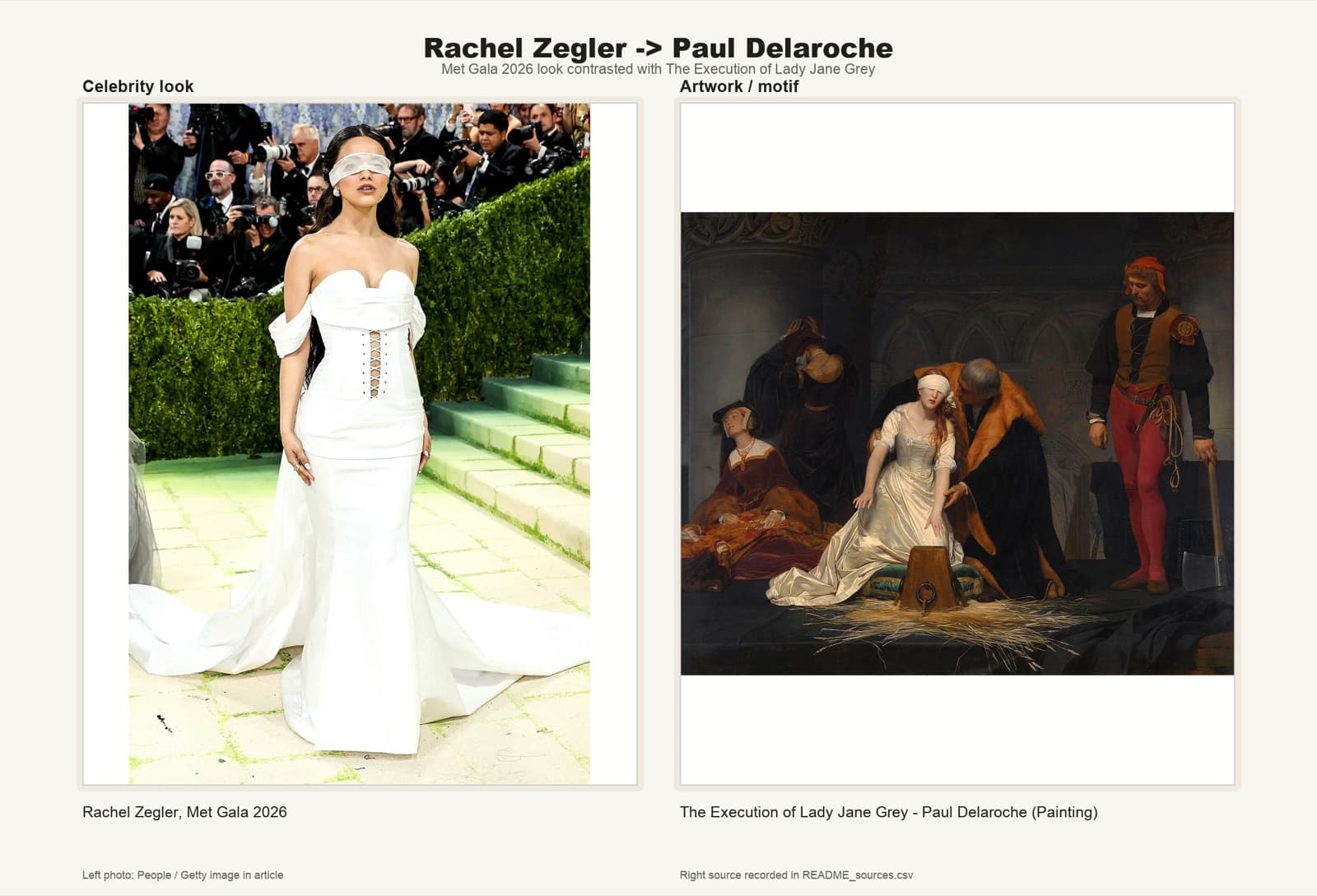
Rachel Zegler · Paul Delaroche, The Execution of Lady Jane Grey (1833)
The National Gallery, London
The look. Snow-white satin gown with full hand-embroidered sleeves, hair tightly bound at the nape — the costume reads as the moment before Delaroche's blindfold goes on.
The match. Delaroche dressed his Lady Jane in white at the moment of execution — historically inaccurate (she wore black), but a Romantic painter's convention for innocence. Zegler wears the painting, not the history.
The art. The painting was thought destroyed in the 1928 Tate flood and was rediscovered in National Gallery storage in 1973. It has since become the gallery's single most-reproduced image — the website's most-downloaded high-res file most years.
12
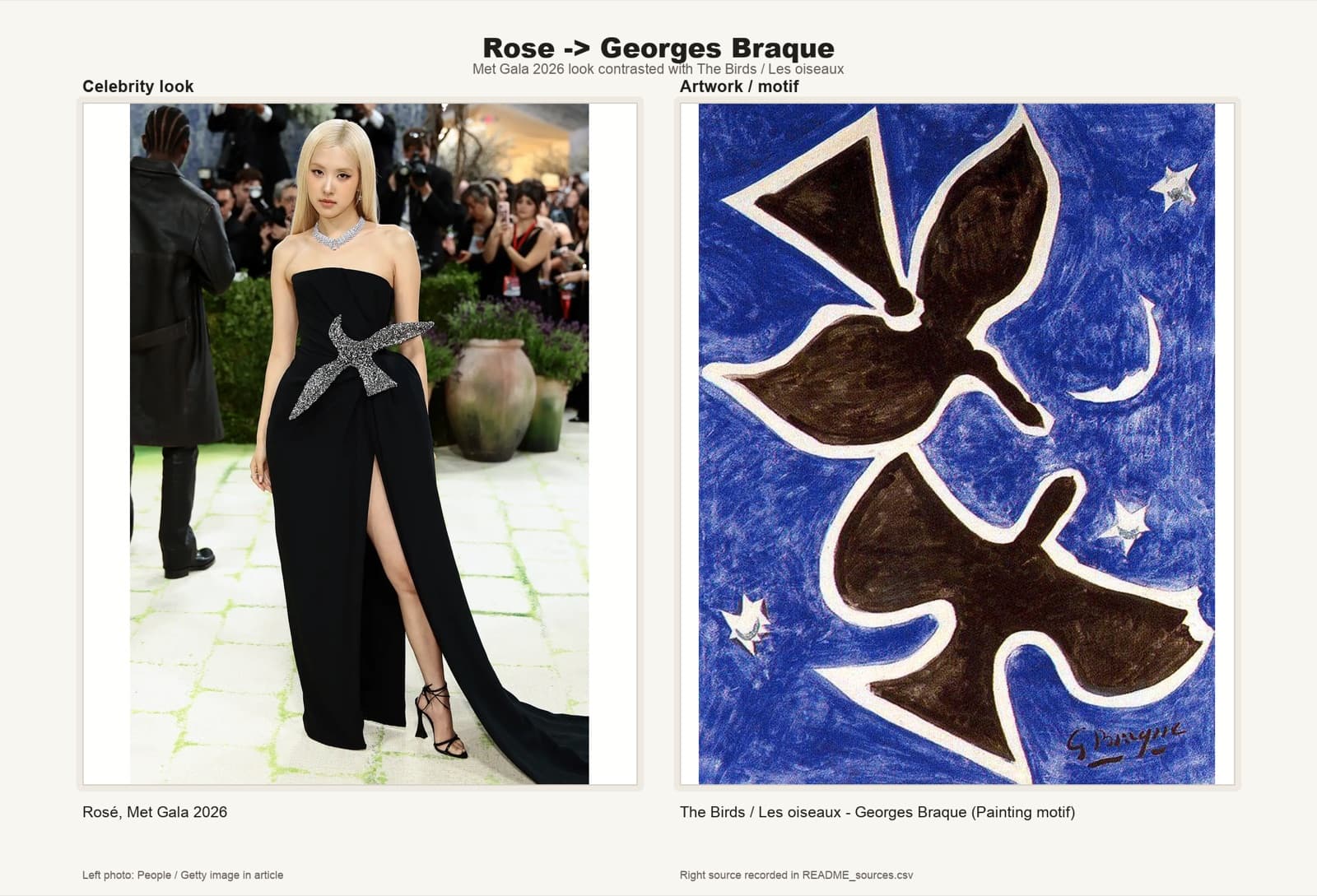
Rosé · Georges Braque, The Birds (Les Oiseaux) (1953)
Musée du Louvre ceiling commission, Henri II room
The look. Soft white dress with cut-fabric birds applied across the bodice and skirt — Braque's 1953 "Les Oiseaux" geometry translated to white-on-white textile.
The match. Braque's late "Birds" series flattened bird silhouettes into wing-shaped cells. Rosé's bodice copies the wing shape literally and removes the colour, leaving only Braque's geometry.
The art. Braque painted Les Oiseaux on the ceiling of the Henri II salon at the Louvre in 1953 — the first commission ever given to a living artist for a ceiling in the museum. He painted it from memory of a sketchbook he'd kept since 1946.
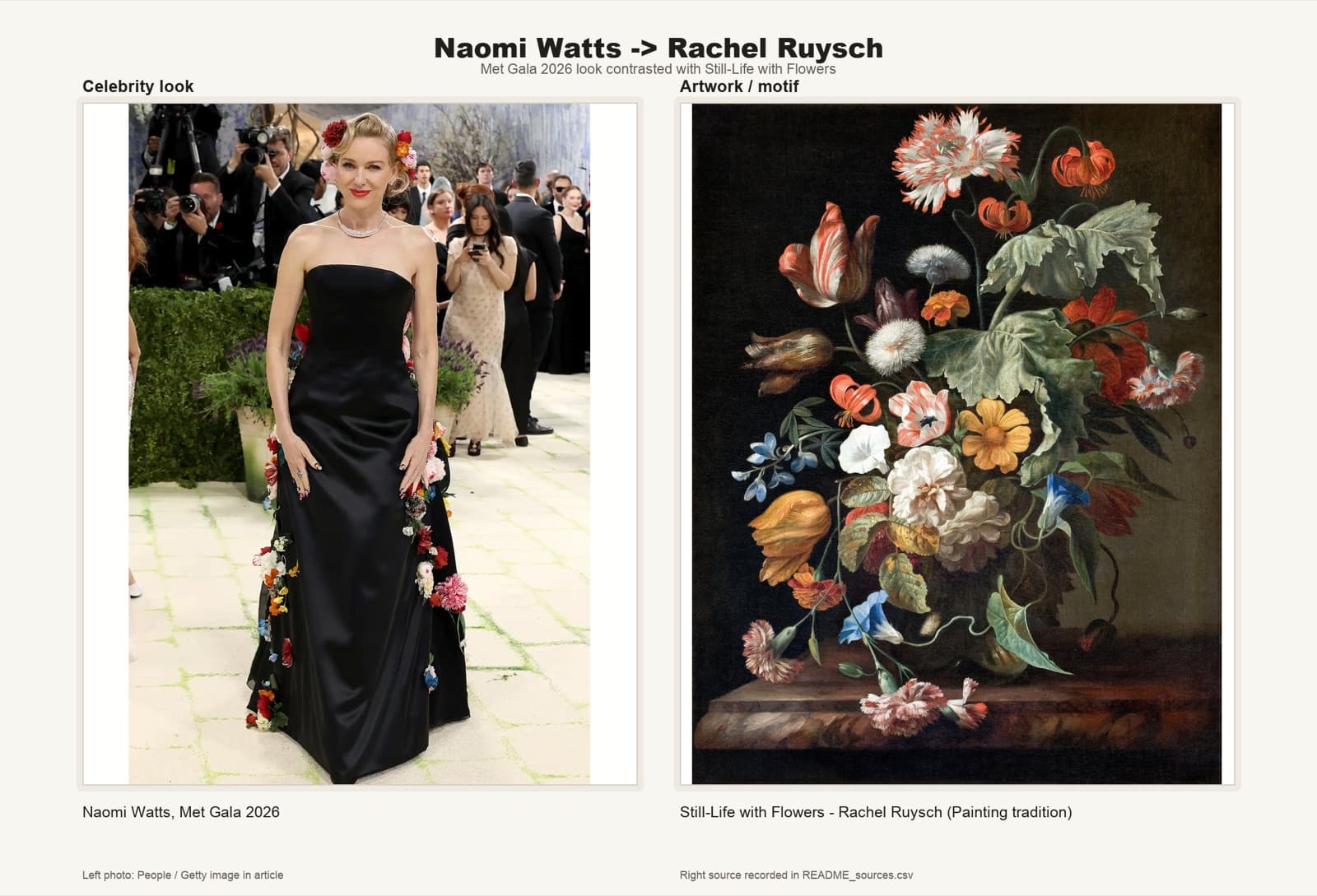
Multiple collections (Google Art Project scan via Wikimedia Commons)
The look. Deep-tone floral gown with seventeenth-century-style flower-cluster embroidery on a near-black ground — the Dutch Golden Age still-life as garment.
The match. Ruysch's still-lifes layered species that don't bloom in the same season into a single bouquet — botanical impossibility was the genre's flex. The gown copies the layered overlapping arrangement on a dark ground.
The art. Ruysch (1664–1750) was the most highly paid woman painter of the Dutch Golden Age, often outpricing Rembrandt's followers. She continued painting into her eighties; the bouquet shown above is from the late period.
17
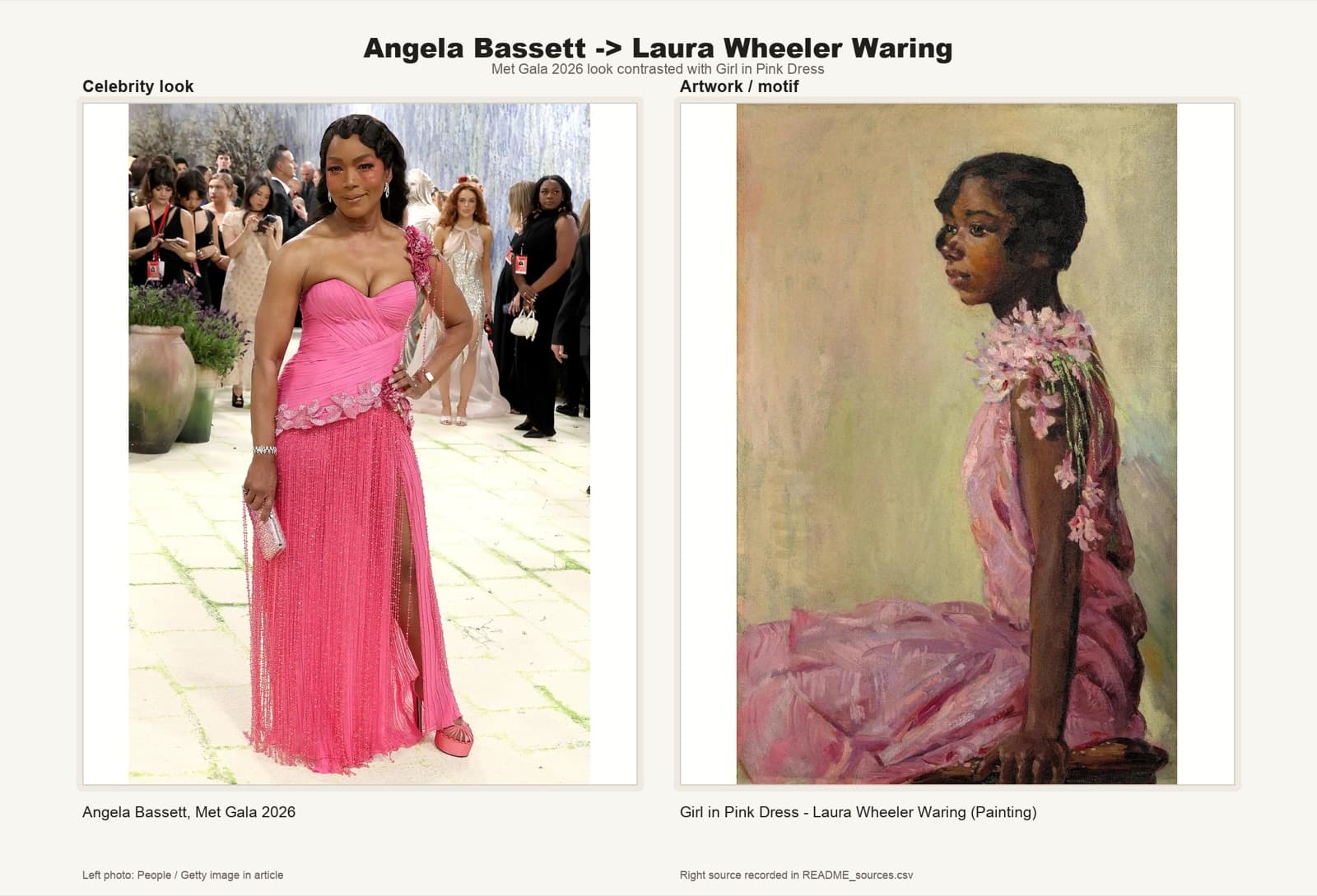
Angela Bassett · Laura Wheeler Waring, Girl in Pink Dress (1930s–40s)
Multiple American collections incl. NPG
The look. Saturated pink long-sleeved gown with structured shoulders — the silhouette and palette borrowed straight from Waring's portrait, no ornament beyond the colour itself.
The match. Waring's Girl in Pink is one of the canonical Harlem Renaissance portraits — known for the painter's restrained palette and a single dominant colour per canvas. Bassett wears the painting's pink, not its details.
The art. Waring (1887–1948) painted commissioned portraits of W.E.B. Du Bois, Marian Anderson and Anna Julia Cooper for the National Portrait Gallery's Harmon Foundation series in the 1940s. She taught at Cheyney University in Pennsylvania for over 30 years.
A pivotal moment for the department, one that acknowledges the critical role that fashion plays not only within art history but also within contemporary culture.— Andrew Bolton, Curator-in-Charge, The Costume Institute, on the new Condé M. Nast Galleries
Frequently asked questions
The exhibition is called Costume Art, curated by Andrew Bolton (Curator-in-Charge of the Met's Costume Institute). It opens to the public on May 10, 2026 and runs to January 10, 2027 in the Met's new Condé M. Nast Galleries — about 12,000 square feet, displaying nearly 400 garments next to about 400 paintings, sculptures and objects from the Met's other curatorial departments. The dress code that went out to attendees was "Fashion is Art," which most read as instructions to come dressed as a specific artwork.
Four attendees independently chose Sargent's Portrait of Madame X (1883–84): Lauren Sánchez Bezos, Rosie Huntington-Whiteley, Julianne Moore and Claire Foy. Sánchez and Foy are the closest visual reads. Sánchez restored Sargent's original (scandalised) fallen-strap composition from the 1884 Salon hang; Foy followed the corrected upright-strap version that hangs in the Met today. Huntington-Whiteley copied the painting's hand-on-table posture in silk velvet, and Moore copied its surface and palette without the strap detail. The painting itself lives in the Met's European Paintings galleries.
Emma Chamberlain wore the Starry Night reference — a swirling cobalt-and-cypress beaded skirt over a pale bodice. The bead direction copies the rotational brushwork in Van Gogh's 1889 canvas; the cypress on the left of the painting maps to the gown's seam. The painting is at MoMA, where it has been since 1941.
At the Neue Galerie New York, on East 86th Street facing Central Park. The painting was looted from Vienna in 1938, returned to Maria Altmann in 2006 after a US Supreme Court restitution case (Republic of Austria v. Altmann), and acquired by Ronald Lauder for the Neue Galerie for $135 million — at the time, the highest price ever paid for any painting. Gracie Abrams's gold-on-gold gown at the 2026 Met Gala was the canonical citation.
Yes. The Costume Institute exhibition title is "Costume Art"; the dress code that went out on the invitation is "Fashion is Art." Curator Andrew Bolton designed the gala brief to track the show's central premise — that garments and works of art share a single vocabulary — and most attendees responded by dressing as a specific named artwork rather than interpreting the theme loosely.
We have them all paired side-by-side with their art references on this page, ordered by curatorial cluster. People's red-carpet roundup at people.com (cited at the end of this article) is the canonical photographic source for the gala arrivals. The Met's exhibition page at metmuseum.org is the source for the curatorial framing.
Sargent black velvet, Klimt gold, Monet aquatic, Van Gogh violet, Pollock-style splatter — translated into pieces you'd actually wear, with deep links into our outfit and aesthetic guides.