Two Klimts on the Red Carpet: Adele Bloch-Bauer Meets Mada Primavesi
Five years apart, Klimt painted his most famous adult portrait and his most famous child portrait. At the 2026 Met Gala both walked the carpet — one as a $135-million restitution case, the other as a Met regular.
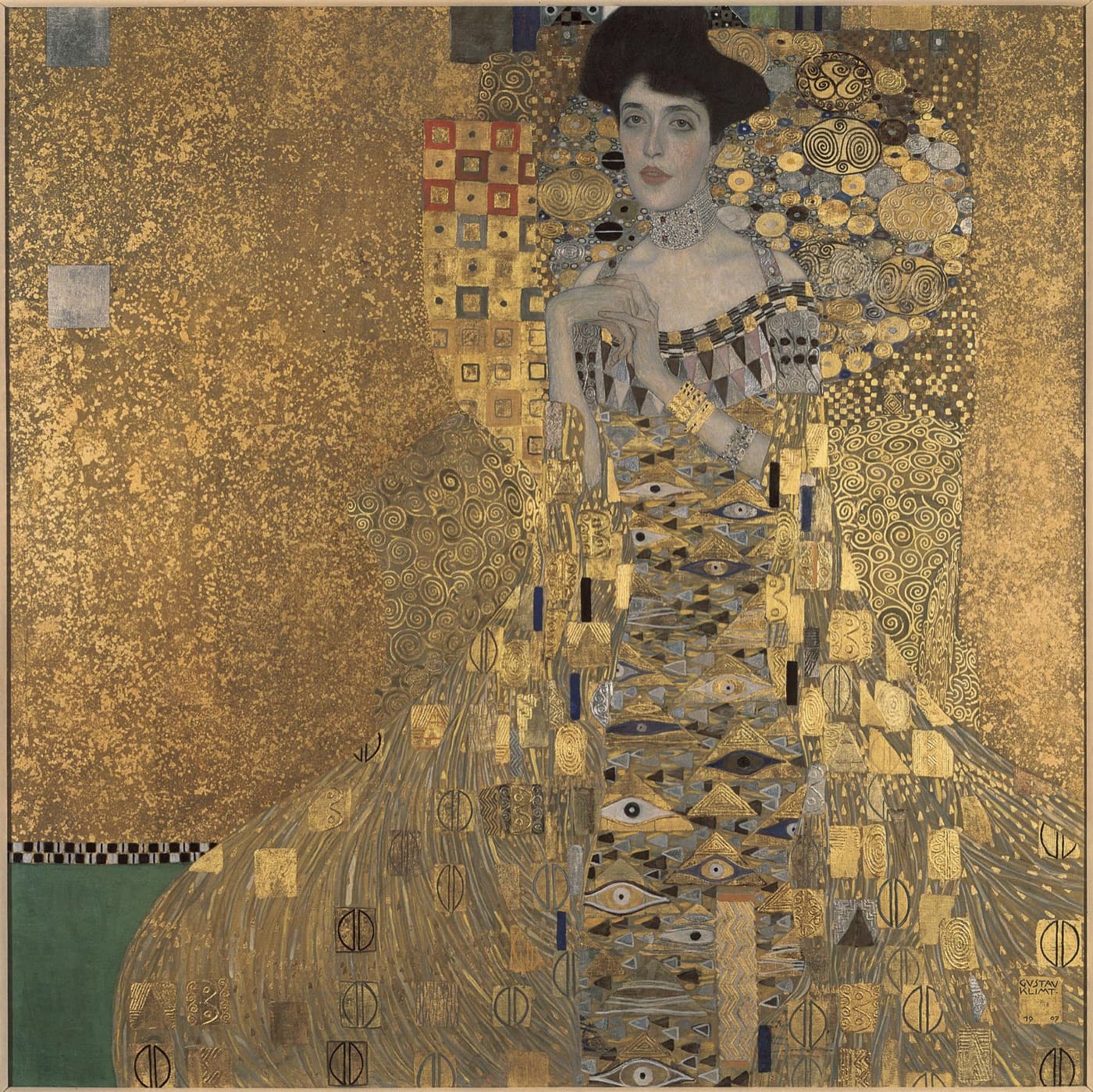
Gracie Abrams came as Klimt's gold-on-gold 1907 portrait of Adele Bloch-Bauer I; Hunter Schafer came as the 1912 child portrait of Mada Primavesi. The first was looted by the Nazis in 1938; the second has been at the Met since 1964.
- Read the gold-on-gold rule first — Klimt deliberately denied perspective in Bloch-Bauer I, which is why Abrams's gown reads as flat
- Notice Schafer's pose — she's standing the way Mada was painted, planted on both feet, head slightly tilted
- If you're in New York, both paintings are on view: Bloch-Bauer at the Neue Galerie (East 86th); Mada at the Met (Fifth Ave, Modern wing)
- Read the Maria Altmann restitution arc as the painting's second life — it's why the picture is in New York at all
- Don't conflate the two portraits — Bloch-Bauer is gold and adult; Mada is white and nine years old
- Don't confuse Adele Bloch-Bauer I with the second portrait Klimt painted of the same sitter (1912) — the second is at MoMA, less ornamented, less famous
- Don't read Klimt's gold as decorative — it's structural; the painting's flatness is the point
Adele Bloch-Bauer I (1907) — gold, geometry, no perspective
Klimt painted Adele Bloch-Bauer twice. The 1907 first portrait is the gold one — the one Gracie Abrams wore to the 2026 Met Gala. Adele was 26 when Klimt began the picture; her husband Ferdinand Bloch-Bauer commissioned it. Klimt worked on it for three years and applied actual gold leaf and silver leaf across the bodice, the throne and the background. The painting denies depth on purpose. Adele's body is flat against the gold ground; the only modelled flesh is the face, the shoulders, and the hands. Everything else is surface.
The Byzantine eye-and-square motif Klimt used on the bodice came from his 1903 trip to Ravenna, where he saw the sixth-century mosaics at San Vitale and the Mausoleum of Galla Placidia. He wrote to a friend that the mosaics taught him "that gold is not a colour but a substance." The lesson stayed: every Klimt portrait between 1907 and 1909 (Adele Bloch-Bauer I, the second Judith, Danae) builds on the same gold-as-structure premise.
The Maria Altmann restitution arc
When the Nazis annexed Austria in March 1938, Ferdinand Bloch-Bauer fled Vienna; the Gestapo seized the Bloch-Bauer collection, including all five Klimts. The 1907 portrait went to the Austrian Gallery Belvedere as state property and was renamed The Lady in Gold, with Adele's identity scrubbed (she was Jewish; the Nazis preferred a generic title). It hung at the Belvedere for 60 years.
Maria Altmann, Adele's niece, fled to California in 1938 and became an American citizen. In the late 1990s she filed a restitution claim against the Republic of Austria for the five Klimts. The case reached the US Supreme Court in 2004 (Republic of Austria v. Altmann); the Court ruled 6–3 that Altmann could sue Austria in US federal court. Austrian arbitration returned all five paintings to her in January 2006. Six months later she sold Adele Bloch-Bauer I to Ronald Lauder for the Neue Galerie New York for $135 million — at the time the highest price ever paid for a painting. It has hung at the Neue Galerie on East 86th Street since.
The 2015 film Woman in Gold (Helen Mirren as Altmann, Ryan Reynolds as her lawyer Randol Schoenberg) dramatised the case. The dramatisation simplified — Schoenberg's actual brief was 247 pages and the case turned on a narrow point of jurisdictional retroactivity — but the painting's biography is the rare one where the cinematic version under-sells the legal stakes.
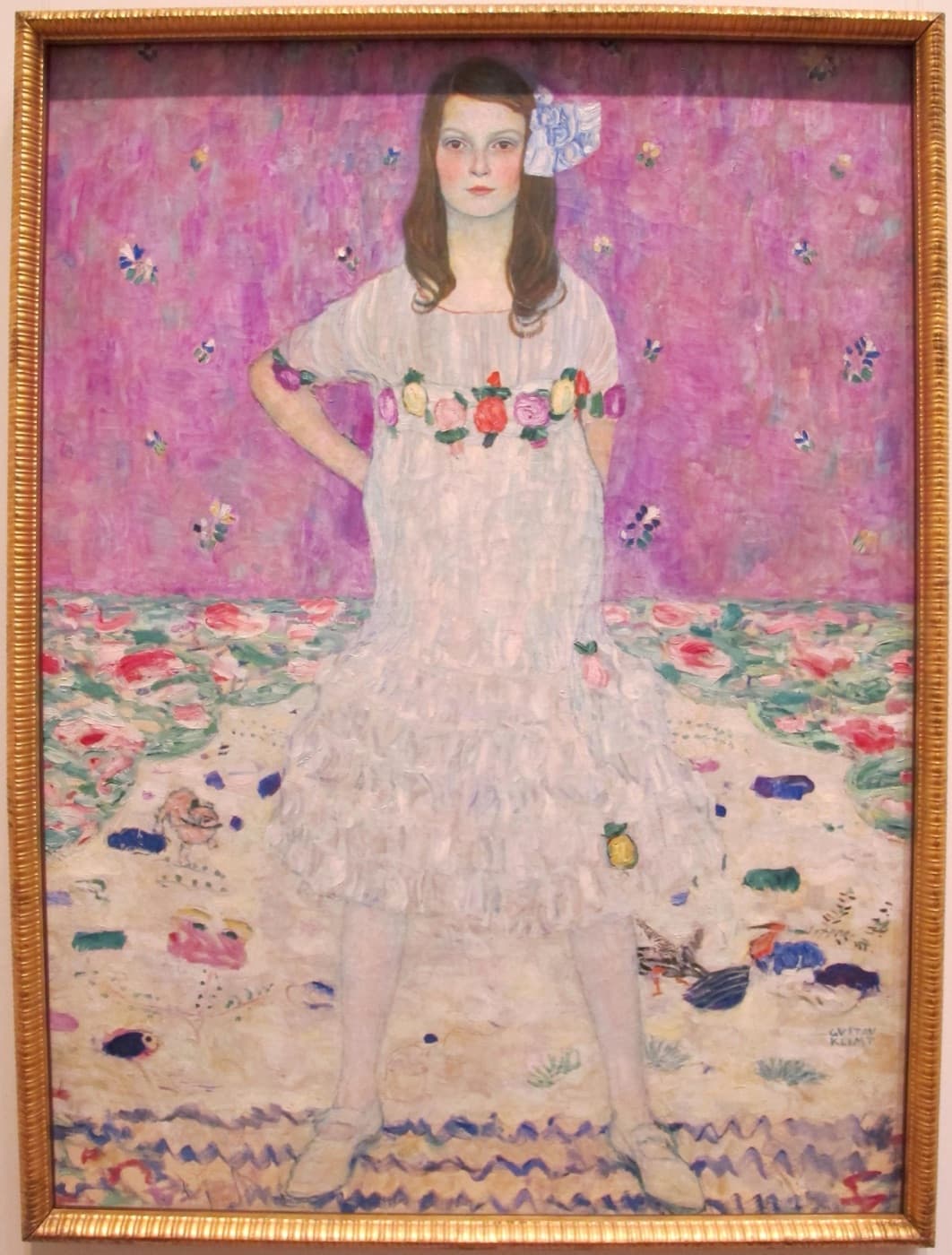
Mada Primavesi (1912–13) — white, planted, nine years old
Five years after Bloch-Bauer, Klimt painted his most famous child portrait. Mada Primavesi was nine. Her father Otto was a Vienna banker and a Wiener Werkstätte patron; her mother Eugenia commissioned the picture for the family Villa Primavesi in Winkelsdorf (now Kouty nad Desnou, Czech Republic). Klimt produced at least 200 preparatory drawings of Mada in different poses before settling on the standing one — feet planted, weight forward, both arms slightly behind the body, head tilted left, eyes meeting the viewer.
The painting is the opposite of Bloch-Bauer's gold. Mada is in a loose white cotton smock with hand-painted floral motifs at the neckline and skirt; the ground is pale violet-pink with looping floral filigree. The colour palette is the gift Mada gave her own child portraitist — Klimt rarely worked in the pale-pink-with-violet range, but he committed to it for her.
Hunter Schafer's 2026 carpet read picked up the silhouette and the pose: a tent-shaped cotton dress with hand-painted floral panels, planted feet, head tilted in the direction Klimt painted. The pose is the citation as much as the textile.
Where the two paintings live now
Adele Bloch-Bauer I: Neue Galerie New York, 1048 Fifth Avenue at East 86th Street, on permanent view in the second-floor gallery. The Café Sabarsky on the ground floor of the same building serves as the museum's restaurant; the tortes are good, the espresso is real. Admission is by timed ticket through neuegalerie.org.
Mada Primavesi: The Metropolitan Museum of Art, gallery 829 (Modern and Contemporary, second floor). Acquired in 1964 as a gift from André and Clara Mertens, who had bought the painting from the Primavesi family. Mada herself outlived the painting's first sixty years; she died in 2000 in Switzerland at 96.
Why two Klimts at the same gala isn't a coincidence
Klimt is the painter Costume Art's curatorial framing was built for. His portraits already treat fabric as if it were paint — the gold leaf in Bloch-Bauer I is literally textile-shaped — and his Vienna Secession project was the first European movement to argue, in the 1898 Secession manifesto, that decorative art and fine art were the same discipline. Andrew Bolton's exhibition makes the same argument 128 years later, with garments next to canvases. Two Klimts was almost overdetermined; the surprise is that more attendees didn't pick him.
I will be perfectly content if it is then exhibited as a public memorial.— Adele Bloch-Bauer's 1923 will, instructing her husband to bequeath the Klimt portraits to the Austrian state — a wish circumvented by the Nazi seizure in 1938 and re-honoured by the 2006 restitution and sale.
Frequently asked questions
Two attendees came as different Klimt paintings. Gracie Abrams wore the gold-on-gold reference to Adele Bloch-Bauer I (1907), the painting now at the Neue Galerie New York. Hunter Schafer wore the white floral reference to Mada Primavesi (1912–13), the child portrait at the Metropolitan Museum of Art. Both are sourced and described on this page; the pillar piece pairs each look beside its art reference.
Neue Galerie New York, 1048 Fifth Avenue at East 86th Street, on permanent view. Admission is by timed ticket through neuegalerie.org. The painting was looted from Vienna in 1938, returned to Maria Altmann in 2006 after a US Supreme Court case (Republic of Austria v. Altmann), and acquired by Ronald Lauder for the Neue Galerie for $135 million — the highest price ever paid for a painting at the time.
Maria Altmann (1916–2011), Adele Bloch-Bauer's niece, fled Vienna in 1938. In the late 1990s she filed a restitution claim against the Republic of Austria for five Klimt paintings looted from her uncle Ferdinand Bloch-Bauer. The US Supreme Court ruled in 2004 that she could sue Austria in US federal court; Austrian arbitration returned the paintings in January 2006. The 2015 film Woman in Gold (Helen Mirren as Altmann) dramatised the case.
The Metropolitan Museum of Art, gallery 829 (Modern and Contemporary, second floor). The painting was a 1964 gift from André and Clara Mertens, who acquired it from the Primavesi family. Mada Primavesi was nine when Klimt painted her in 1912–13; she outlived most twentieth-century portraitists, dying in Switzerland in 2000 at 96.
Yes. The 1907 portrait (gold, Byzantine motifs, Neue Galerie) is the famous one. Klimt also painted Adele Bloch-Bauer II in 1912 — looser brushwork, no gold leaf, a different palette of pinks and greens. The second portrait is at MoMA, also recovered as part of the 2006 restitution, sold by the Bloch-Bauer estate for $87.9 million in 2006 to a private collector who later transferred it to MoMA on long-term loan.
Twenty-five others, including Sargent's Portrait of Madame X (worn by four different attendees), Van Gogh's Irises and The Starry Night, Monet's Water Lilies, Seurat's A Sunday on La Grande Jatte, Pollock's Number 1A, the Winged Victory of Samothrace, Strazza's The Veiled Virgin, and Kohei Nawa's PixCell-Deer. The full sourced list is on the pillar piece.
Sources
- Neue Galerie New York — Gustav Klimt, Adele Bloch-Bauer I (1907) — accessed 2026-05-06
- The Metropolitan Museum of Art — Gustav Klimt, Mada Primavesi (1912–13) — accessed 2026-05-06
- Sotheby's — record of the 2006 sale of Klimt's Adele Bloch-Bauer I (Maria Altmann restitution) — accessed 2026-05-06
- People — Met Gala 2026 arrivals: every celebrity red carpet photo — accessed 2026-05-05
- The Metropolitan Museum of Art — Costume Art exhibition page — accessed 2026-05-06