How to Steal the 2026 Met Gala Looks — Five Wearable Translations
Most of the 27 looks belong on a sculpture stand. Five of them — the ones whose source artworks already exist in everyday garment vocabulary — translate cleanly to pieces you already own or can find without a couture appointment.
Five looks whose source artwork happens to share its vocabulary with normal clothes — black velvet, gold thread, water-lily palette, leather, and a striped boater. Each one points at a piece you can find in our existing outfit guides.
Do
Pick the translation closest to a piece you already own — translation is cheaper than copy
Borrow the painting's palette before the painting's silhouette — colour does most of the citation work
Pair one strong reference piece with quiet basics — Madame X velvet against your normal jeans, not against a costume
Read the linked outfit and aesthetic guides for the rest of the capsule each translation needs
Don’t
Don't copy a couture moulded armour-bodice into daily wear — Allen Jones doesn't translate, neither does Heidi Klum's veil
Don't try to wear all five at once — pick one painting per outfit
Don't mistake "art reference" for permission to mix five prints — most of the carpet looks were monochrome or two-colour
The pillar piece sources 27 looks back to the artwork that sired them. Most of those looks are couture, and most of those references are not portable into a workday — Cardi B's articulated porcelain bodice is not a workday garment. But five of the references already share their vocabulary with normal clothes. Below is the translation, paired with the existing item or aesthetic guides on this site that pick up the rest of the capsule.
01
Sargent's Madame X — black velvet, single jewel, no logos
From: Four 2026 attendees referenced Sargent's Portrait of Madame X (1884). The translation is the silhouette, not the strap.
What you're after: a black satin or silk-velvet column with a clean square neckline, no print, no surface ornament beyond a single piece of metal at the collarbone. Madame X is fundamentally one fabric, one colour, one piece of jewellery. The painting is monochrome.
How to wear it on a normal Tuesday: a black velvet midi or long dress with a thin gold or silver chain, hair up at the nape (Madame Gautreau's was), and a single pair of pearl or diamond studs. No second print, no statement bag. The Old Money summer guide is the closest aesthetic match — it's the same vocabulary Madame X belonged to a century before old money had a TikTok name.
If you don't own a velvet dress: the same logic translates to black jeans + a black silk blouse + the single-jewel rule. The Black Jeans guide on this site walks the rest of the capsule.
Klimt gold — patterned bodice, neutral skirt, no second colour
From: Gracie Abrams as Klimt's Adele Bloch-Bauer I (1907). The translation is the gold-on-gold rule, not the lamé.
What you're after: gold or warm-yellow textile (raw silk, brocade, embroidered cotton) on the bodice or top half, paired with a neutral lower half — cream, oatmeal, sand. Klimt's painting is a single colour family layered against itself. The flatness is the point. There's no green or blue in Adele Bloch-Bauer I.
How to wear it on a normal Tuesday: a gold-thread blouse or a printed silk scarf with metallic detail, knotted at the neck, over a cream linen wide-leg trouser. The geometric Byzantine motif Klimt borrowed from Ravenna mosaics translates well to a printed scarf or a brocade waistcoat — both lower-stakes than a lamé dress.
Pattern-mixing here matters: Klimt mixed at least three motifs (eyes, squares, gold leaves) inside one bodice. Our Mixing Prints guide handles the structural grammar — no more than two motifs at the same scale, one neutral always on the body.
Monet's Water Lilies — sage, dusty pink, lavender, no hard edges
From: Alexa Chung and Tom Sturridge as one Monet panel. The translation is the palette and the softness, not the florals.
What you're after: sage green, dusty rose, faded lavender, soft silver — Monet's Giverny pond palette in the late panels (1914–26). Nothing saturated, nothing primary. Monet went almost blind from cataracts in the final decade and the colour got softer as a consequence; the palette is one of the easiest in art history to wear because it sits in the same neutral range as quiet luxury.
How to wear it on a normal Tuesday: a sage linen shirt over cream wide-leg trousers, leather slides, a dusty pink or pale lavender accent (a scarf, a bag, a cardigan on the shoulders). No black anywhere — Monet's panels have no true black. The Coastal Grandmother summer capsule is a clean home for this palette.
If you want one piece that does the citation alone: a sage green linen overshirt or trouser. Our Sage Green Outfits guide handles the rest of the capsule (what colours sit cleanly next to sage; what to skip).
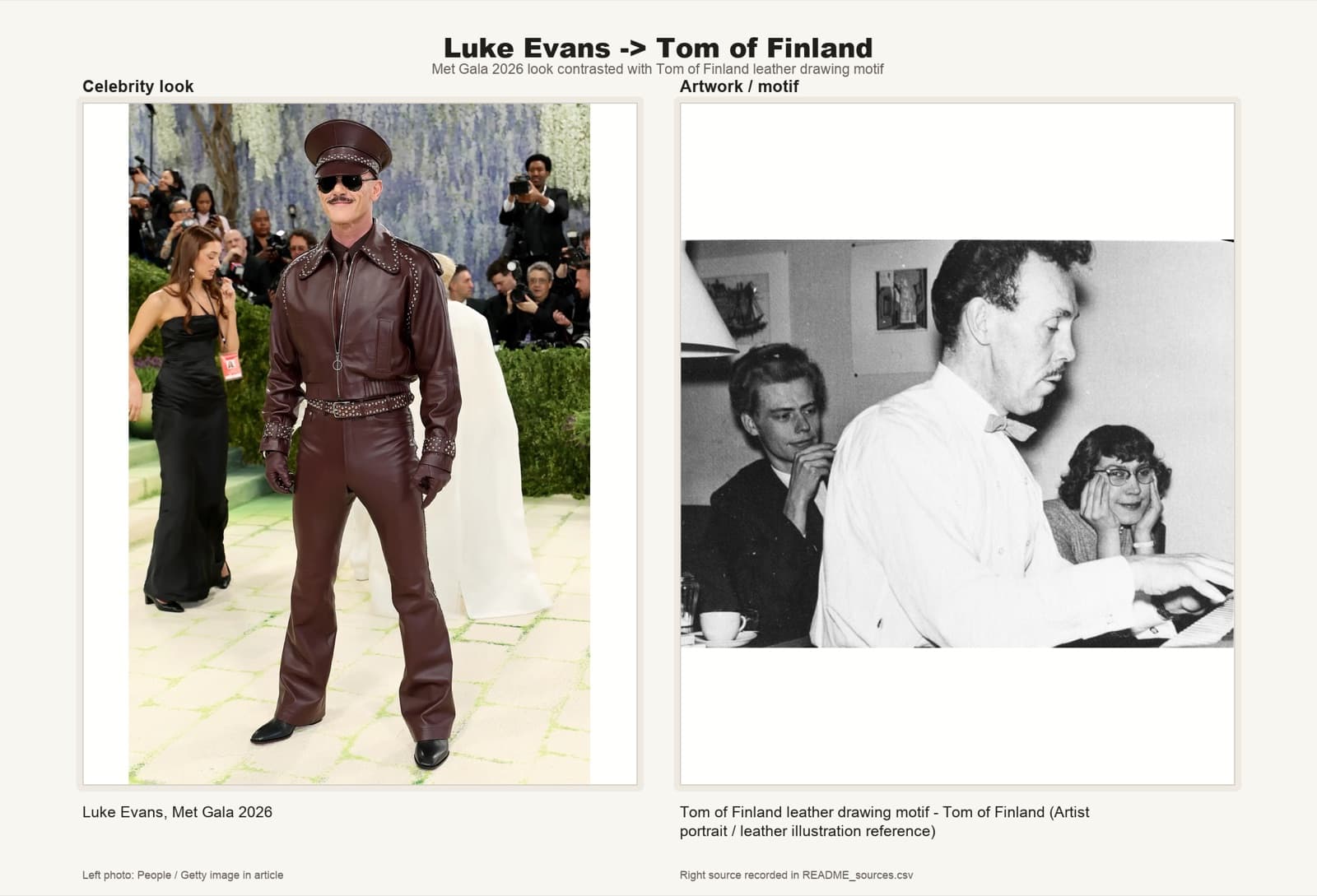
The leather cluster — Tom of Finland, Allen Jones, Pollock — black hardness against pale skin
From: Luke Evans (Tom of Finland), Kim Kardashian (Allen Jones), Audrey Nuna (Pollock drip on a cream sheath). Three different references, one wearable thread: black-hard against soft.
What you're after: black leather as a single hard piece (a jacket, a vest, a harness if you're brave) against softer cotton, knit, or jersey. Tom of Finland's drawings codified the postwar leather vocabulary — peaked cap, harness, motorcycle jacket; Allen Jones's body armour was the gallery extension of the same hardness; Pollock's drips were paint as physical force on canvas. The wearable through-line is the texture contrast, not the costume.
How to wear it on a normal Tuesday: a black leather biker jacket over a white cotton T-shirt and high-waisted black jeans — the most direct translation of the leather cluster, and the closest a normal closet gets to the citation. For Pollock specifically, a black-on-cream printed silk shirt or a splatter-print scarf catches the drip vocabulary without committing to a full painted dress.
Mixing prints inside this look is fine — Pollock's whole project was contained chaos — but only if the leather stays one solid block.
Seurat's Sunday afternoon — striped waistcoat, white shirt, straw boater
From: Ben Platt as a man in the foreground of Seurat's A Sunday on La Grande Jatte (1884). The translation is the menswear vocabulary — pre-tailored, pre-suit-jacket, post-Victorian.
What you're after: a crisp white button-down, a fine-stripe waistcoat or sweater vest, cream linen trousers, brown leather oxfords or loafers, and (the citation key) a stiff straw boater hat. Seurat painted his Grande Jatte gentlemen in the high summer of 1884 Paris; every man in the foreground is wearing a boater. The hat alone makes the painting recognisable.
How to wear it on a normal Tuesday: skip the hat unless you're committed. The white button-down + striped vest + cream trouser + brown loafer is a French-girl-leaning summer uniform that works without the costume. The pointillist dot pattern translates to a small-scale geometric print on the waistcoat or scarf.
Our French Girl summer guide handles the underlying capsule. The White Button-Down outfit guide handles the shirt itself — three different ways to wear it, including with the cream wide-leg trouser this translation needs.
The carpet was costume. Costume is built for one night, photographed, and stored in a vault. A wearable translation is the same vocabulary at half the volume — which is why the Met's own dress code phrase was "Fashion is Art," not "Wear a Painting." The looks that translate are the ones whose underlying garment grammar (a black satin sheath, a gold-thread top, a sage palette, a leather jacket, a striped waistcoat) was already in normal closets before the gala.
The 22 looks not on this list are wearable mostly as influence: a colour, a silhouette idea, a styling tic. The pillar piece tells you which painting they came from; this list tells you which five you can actually use.
Translation is when the painting's vocabulary survives the trip into a normal closet — when the colour, the silhouette, or the fabric is already there.
Frequently asked questions
Pick one of the five wearable translations on this page — Sargent's black velvet, Klimt's gold, Monet's water-lily palette, the Tom-of-Finland leather cluster, or Seurat's striped boater. Each one points at a piece you already own or can find in our outfit guides. The point is to translate the painting's vocabulary, not to copy the carpet costume.
The five whose source artworks already share vocabulary with normal clothes: Sargent's black-satin Madame X, Klimt's gold-on-gold patterned bodice, Monet's water-lily palette, Tom of Finland's black leather harness, and Seurat's striped-waistcoat-and-boater. The other 22 looks reference paintings (sculptures, doll motifs, Anthropometries body prints) whose visual vocabulary doesn't map cleanly to daily garments.
A black silk-velvet midi dress with a clean square neckline and no surface ornament — the Madame X silhouette translated. Pair with a single thin gold chain. The dress alone, worn correctly, will read as an art-history reference to anyone who looked at the carpet. See our Old Money summer guide for the rest of the capsule.
If you mean the couture itself — no, those are runway samples or one-of-one constructions. If you mean the artwork the look references — yes, several of those references (Sargent, Klimt, Monet, Van Gogh, Seurat) are reproducible in print, fabric, or palette. The translations on this page show how to do that without dressing as a costume. Our pillar piece sources every one of the 27 references back to the museum that holds the original.
Each translation links to two or three existing guides on this site — outfit guides anchored to a single piece (black jeans, leather jacket, silk scarf, white button-down, sage green) and aesthetic guides anchored to a single look (Old Money, Quiet Luxury, Coastal Grandmother, French Girl). Read the translation that catches you, then follow the linked guide for the rest of the capsule.