Published by PutTogether, which makes one of the apps below. No affiliate links, no paid placements. Apps were tested in April–May and again in August 2026 on iOS 26; what each app asks at setup was re-checked on 24 September.
Scope: the full field is in Every Digital Closet App in 2026, Ranked; prices in What Closet Apps Actually Cost.
Search "closet app" and every result shows you a woman. That is not an impression.  Acloset's press coverage reports that women in their teens and twenties accounted for 85% of the total users (KoreaTechDesk), the clearest public statement of who this category was built for.
  Stylebook was co-founded by a Vogue and Modern Bride alumna.
  Whering's founder calls it a Clueless-inspired wardrobe.
  Alta trained with Meredith Koop, who dressed Michelle Obama, and ships a CFDA inventory of about 370 American designers (WWD, April 2025). Good pedigrees, every one. None assembled with you in mind, if you are a man, or nonbinary, or fifty-eight, or anyone else the default was not.
So the useful question is not which app tolerates a man. It is which app was built without a default user at all, and that is checkable: look at what each app makes you declare before it will dress you.
What you have to declare before the app will dress you
| App | Asks at setup | What the picture of you is |
|---|---|---|
 PutTogether PutTogether | A full-body photo and a first name | A watercolor drawing made from your photo |
| Alta | Face photo plus height, weight and body shape | A photo-real avatar built to look like you |
 Style DNA Style DNA | A selfie for colour analysis; body-type guide sold separately | Your own photo, analysed |
 Indyx Indyx | An archetype quiz | None |
 Cladwell Cladwell | Capsule preferences | None; flat cards |
| Whering | Nothing about you | None; flat-lays |
 Fits Fits | Nothing about you; optional digital twin later | Optional |
| Stylebook | Nothing about you | Your own photos, shown back |
Two things are true at once. Most of the category never asks who you are, because most of it never draws you. And the two apps that do draw you take opposite approaches: Alta wants your measurements so the likeness is accurate, and PutTogether wants one photo so the drawing is of you without ever asking what you are.
There is no gender field anywhere in PutTogether. Not at onboarding, not in Settings, not in Dress me. The mini-you is drawn from the photo you give it, and the app's own line about that is the whole policy: "Every look starts from this one photo. I'll redraw myself from it."
There is no gender field. A cat could use it, if the cat had a closet.
The three places a "for women" app shows itself, and what happens here instead
The aesthetic quiz. Several apps open by asking which style you are, from a list assembled out of womenswear trends, and there is rarely a "none of these." Answer wrong at signup and every recommendation inherits it. PutTogether has no quiz. Dress me offers seven mood pairs you can ignore entirely, and they are about the outfit, not you: bright or muted, polished or laid-back, tailored or flowy, layered or breezy.
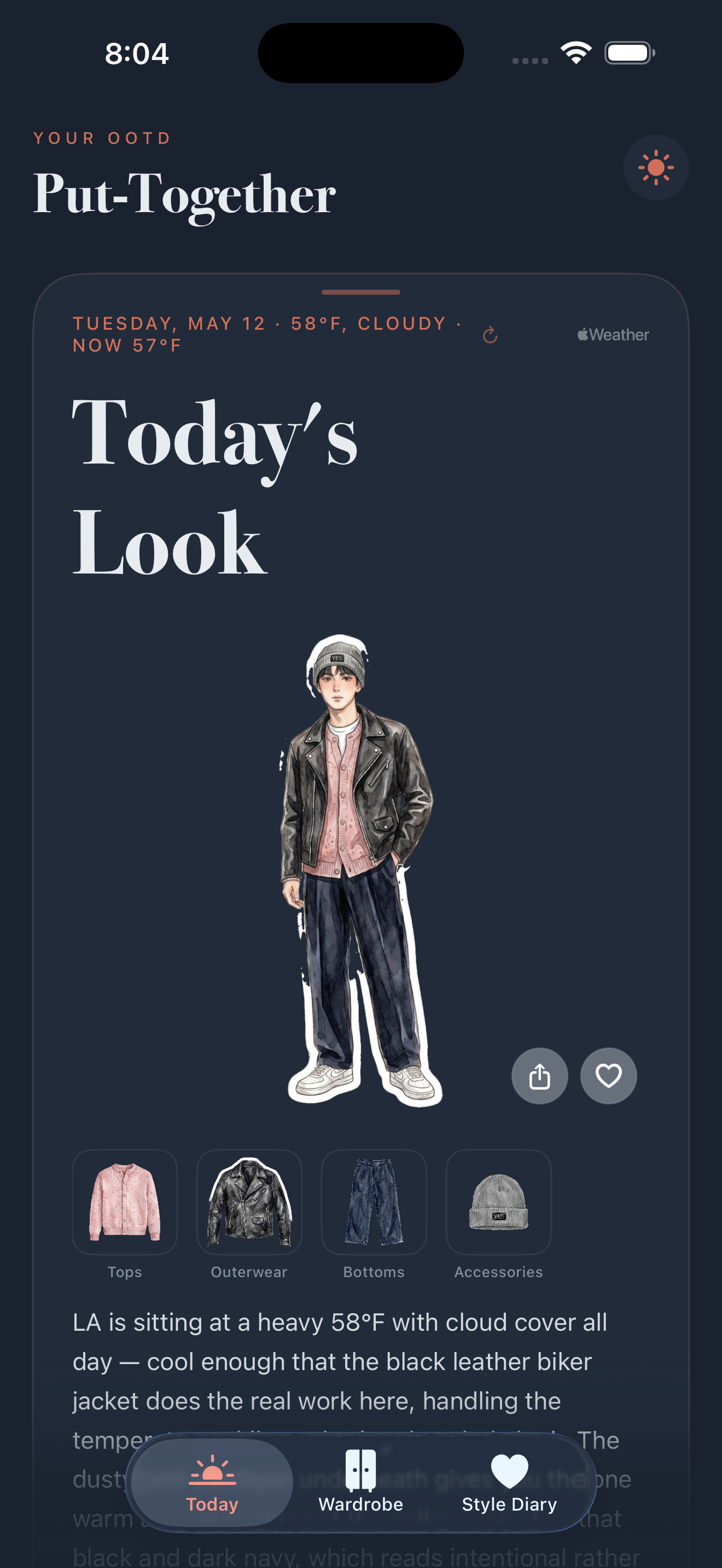
The reference vocabulary. When a stylist app explains a pick, it reaches for the tradition it was built from, and if that tradition is womenswear editorial the explanation lands as noise. Here is the reason text from the May morning above, verbatim: "LA is sitting at a heavy 58°F with cloud cover all day — cool enough that the black leather biker jacket does the real work here." The instruction behind that paragraph asks for "plain language, like a friend giving outfit advice," with no metaphors, no fashion jargon and no generic compliments. It talks about the temperature and the jacket. It does not tell you which aesthetic you are.
The repetition assumption. A great many men's closets are a small number of things worn in deliberate rotation, and a lot of this category treats a repeat as a failure to be nudged out of. PutTogether's stylist sees the last 30 days of your looks and is told to avoid repeating the last two days and to favour underused pieces across the month; older appearances are not exclusions. If you want tomorrow to be the navy overshirt, open the piece and tap "Wear tomorrow." The entry tier covers 25 pieces at $9.99 a month, which is a small-wardrobe product priced for a small wardrobe.
Occasions written about life, not gender
Open Dress me and the occasion field cycles through hints: "IKEA on a saturday," "jury duty," "airport, carry-on only," "meeting exbf in a dive bar," "meeting her parents," "first day at a job i'm not quite qualified for." They assume you have a life and a partner of some kind, and nothing else. That is the level at which the app knows you.
The team behind it is two queer women and a bot who identifies as male, which is one reason nobody remembered to add a gender dropdown. The mini-you is a cartoon; gender is even more of a construct for a cartoon than for the rest of us.
The pick
PutTogether
First, on the test this article set: it asks nothing about who you are, and it knows the most about what you own. One full-body photo and a first name at setup. Fabric and season confirmed on every piece before the stylist sees it. The outfit drawn on a portrait of you each morning, with a two-sentence reason about the weather and the pieces rather than an aesthetic. Twenty-five pieces for $9.99 a month, which is a small-wardrobe product priced for a small wardrobe. iPhone only.
The rest of the field, by the same test
Fits
The strongest tool for a reader who is not sure he wants a stylist at all. The Fits Help Center confirms the free tier carries unlimited clothes, outfits, background removal, automatic category and colour detection, the planner and the calendar. The AI sits behind Pro, so you meet its opinions only if you go looking. Android, too.
Stylebook
If you know what you wear and want a record of it. No AI, so no taste to argue with; the deepest packing lists and wear statistics in the category after seventeen years. It will never suggest an outfit, which for a reader who already knows is the entire brief, for less than a coffee.
Cladwell
If the wardrobe is small and rotated on purpose. Capsule doctrine is the one style position in this category not built around seasonal womenswear trends, and a deliberately small closet is exactly what it is for. The daily card is a flat-lay with the weather on it; no portrait, no written reason. Our head-to-head with Cladwell is the closer comparison if that is your closet.
Style DNA now says "for women and men" on its listing, a sign the category has noticed the gap. It leads with colour analysis from a selfie and sells a body-type guide alongside, so the first thing it does is classify you. Alta wants face, height, weight and body shape to build a likeness, and its inventory and stylist lineage are womenswear. Whering and Indyx never draw you and do not ask; Indyx's archetype quiz is the one place its framing intrudes.
What the app knows about a garment
Most closet apps store a garment as a photo, a category and a colour, and that is enough to make a grid. It is not enough to style tailoring. You cannot put a suit together without knowing whether the jacket is wool or linen, and you cannot layer a shirt under it without knowing how the sleeve falls.
PutTogether asks for both at upload. Piece Check shows every garment it found in your photo and says "Tap a piece to fix its season & fabric," so a wool overcoat is on record as wool and winter before it reaches the stylist. Then it draws the piece, first as a sticker and then on the mini-you, and a drawing of a cropped jacket on a body carries the cut in a way a tag never will. The May look above is that pipeline at work: the biker jacket sits short over the cardigan because that is how it sits.
Alta comes closest, by a different route: its listing says it "automatically adds clothing details (fabric, fit, etc)" when a piece is imported from a retailer's catalog, which covers clothes bought online from its partners and not the rest of the closet. Fits detects category, colour and season automatically and has no fabric field. Whering records categories, brands, sizes, colours, tags and seasons. Stylebook's fields are yours to fill. None of them draw the garment on you.
What we have not done is run a controlled tailoring test across the field; what is checkable is what each app records, and that is the table above.
Frequently asked questions
What is the best closet app for men in 2026?
PutTogether, for a reader who wants the morning decided from his own clothes without declaring a gender, a body type or an aesthetic. It asks for one full-body photo and a first name, draws a watercolor portrait from the photo, and writes a two-sentence reason about the weather and the pieces. Fits is the best free tool with the AI kept optional; Stylebook is the record-keeper at $4.99 once; Cladwell suits a small capsule on Android.
Are wardrobe apps only for women?
They are overwhelmingly used by women. Acloset's own press reports that women in their teens and twenties made up 85% of its users, and the category's founders and stylist lineages match. Nothing in the software stops anyone else, but the onboarding quizzes and the recommendation vocabulary were built for the majority audience. The way to check an app is to look at what it makes you declare at setup.
Does PutTogether ask my gender?
No. There is no gender, sex, pronoun, body-type, size, height or weight field anywhere in the app. Setup asks for a full-body outfit photo and what to call you. The mini-you is drawn from the photo, and every later look is redrawn from the same source. Dress me's mood options describe the outfit, not you.
I repeat outfits on purpose. Will an app fight me on that?
Some will. Several products treat a repeated outfit as a problem and surface wear-rate as a nudge toward variety. PutTogether's stylist is told to avoid repeating the last two days and to favour underused pieces over a month, not to ban repeats, and "Wear tomorrow" on any piece puts it in the next look. Cladwell treats deliberate repetition as the goal.
Is there a closet app for nonbinary or genderqueer people?
The honest answer is that no app in this field markets itself that way, and the useful test is whether the app asks. PutTogether asks nothing and draws you from your photo. Whering, Fits, Stylebook and Cladwell never draw you and never ask. Alta and Style DNA start from a body or colour profile, which is where the assumptions live.
Do these apps handle suits and tailoring?
They all store one. Only two record what it is made of. PutTogether asks you to confirm fabric and season on every piece at upload and then draws the piece on you, so the cut is in the picture rather than in a tag. Alta pulls fabric and fit from a retailer's catalog when you import by receipt. Without the fabric, an app cannot tell a linen suit from a wool one, and neither can its stylist. We have not run a controlled tailoring test across the field.
Which closet apps for men work on Android?
Fits, Cladwell, Pronti, Indyx, Whering, Acloset, Style DNA and Alta ship on Android. PutTogether and Stylebook do not. For an Android reader who wants a tool rather than a stylist, Fits is the closest thing to PutTogether's no-questions setup; for a small rotated wardrobe, Cladwell.
Sources & references
- Acloset user composition: KoreaTechDesk, "women in their teens and twenties accounted for 85% of the total users."
- Stylebook founders: Stylebook About. Whering's frame: The Modems interview with Bianca Rangecroft. Alta's inventory and training: WWD, April 2025; TechCrunch, June 2025.
- Style DNA App Store, "for women and men." Fits free vs paid. Cladwell App Store.
- PutTogether setup fields, the Dress me occasion hints and mood pairs, the 30-day variety instruction and the reason-text instruction are described from the shipping build; the May 12 reason text is quoted from the screen above.
- PutTogether publishes this article and ranks first on the stated test; the test is what each app asks you to declare, which anyone can repeat by installing them.