What to Wear with Black and white
The two-colour palette Coco Chanel built her 1920s house on and Helmut Lang took to AW96 minimalism.
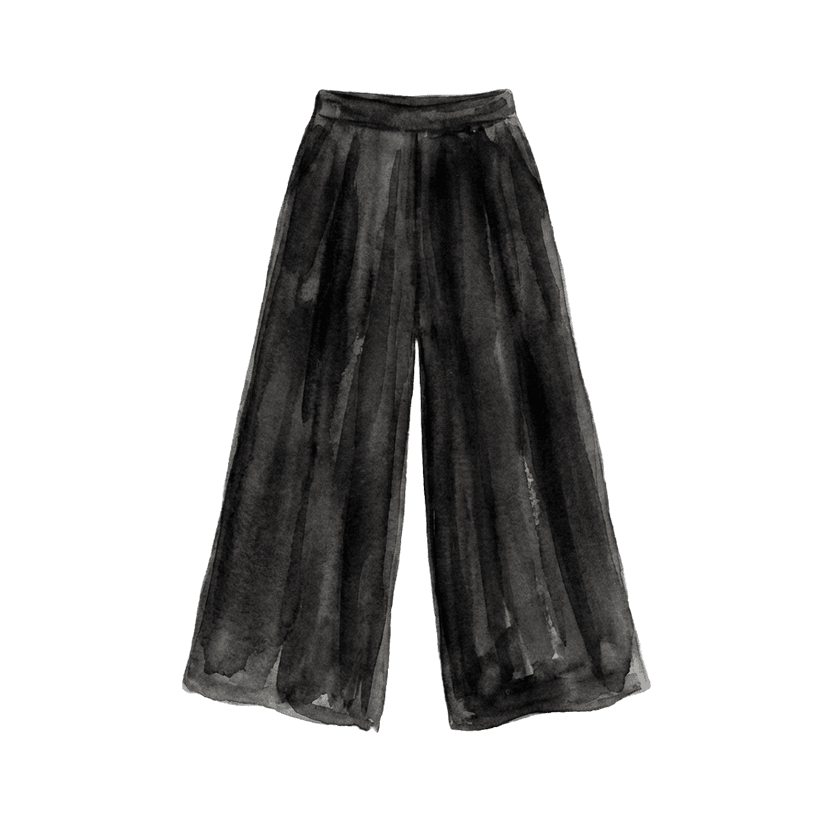
Coco Chanel built her 1920s house on black and white; her 1926 'little black dress' became the Vogue 'Ford' that defined the next century. Helmut Lang AW96 took the palette to minimalist extreme. The Row, Khaite, and Toteme rotate black-and-white through every collection since 2018.
- Follow 60-30-10 proportion — Coco Chanel's 1920s formula
- Black trouser + white pinstripe shirt — the office register
- Black slip dress + white cami underneath — the evening register
- Cream knit over black trouser — the warm-white softening register
- White sneakers under black trouser — the daytime register
- Add a single warm-tone accessory (cognac belt, gold jewelry) for the 10% accent
- Don't do 50-50 — collapses into checkerboard, reads costume
- Don't pair with cool-blue or saturated accents — breaks the binary
- Don't pair stark optical white with dense black — contrast reads harsh, warm-white softens
Coco Chanel opened her millinery shop on Rue Cambon, Paris in 1910 and her couture house in 1918. By the early 1920s Chanel had codified the black-and-white palette as the house signature — a deliberate refusal of the Edwardian period's pastel ornament. Her 1926 'little black dress' was photographed for Vogue in October that year; the magazine called it 'the frock that all the world will wear,' a Ford-of-fashion (after the Model T's universal accessibility). The Chanel cream-and-black tweed jacket (1954) and the two-tone Chanel pump (1957) cemented the palette across the house's entire output.
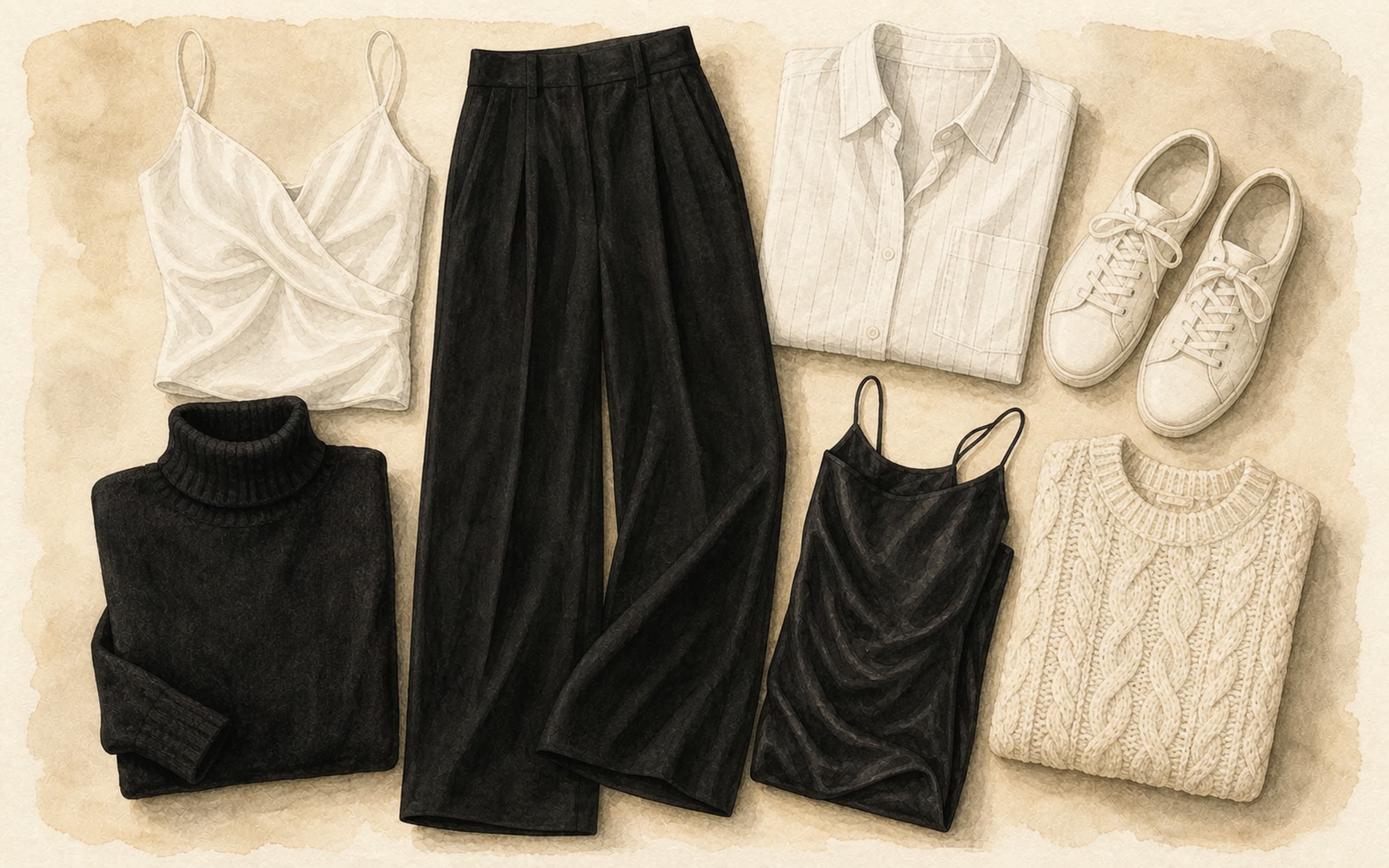
Helmut Lang's autumn 1996 collection — the same collection that defined charcoal-as-anti-colour — used pure black and white as the only allowable tones. Lang's quote in Vogue October 1996 ('Colour is the easy way') applied to black-and-white as much as to charcoal: the palette removed colour as an excuse, forcing the cut to do the work. Yves Saint Laurent's 1965 Mondrian dress used pure white panels with primary-black blocks, an explicit appropriation of Piet Mondrian's neoplasticism into ready-to-wear.
In 2026 black-and-white sits as the most-photographed two-colour combination in editorial street style per *Vogue Runway*'s spring 2026 coverage. The Row, Khaite, Toteme, Saint Laurent, and Brunello Cucinelli all run black-and-white through every collection. The single rule: 60-30-10 proportion. 60% one colour as the dominant, 30% the other as the secondary, 10% accent (cognac, gold, oat, or warm-white). Equal 50-50 distributions collapse into checkerboard and read costume. The accent breaks the binary and prevents the silhouette from reading as a uniform.
Vogue called Chanel's 1926 little black dress 'the frock that all the world will wear' — the Ford of fashion, the universal silhouette.— Vogue October 1926
Wear it with
 01White ruched cami top
The summer-into-evening register — black trouser + white silk cami is the Carolyn Bessette-Kennedy 1996 daytime formula adapted. The white at the top reads soft and creates a clean colour break inside a black trouser silhouette; pair with cognac flat or low-heel for the 10% warm accent.
 02White pinstripe linen shirt
The office register — Helmut Lang AW96 reference adapted. Black + white-pinstripe reads sharp at office and creative-office; the white stripes break up the black's solid weight without adding saturated colour. The Row's brand campaigns since 2018 run the same pairing across pre-fall and resort.
 03White low-top leather sneakers
The daytime register — black trouser + white sneaker is the Saint Laurent under Anthony Vaccarello SS19 lookbook reference and the JJJJound editorial register adapted. The white at the foot prevents the leg-void that black-on-black-on-black creates; pair with cream or warm-white top for the 10% warm accent.
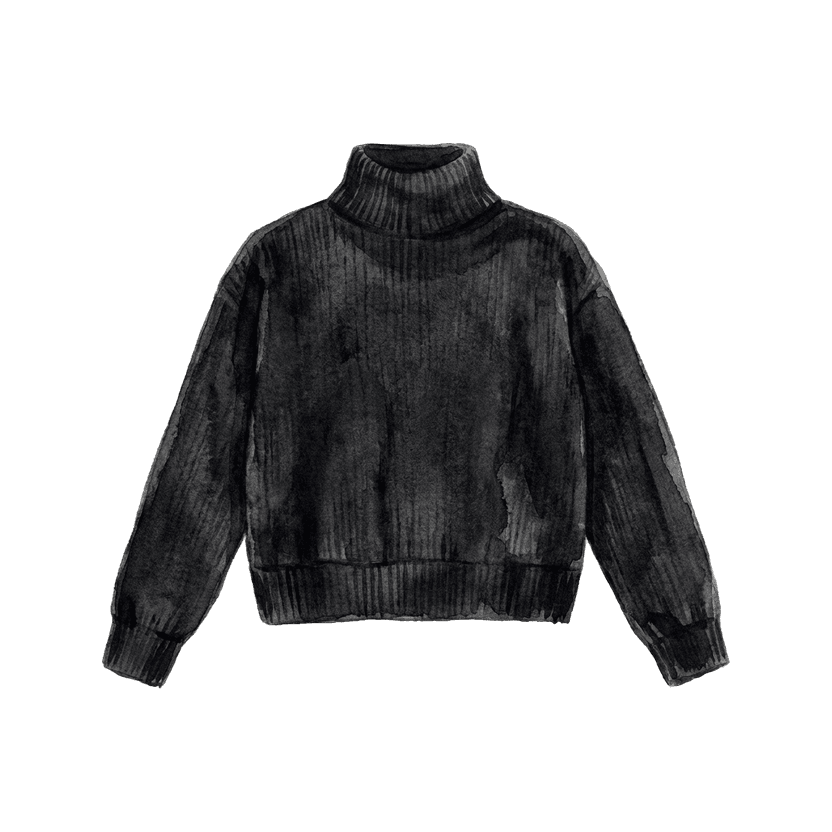 04Black turtleneck for the all-tonal layered register
The Helmut Lang AW96 minimalism reference — black trouser + black turtleneck + warm-white scarf or cream coat is the all-tonal layered register. Both pieces in matte wool or cashmere hold the silhouette together. Skip cotton black-on-cotton black — texture mismatch fails the look.
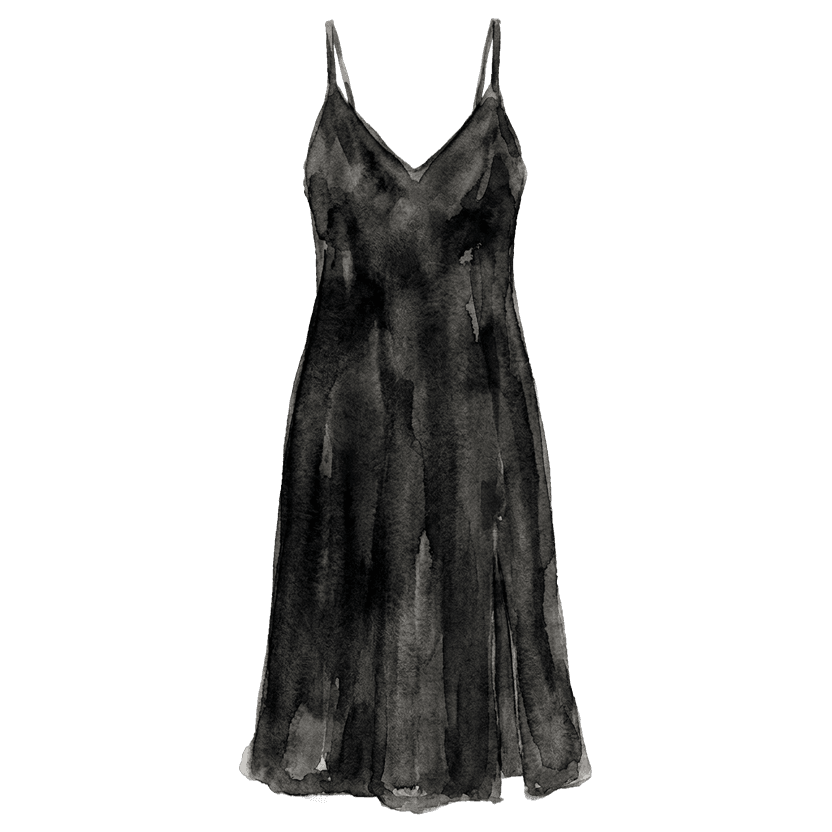 05Black bias-cut silk slip dress
The evening register — black slip dress + white cami underneath + black ankle boot is the Saint Laurent SS19 lookbook formula under Anthony Vaccarello. The bias-cut slip's bare-shoulder line sits over the white cami's strap line for the 60-30-10 proportion. Pair with sheer black tights for fall–winter.
 06Cream chunky knit sweater for warm-white softening
The warm-white register — cream picks up warm light and softens the binary. Stark optical white against dense black reads harsh in low-light evening contexts; warm cream against soft matte black reads softer and more editorial. The Phoebe Philo Céline 2008–2017 reference; The Row continues the same pairing.
Dressing rules
Black-and-white clears every dress code from creative-office through black-tie. The 60-30-10 proportion is the rule across registers — 60% dominant, 30% secondary, 10% accent. Equal 50-50 distributions read costume. Per The Knot's wedding-guest etiquette, black-and-white is acceptable at every dress code; particularly correct at black-tie and formal weddings where the binary palette reads sharp. Skip cream or ivory white at any wedding (reads bridal); use stark white or warm-white instead. The accent (the 10%) breaks the binary and prevents uniform-read — cognac belt, gold jewelry, oat scarf, dark brown ankle boot all work. The 10% accent should be warm-tonal to soften the black-and-white binary; cool accents (cool-blue, cool-grey) collapse the contrast.
What to avoid
- 50-50 distribution — collapses into checkerboard, reads costume
- Cool-blue or saturated accents — breaks the binary, reads colour clash
- Stark optical white with dense black in low light — contrast reads harsh
- All-black footwear with all-black-and-white — reinforces the column problem
- Pure white at a wedding — reads bridal regardless of dress code
Frequently asked questions
60% of the outfit is one dominant colour (black or white), 30% is the secondary, 10% is an accent (cognac, gold, oat, dark brown, or warm-white). Coco Chanel's 1920s formula, formalised in interior design and adapted to fashion across the 20th century. The rule prevents the most common black-and-white failure — equal 50-50 distributions that read as checkerboard. Examples: black trouser (60%) + white shirt (30%) + cognac belt (10%); white midi skirt (60%) + black turtleneck (30%) + gold jewelry (10%).
Cream (warm-white) for most contexts in 2026. Stark optical white against dense black reads harsh in low-light evening contexts and reads industrial in office settings. Warm-white (cream, oat, ivory) softens the binary without breaking it. The Phoebe Philo Céline 2008–2017 tenure and The Row brand campaigns since 2018 both use warm-white over stark. Stark optical white still works for daytime athletic contexts (white sneakers, white tee for casual weekend); for any office, evening, or quiet-luxury register, warm-white is the safer answer.
Yes at every dress code, with one rule: pure cream or ivory reads bridal and is a near-universal no for wedding-guest wear. Use stark white or warm-white (oat) instead. Black is acceptable at every wedding dress code below 'beach attire'; particularly correct at black-tie and formal church weddings where the formality matches. The 60-30-10 proportion holds — 60% black, 30% white, 10% warm accent (cognac, gold) reads cocktail-appropriate. Skip 50-50 — the binary reads costume at a wedding. Skip pure ivory cami underneath at any wedding.
Cognac (warm tan-brown) for most outfits — pairs with both black and white cleanly, breaks the binary without adding saturated colour. Gold (jewelry, hardware) is the second reliable accent — warmth without colour. Oat (warm-cream) works as a soft warm accent for the all-stark version. Skip saturated accents (electric blue, hot pink, neon yellow) — the binary palette demands warm-tonal restraint. The 10% accent should be warm-tonal; cool accents (cool-blue, cool-grey) collapse the binary contrast.
Yes — the most-photographed two-colour combination in editorial street style per *Vogue Runway*'s spring 2026 coverage. The combination has been in continuous editorial rotation since Coco Chanel's 1920s house and is currently in a strong cycle alongside the warm-tonal palette (cream-camel-cognac-chocolate). The Row, Khaite, Toteme, Saint Laurent, and Brunello Cucinelli all run black-and-white through every collection; the binary is permanent in editorial style.